Creating Self-Paced Courses with your content
The Content Creator (users with Content Creation privileges), Administrator (users with Administrative privileges), or any user with permission to create courses can create two types of courses on Skill Lake: Self-paced courses and Instructor-led courses.
Self-paced courses are courses that the learners can pursue at their own pace. These courses do not have an instructor, live sessions, or definite start and end dates.
The courses you have set the course visibility as Open will be available for all in the Browse courses (Course library) tab. You can restrict the course to a specific group/learning group by setting the course visibility as Restricted. It will be available only to the learners of the specified organizational groups/learning groups in the Browse courses (Course library) tab. By configuring and selecting the certificate template, you can decide whether the course offers a certificate.
Creating a Self-paced course
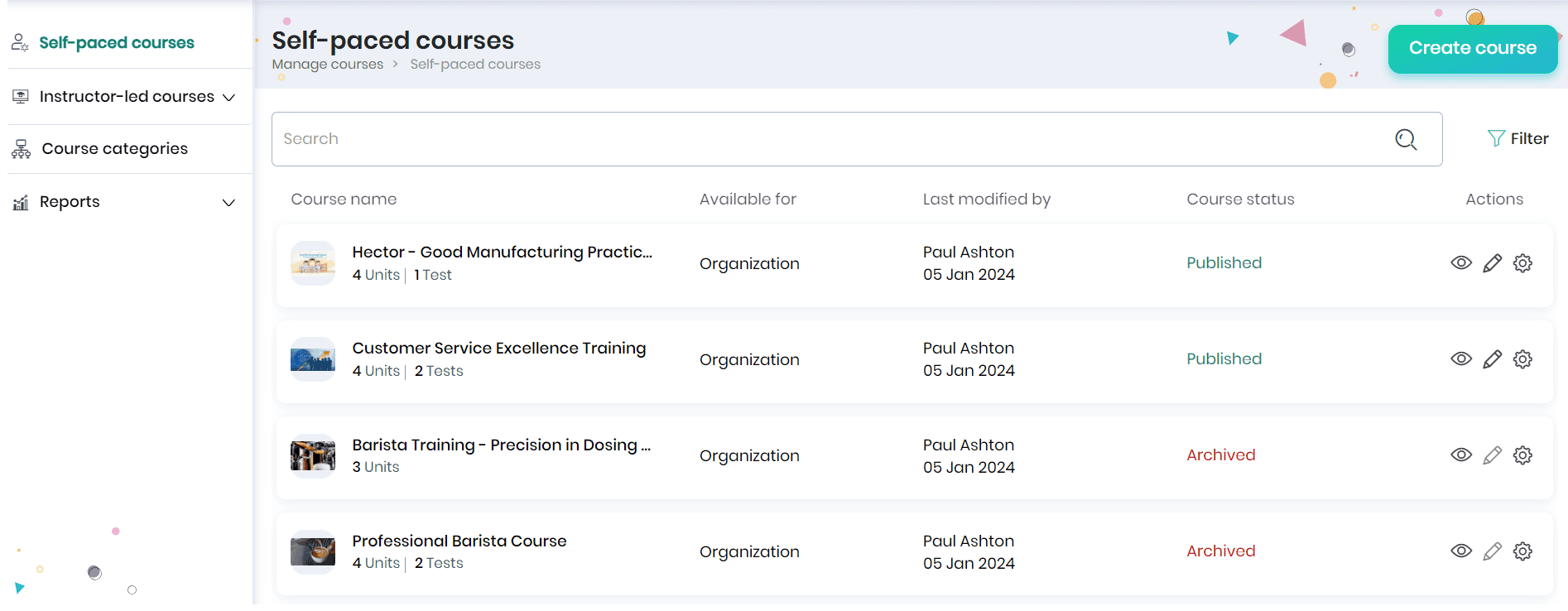
To create a new “Self-paced” course, click on the Manage > Courses tab. You will be navigated to the Self-paced courses page, where you can click Create course > With your content to start creating courses.
Course Information
You will navigate to the Create course page to enter the course’s basic information.
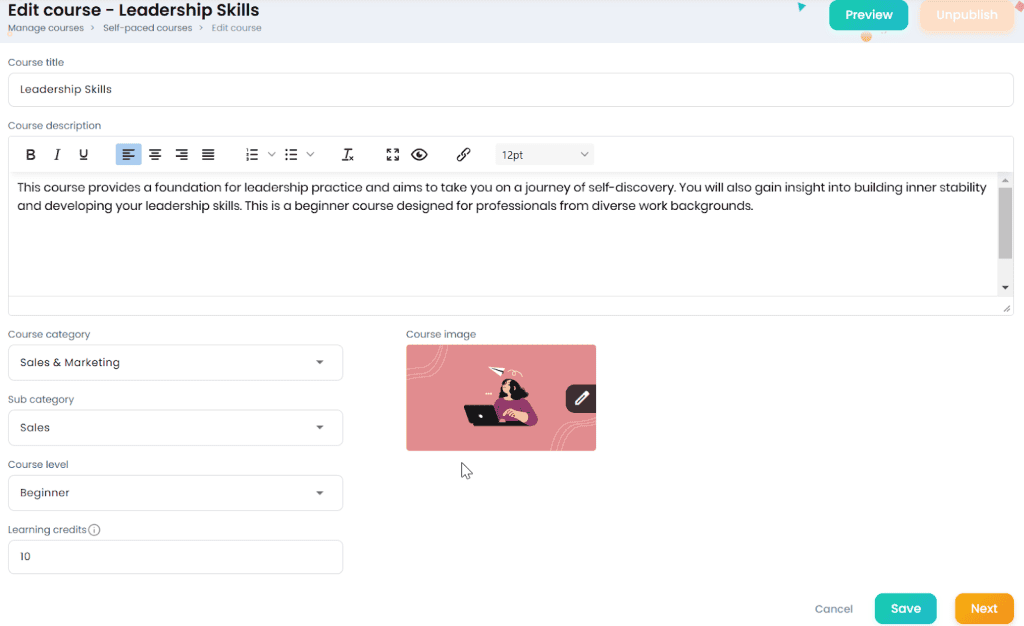
In the Course Information section:
- Enter the course title and course description.
- Select the course category, sub-category, course level, and course image.
- Enter the learning credits that the learner achieves on completing this course.
- Click on the Save button to navigate to the Course Settings section.
Course Settings
This section helps you to configure the course author, course owner, groups/subgroups to which course is accessible for, allow the course to be published outside Skill Lake and configure certificate on course completion of the course.
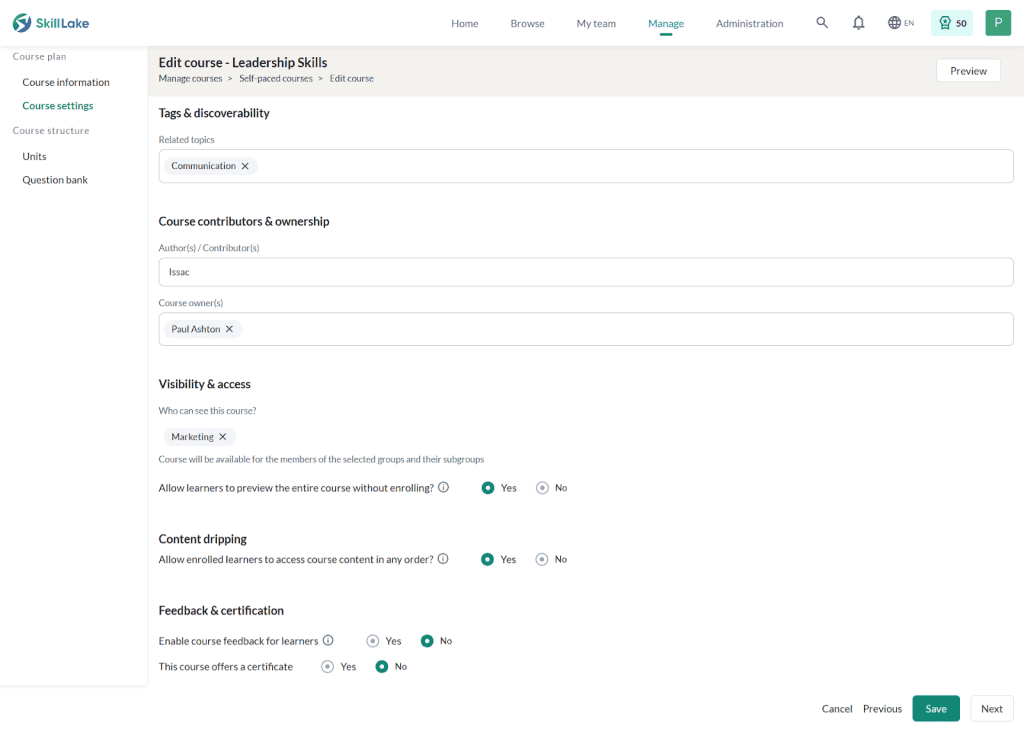
The Course Settings helps you to configure the following:
- Search tags or Topics to which the course is related (tags based on which the course can be searched)
- Authors or Contributors (external or internal authors) are entered to acknowledge their contributions and give them due credit.
- Course owner(s) (course owner can manage the book provided he/she has the required roles and permissions)
- Who can see this course (groups/learning groups/sub-groups to which this course is available). The course will be available for the members of the selected groups, learning groups, and their subgroups.
Note: Access/Visibility of restricted course:
- Learning: Under the Browse Courses tab, the courses are restricted to the organizational groups/ learning groups they belong to.
- Mentoring: Mentors can assign only those visible courses to both them and their learners.
- Course Management: Only those who create the restricted course/course administrators/those who have permission to manage all courses will be able to manage such courses.
Create hidden and restricted self-paced courses
Administrators can hide self-paced courses or restrict access to specific learners. This feature supports use cases such as pilot programs, confidential compliance training, and role-specific onboarding while maintaining group-based eligibility rules.
Note: Administrators with the Manage Enrollments for Hidden Courses permission can manually enroll any user into a hidden course, provided the user belongs to the target Groups or Learning Groups configured for the course.
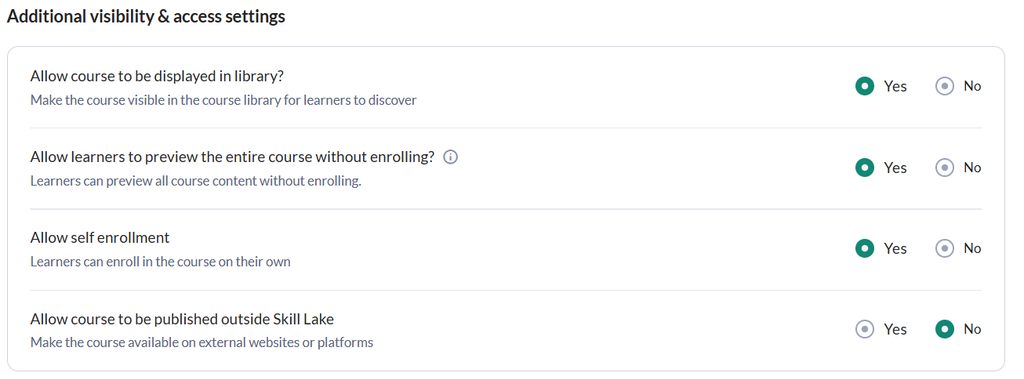
Allow the course to be displayed in library? Choose the Yes option to make the course visible in the course library for learners.
Note: If you choose the No option, this course will be listed in the Browse Courses page for the learners who have the Manage Enrollments for Hidden Course permission for hidden courses.
Allow self enrollment: Choose the Yes option to enroll in the course of their own.
Note: Choose the No option if the learners are not allowed to self-enroll in courses, but they can preview the course if their Mentor has shared the url of the course.
Share the course to external users

- Choose the ‘Yes’ option to allow the course to be visible outside Skill Lake. A URL will be generated and can be shared with the external users of Skill Lake. Click on the Save button to save the changes made.
Enabling course preview only after enrollment

- Choose the ‘No’ option next to ‘Allow learners to preview the entire course without enrolling?’ to keep the course content private until learners enroll. This is useful for certification or compliance courses where the content shouldn’t be visible upfront. By doing so, learners can access the course content only after enrollment.
Unlocking the course content in any order
- Choose the ‘No’ option next to ‘Enable course content order’ if you want learners to access the course content in a sequential order, promoting structured learning.
Course enrollment expiration
- Choose the Yes option in the ‘Enable enrollment course expiration’ option to set an expiry date for this course. Enter the number of days the course remains valid after the completion date.
- Tick the ‘Enable auto re-enrollment’ option to enroll the learner automatically when its validity is over. Enter the number of days within which the learner has to complete learning this course.
Enabling course feedback for learners
- Choose the Yes option adjacent to the ‘Enable course feedback for learners’ option and select the feedback form from the ‘Select feedback form’ panel bar. To view the feedback form, click the View icon, and click the Edit icon to change the feedback form.
Note: If the feedback form is enabled, it will be added as the last unit of the course, and the learner should complete it for course completion.

Including Certificate for the course
- Choose the Yes option adjacent to ‘This course offers a certificate’.
- The learner will be issued a certificate for completing the course.
- Click on the below icon to select the certificate template for the course from the available templates. Refer to the article Managing Certificates.
- Click on the Done button to save the changes made.
- To move to the ‘Course Information’ section, click the Previous button. A confirmation message appears, and you may click on the Confirm button.
Course Tightening
- Choose the Yes option adjacent to ‘Enforce lesson completion’ option to configure the learners must complete every learning content in a lesson before they mark it as completed.
- Click on the Save button to save the course settings.
- Click on the Next button to navigate to the next screen to create the course units.
- Click on the Cancel button to cancel the course settings.
Course Structure
A course is structured as a set of “Units”. Each unit can have one or more “Content” blocks and “Tests” in between or at the end. Click on the Add unit or Import units icon to add/import units.
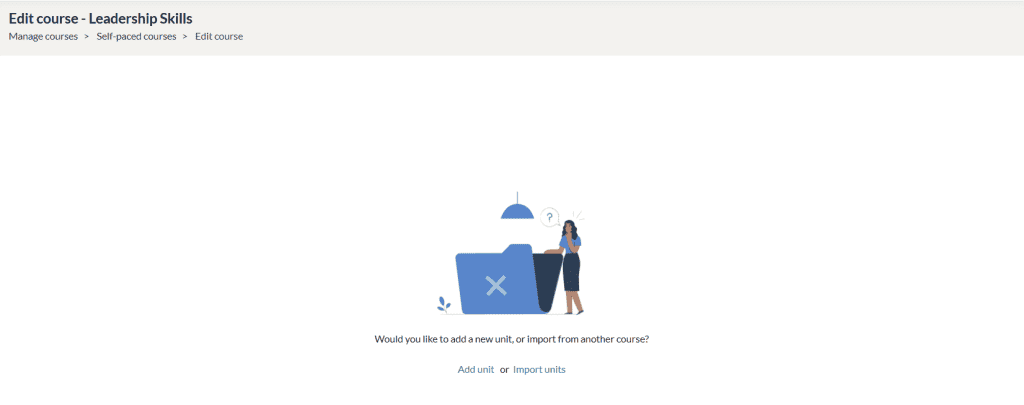
Units
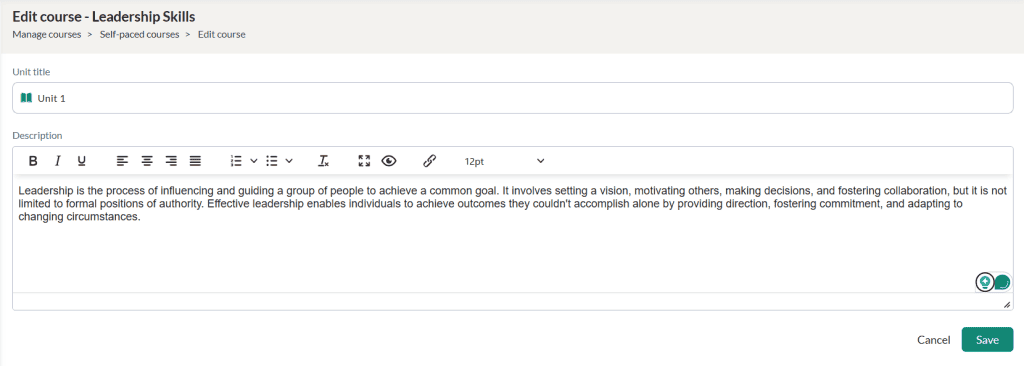
- Click on the Add Unit button to create a new unit to the course. You may also create units by importing from another published course.
- Enter the unit’s name, to be created, and a brief description (to give the learners a clear understanding of the unit), and click on the Save button.
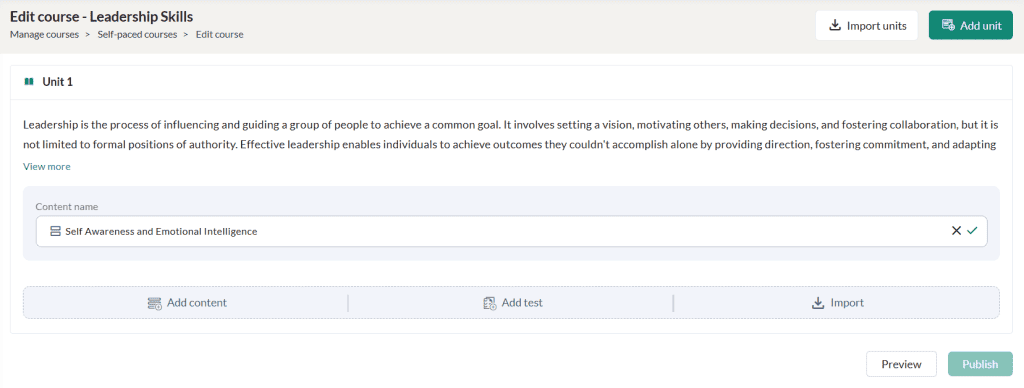
- In the Units section, you can add the learning materials.
- Click on the Add Content > Add content manually to begin adding a content by first providing a title/name for the content.
- The Content Name (or title) can be keyed in this field and click on the tick button to Save.
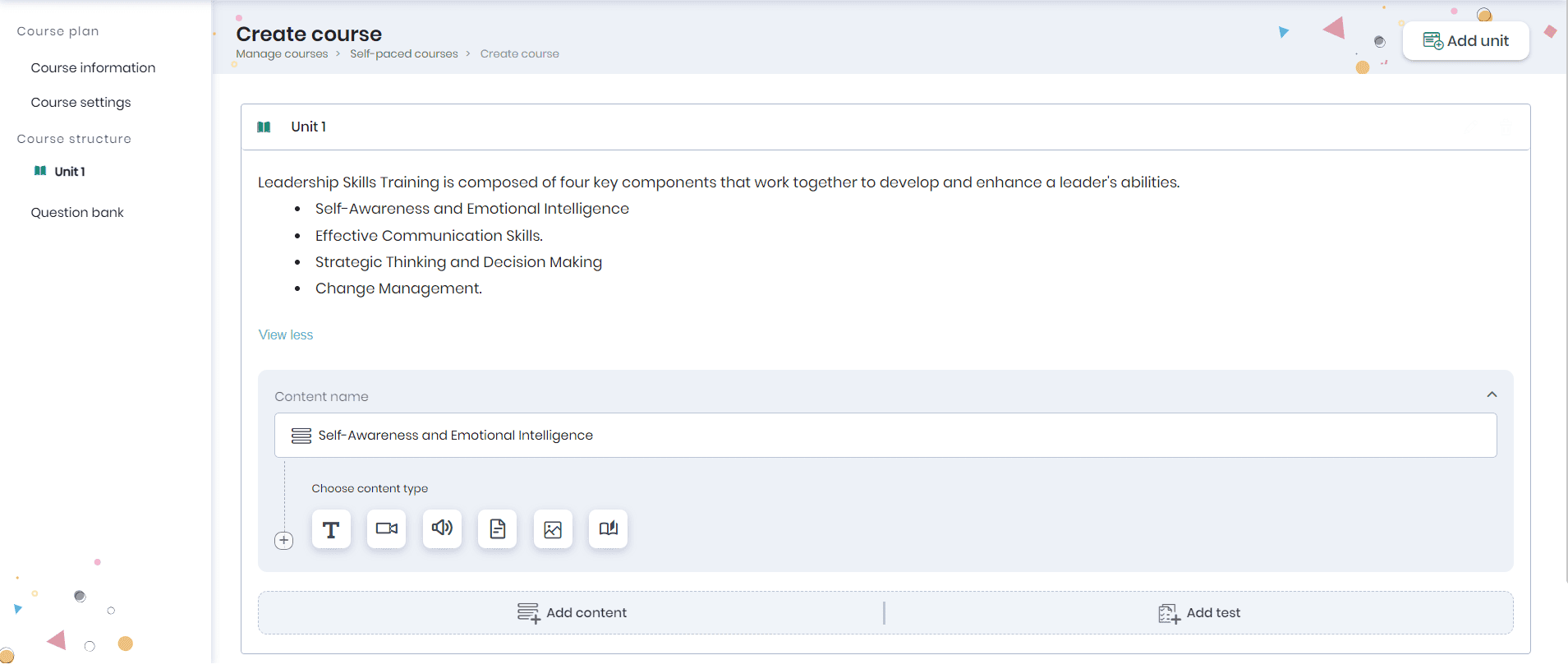
- A “content” block is a mashup of text, video, audio, images, documents/PowerPoint presentations, or SCORM content sequenced in the mentioned order.
- You can click on the desired icons to add the respective material.
Text Box
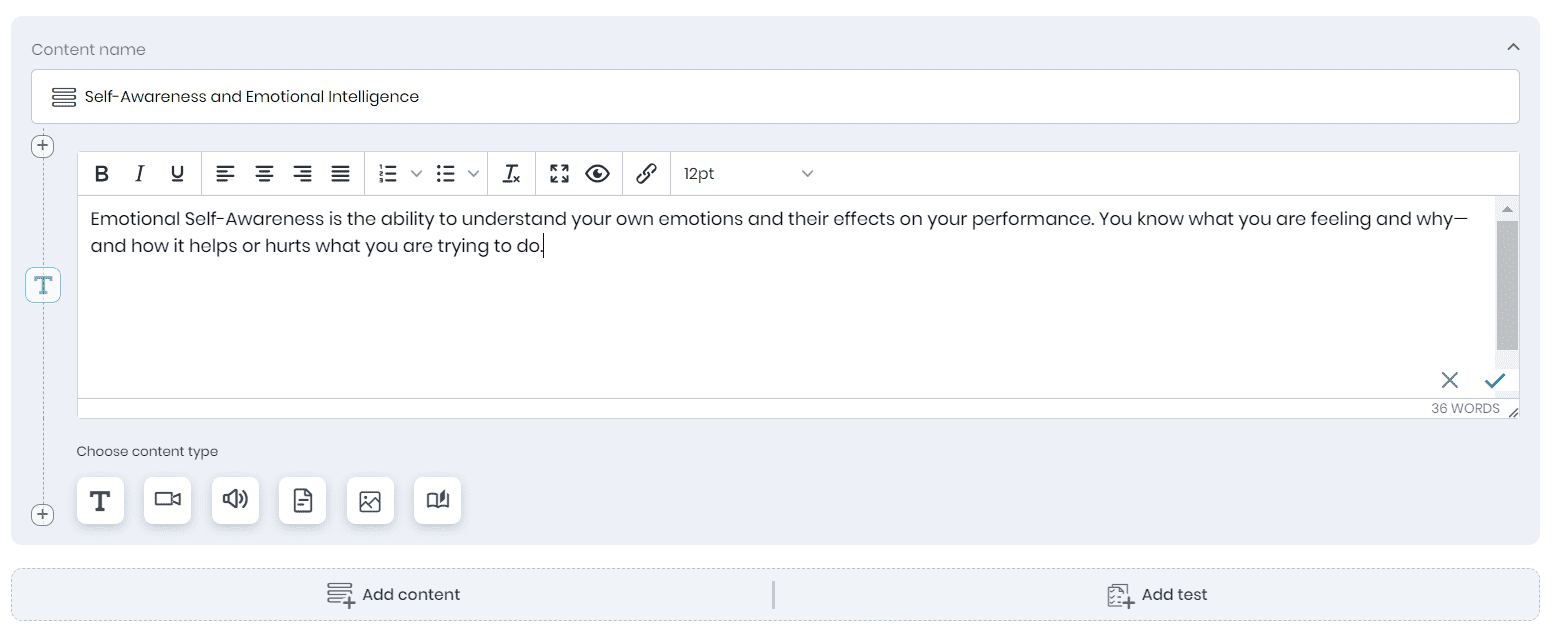
- Click on the Text box icon to include text material within the content. You can format, align, number, and insert links to the content and click on the tick button to save.
Video
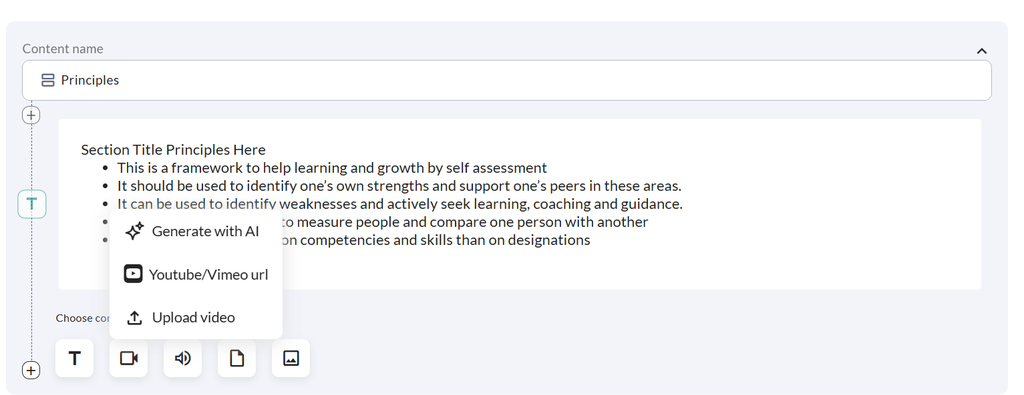
Click on the Video icon to add video material to the content. You can add the video as a Youtube/Vimeo url or can upload the video from your system.
Adding video as Youtube/Vimeo URL
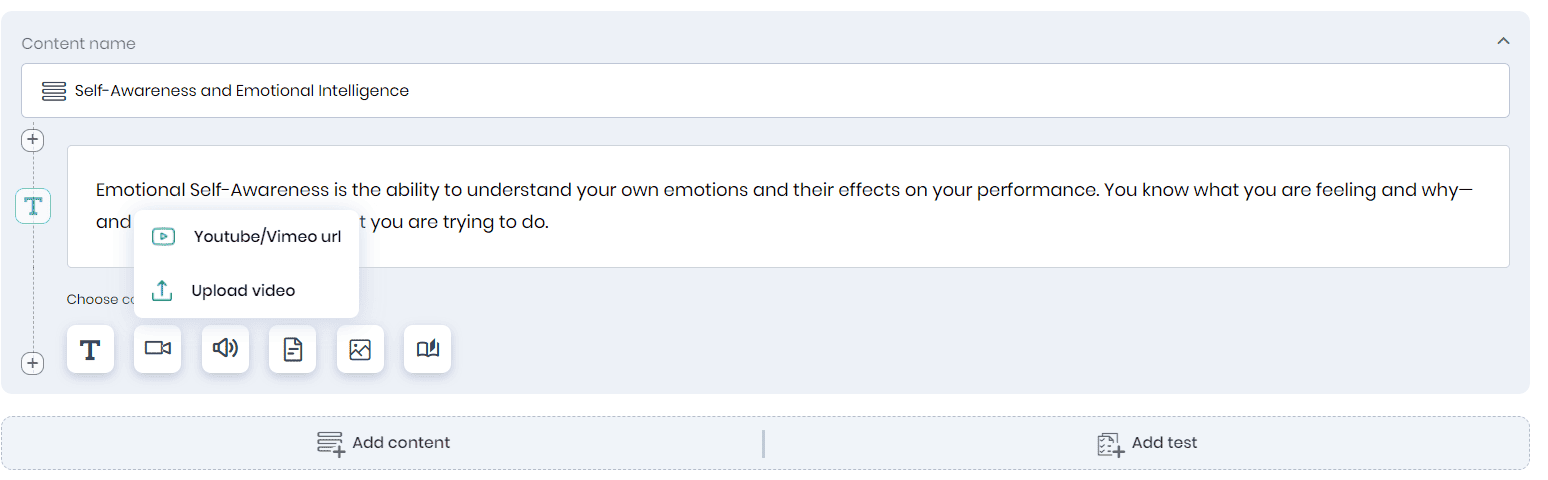
- Click on the Youtube/Vimeo url icon to add the video url.
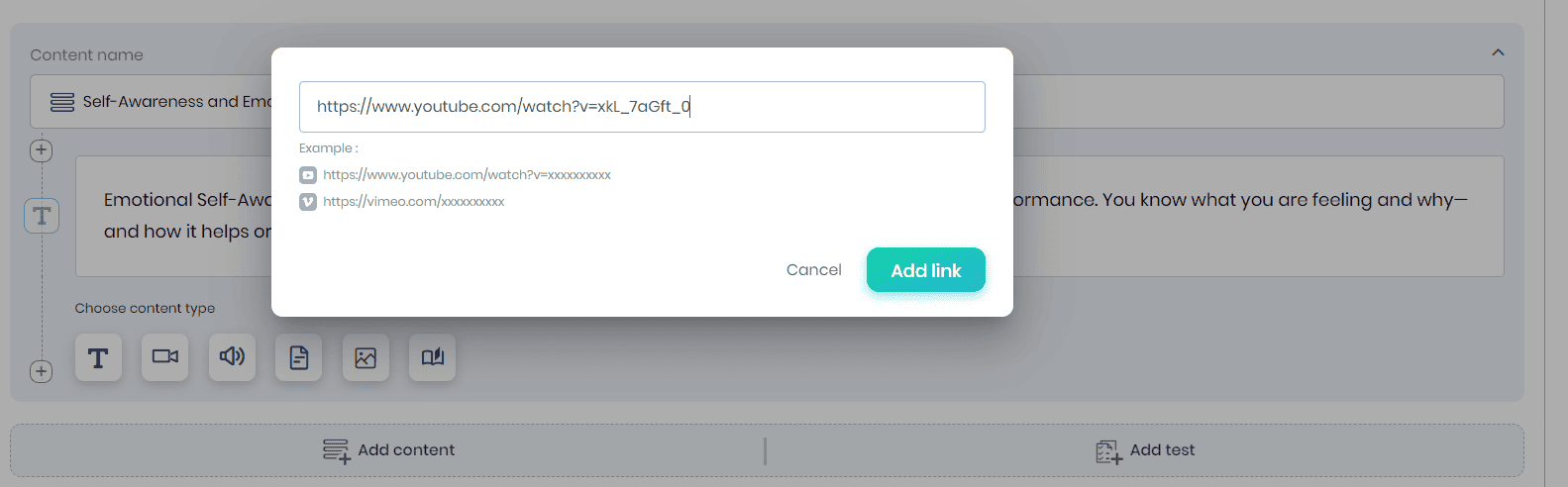
- Click the Add link button to save the video to the course content.
- Tick the ‘Lock video scrubbing’ option to disable learners from skipping the video content.
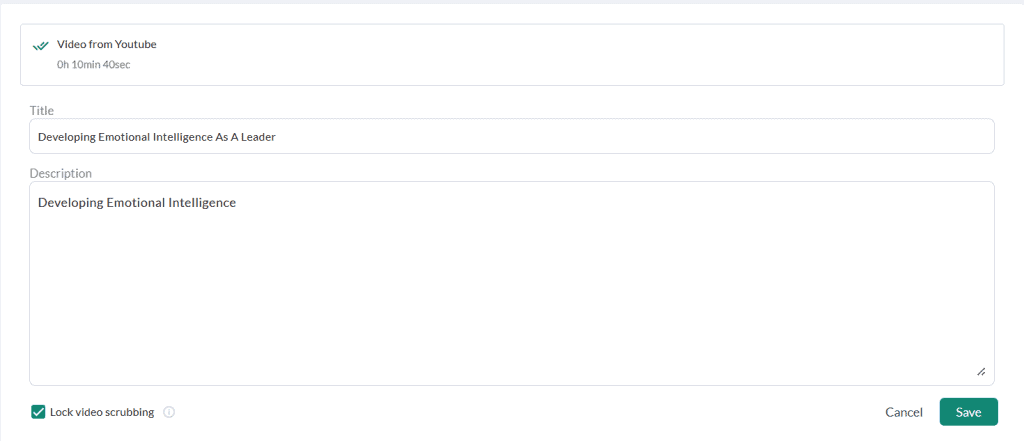
- Click on the Save button to save the video to the course content.
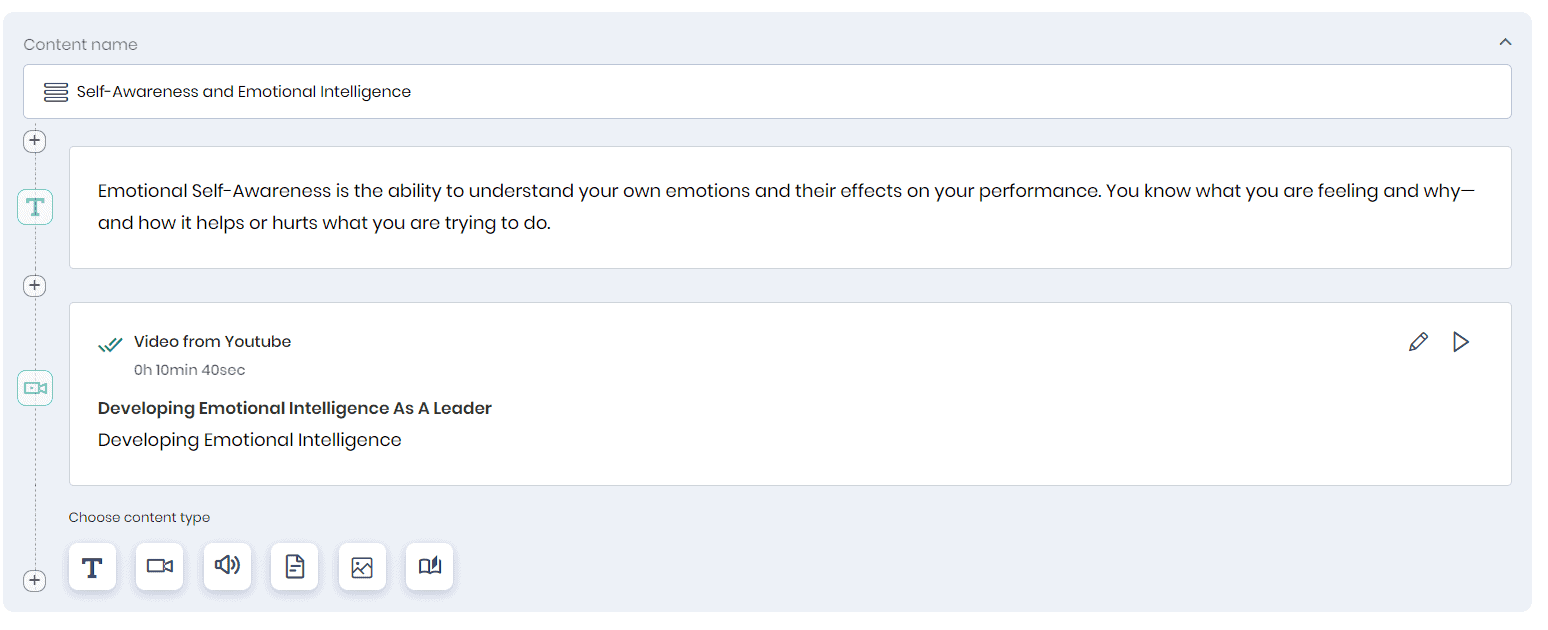
Adding video from your system
- Click on the Upload video icon to upload the video from your system.
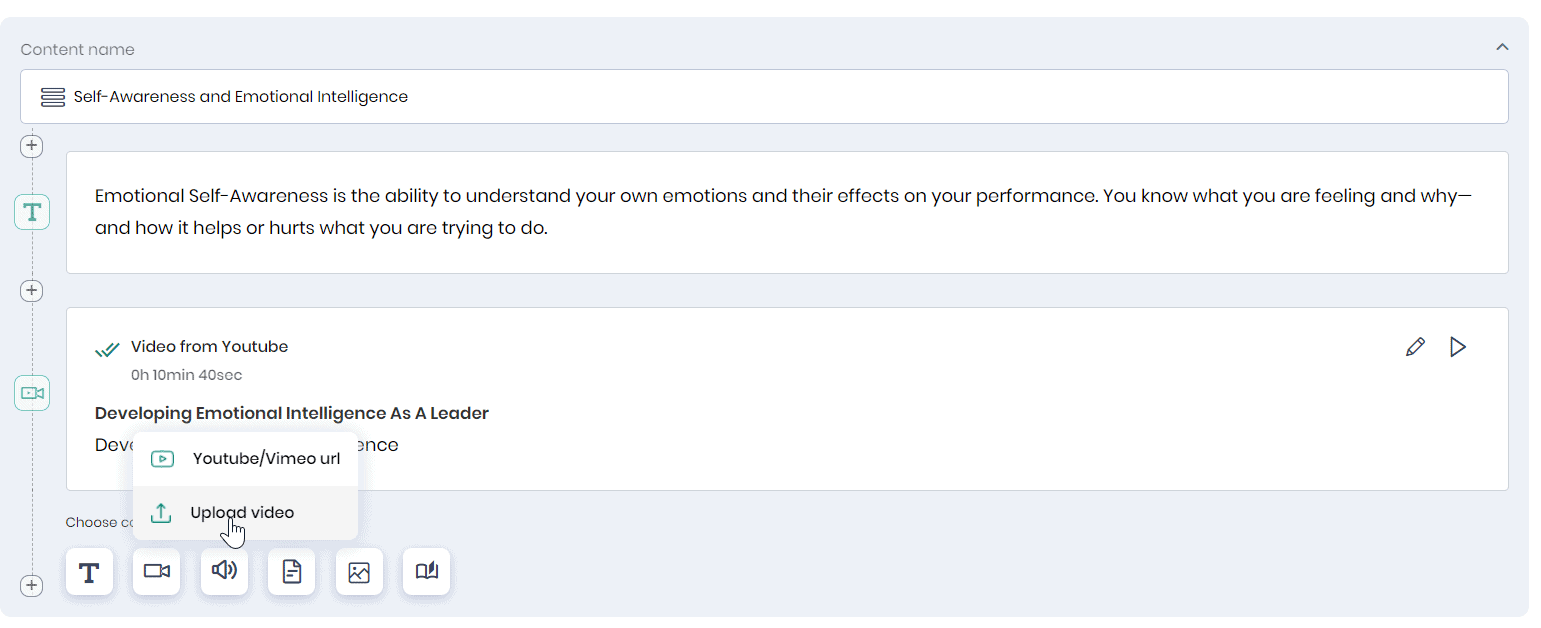
- Upload the video by drag and drop or browse from your system. You may upload the video in mp4.
- Tick the ‘Lock video scrubbing’ option to disable learners from skipping the video content.
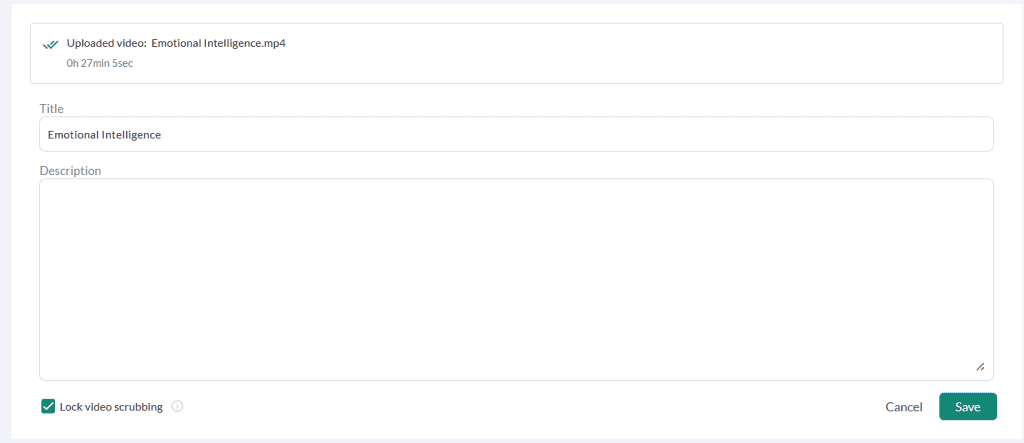
- Click the Save button to start uploading the video to the course content.

- The uploaded video will be displayed as shown below.

- Click on the Edit icon to edit the video title and description.
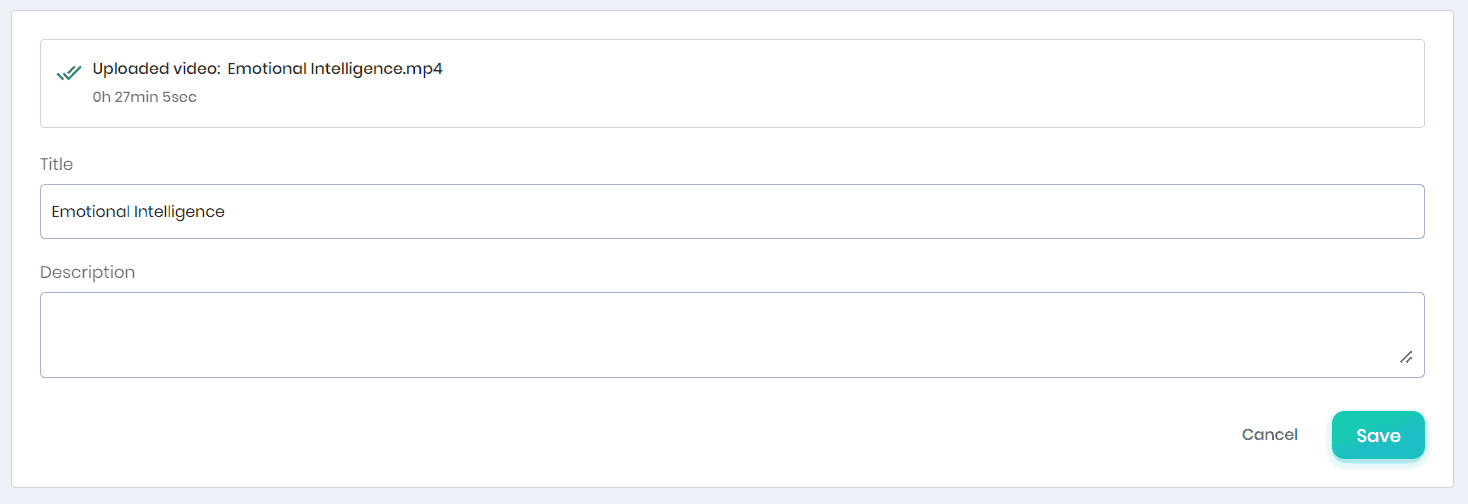
- Click on the Play icon to play the video.
Generate video using Leadde
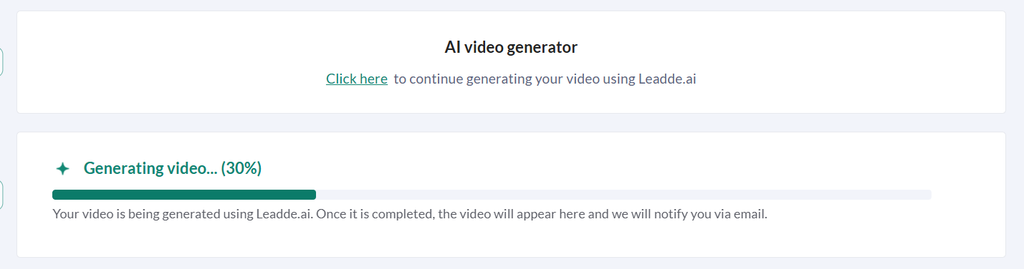
The Leadde integration lets you create professional video content directly within your Skill Lake courses. Once connected, you can open the Leadde editor, generate your video, and automatically sync it to your course without manually downloading or uploading files.
Note:
- You must have an active Leadde subscription and a valid Leadde API key configured before using this feature.
- You must have the configured AI permissions through Administration > Settings > Roles & Permissions to generate video using AI tool.
- Click on the Generate with AI icon to open the Leadde video editor.
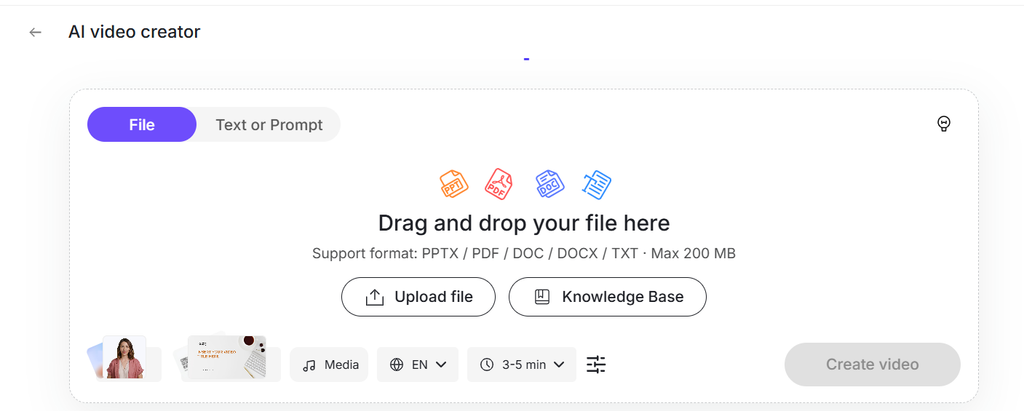
- Choose your input method:
- Text / Prompt tab: Enter your video prompt directly.
- File tab: Upload a document containing your prompt.
- Click the Create video button.
Skill Lake tracks the video generation progress and automatically attaches the finished video to your course. You will receive an email notification when processing is complete.
Audio
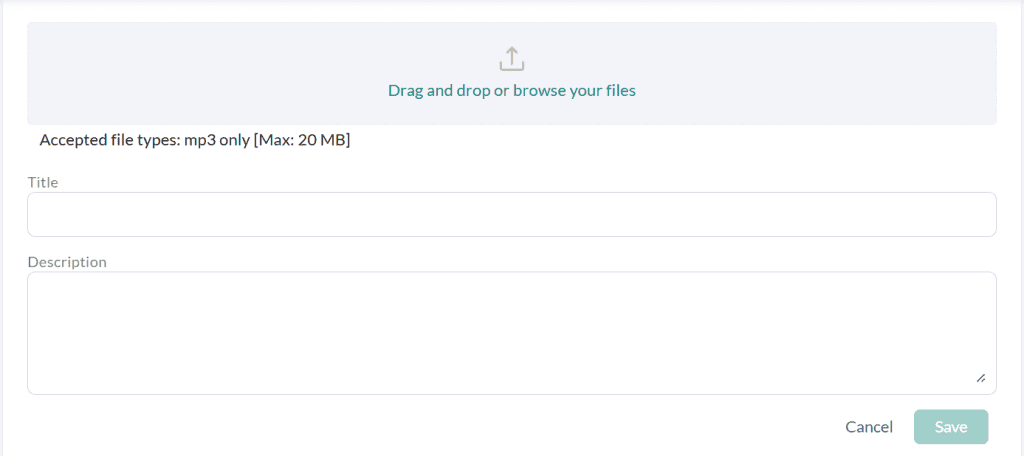
- Click on the Audio icon to add audio to the course content. Upload the audio file in mp3 format, enter the title and description and click on the Save button to save the audio file.
Document

- Click on the Document icon and the Upload Document option to add a word, excel or pdf document to the course material.
- Click on the Upload PPT to upload a PowerPoint presentation. Browse and select the document and it will be added as part of the content block.
- The Allow learners to download this document option helps the learners to download the document during their learning process.
Image
- Click on the Image icon to add an image to the content block.
Generate AI images for course
You can create a custom AI-generated image directly within the course. This feature uses your course text to automatically generate relevant diagrams, illustrations, or photorealistic graphics.
Note: As a pre-requisite, you must have configured AI permissions through Administration > Settings > Roles & Permissions and enabled the OpenAI feature in Administration > Settings > Integrations to generate AI images.
- While editing the course, click on the Image icon and Generate Image option.
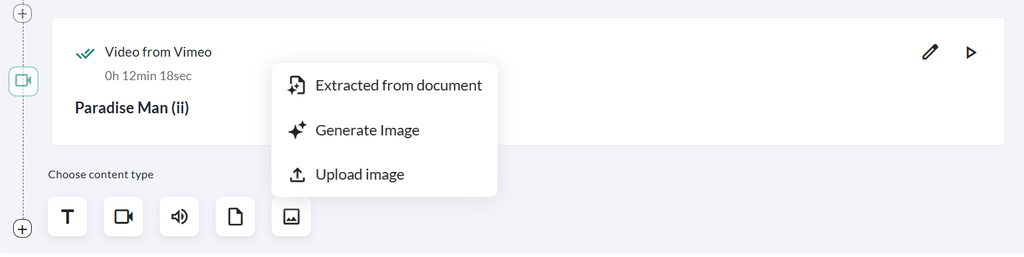
- In the Generate Image pop-up, select the image style, enter the course content, and click the arrow button.
- The image will be generated and you may modify the image based on the prompt given in the text box below. Click the top arrow.
- Once the image generated is final, click on the Add Image button to insert to the content.
- The image will be displayed in the content. You may use the Refine with AI icon on the right to generate the image again. Click the Download icon to download the image.
SCORM file
- Click on the SCORM icon to upload the SCORM package.
- Enter the title and description of the SCORM package and click Save.
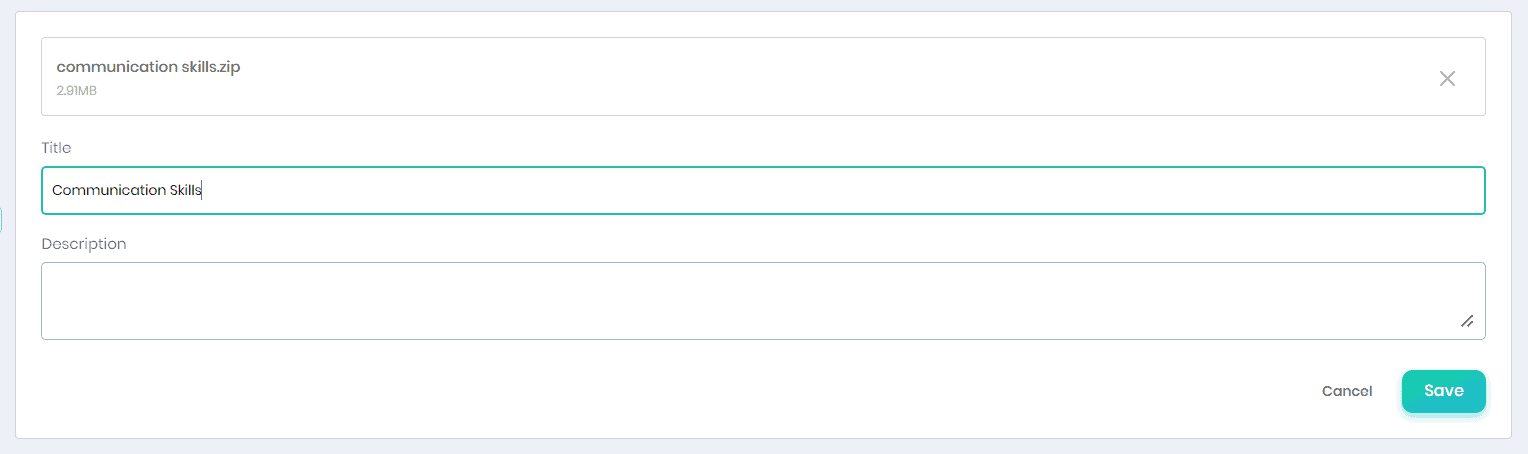
- Also, you can hold and drag the icon on the left to rearrange the course material.
- If you want to add new material between 2 existing ones, click on the “+” icon on the left and add the desired content type.
- Once the content is saved, it gets added to the Unit.
Adding units
- Click on the Add Unit button on the right side to add more units to the course.
Adding AI role play
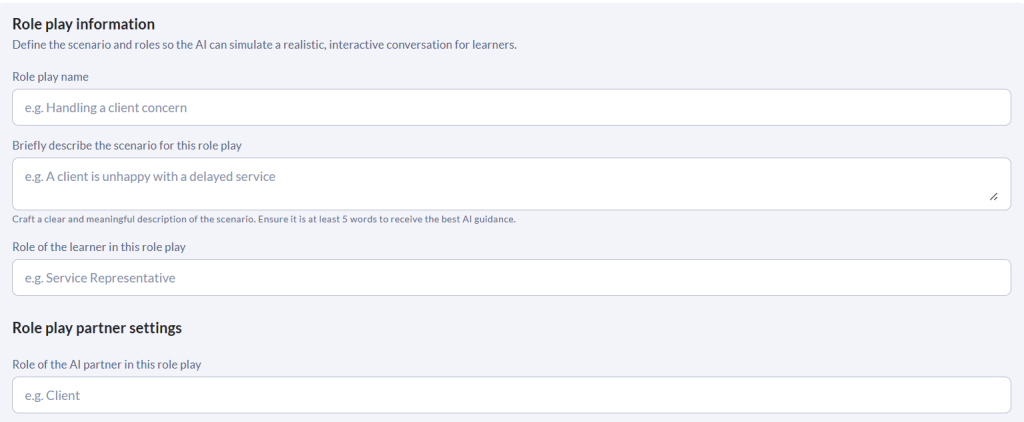
The Role Play Scenario feature lets course admins create interactive, AI-driven conversations that simulate real-life situations. Learners can practice responding to different scenarios in a safe and guided environment.
Note: As a prerequisite, you must have configured AI permissions through Administration > Settings > Roles & Permissions and enabled the OpenAI feature in Administration > Settings > Integrations to generate AI role play.
When creating a role play, define the scenario and the roles for both the learner and the AI partner.
- Click the Add AI role play button to add a role play for the course.
Role Play Information
- Role play name: Enter a clear and descriptive name for the scenario.
Example: Handling a client concern - Scenario description: Provide a short description about the situation for this role play.
Example: A client is unhappy with a delayed service - Role of the learner: Enter the learner’s role in the conversation.
Example: Service Representative
Role Play Partner Settings
- Role of the AI partner: Enter the AI’s role in this scenario.
Example: Client
Note: AI will use inputs – Scenario, Role of the learner and AI to create this conversation.
Generating content with AI
Content creators can quickly create lesson titles, body text, and optional visual images using AI.
Note: As a prerequisite, you must have configured AI permissions through Administration > Settings > Roles & Permissions and enabled the OpenAI feature in Administration > Settings > Integrations to generate content with AI.
- Click on the Add Content > Generate content with AI to begin adding content using AI.
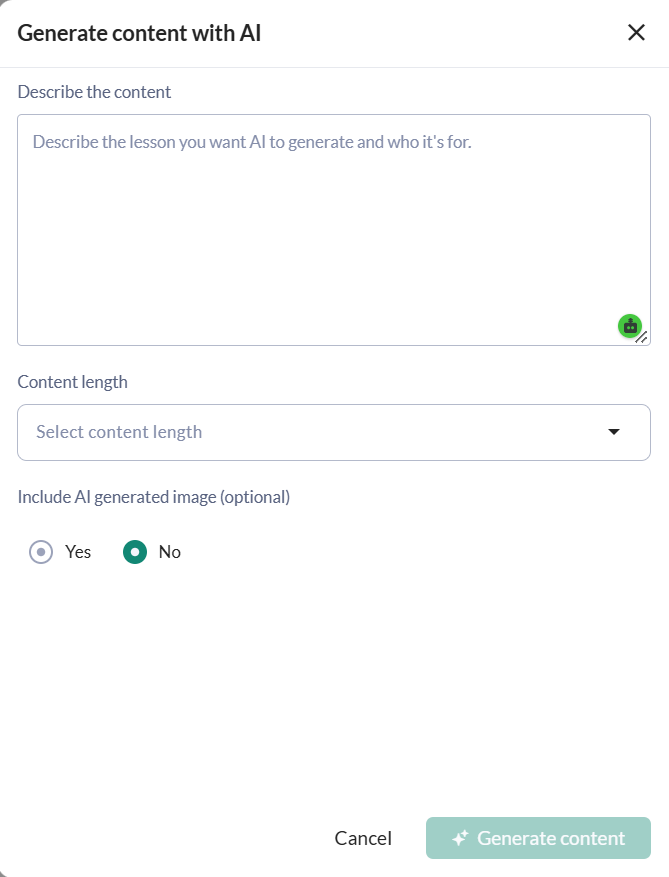
- Enter the lesson description you want to generate.
- Select the desired content length.
- Choose the Yes option to include AI-generated images.
- Click on the Generate content button to generate the content.
Adding tests
- Click on the Add test button to add a graded or guided test for the course material.
- For guided tests, the Course Administrator can provide options that will guide the learner to the correct answer.
- For graded tests, they can set a pass criteria, and number of attempts.
- The scores are recorded based on which the instructor can evaluate the learners. Refer to this article to learn more about creating tests.
- Click on the Add question button to add questions (multiple choice or true or false question) directly to a test manually if the questions are unavailable in the question bank.
Note: When adding questions, select the tags that match the test. If no tag is selected, Admin will be notified and can still add the question, but it won’t be included in the test unless the right tags are used. Tags are important for linking questions to the test.
Creating multiple choice questions
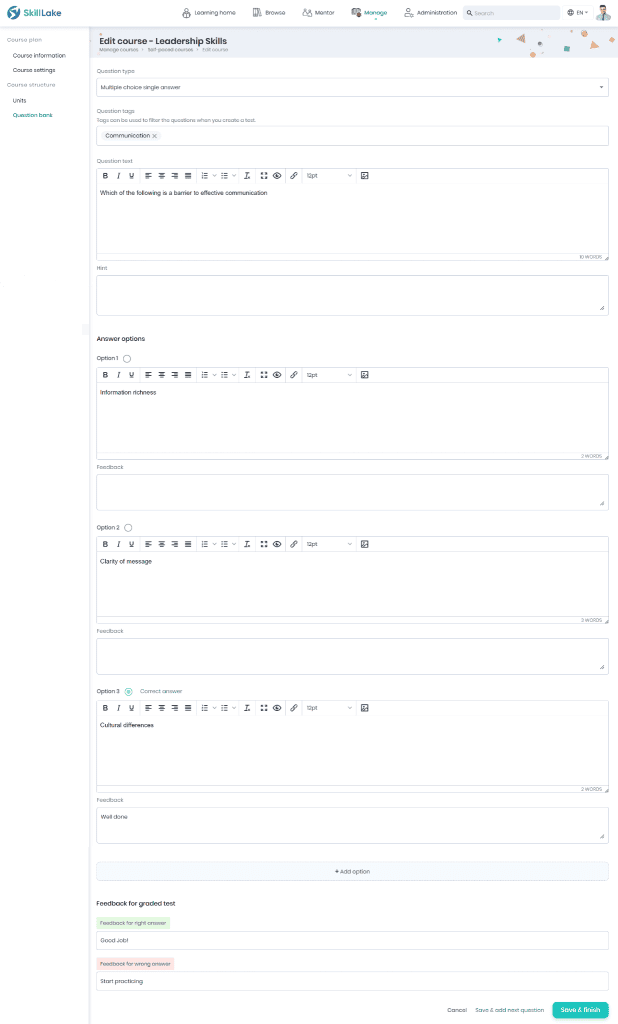
- Click on the Create Question button to create a question.
- Select the question type as ‘Multiple choice single answer’ and question tags (used to filter the relevant questions from the question bank while creating a test)
- Enter the question text and hint for the question (optional).
- Below that, you can enter the answer options (By default 3).
- If you want to add additional answer options (more than 3 options), you can do so by clicking on the Add option button.
- The option you mark as ‘Correct answer’ will be considered the correct answer for the question.
- The feedback you enter under each option is what the learner gets when they attempt a guided test, which is helpful for self-evaluation.
- Enter the feedback for correct and wrong answers for the graded test.
- Click on Save and add the next question button to add another question.
- Click on the Save & Finish button to save and complete adding questions.
Creating True or False questions
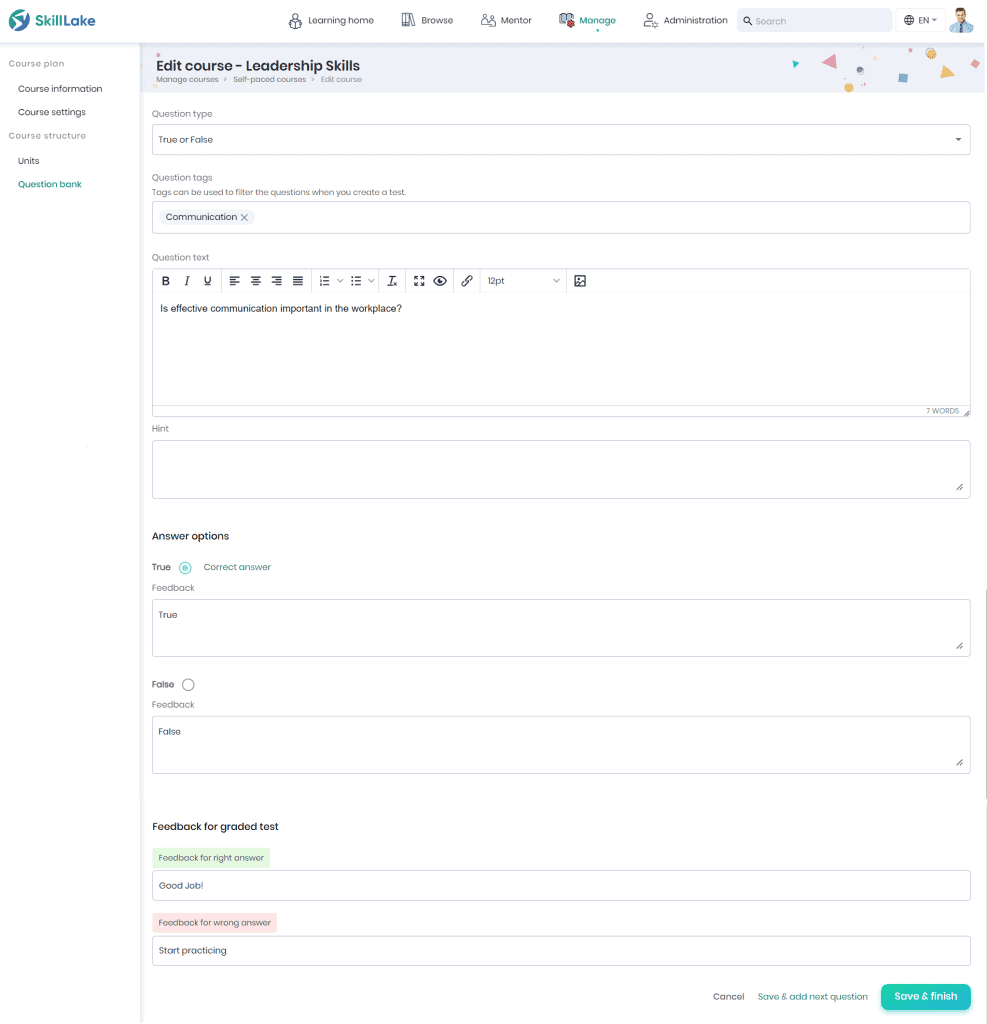
- Click on the Create Question button to create a question.
- Select the question type as ‘True or False’ and question tags (used to filter the relevant questions from the question bank while creating a test)
- Enter the question text and hint for the question (optional)
- In the Answer options, you can enter the true option and enter the feedback for the correct answer.
- Also, you can enter the false option and feedback for the incorrect answer.
- Enter the feedback for correct and wrong answers for the graded test.
- Click on Save and add the next question button to add another question.
- Click on the Save & Finish button to save and complete adding questions.
Note: Click on the Import button to import the content from another course.
Previewing the course
- At any point, while creating the course, you can click on the “Preview” button to check the learner view of the contents or course parameters that have been added (provided you have the required roles and permissions).
- A confirmation message appears, where you have to click on the Confirm button to preview the course.
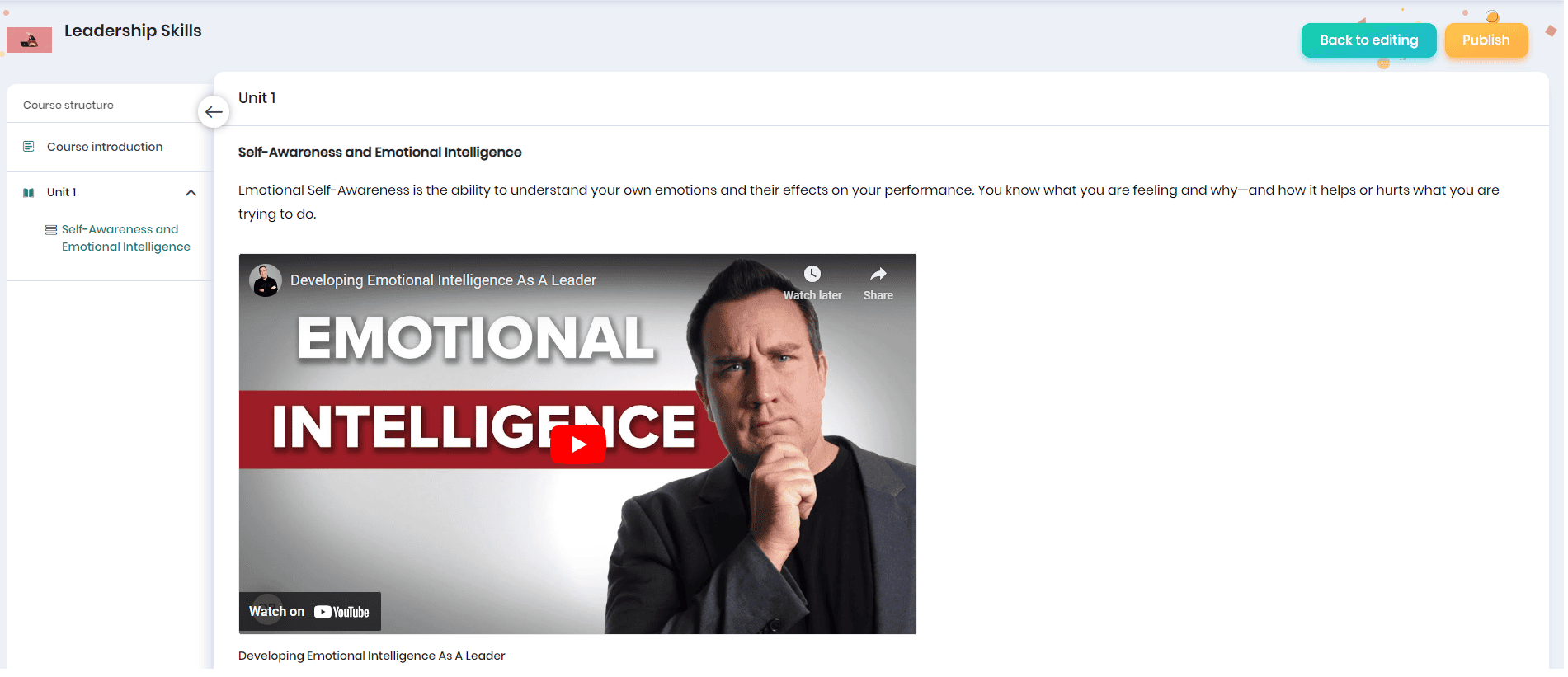
- Click on the Back to editing button to continue editing the course material.
Publishing the course
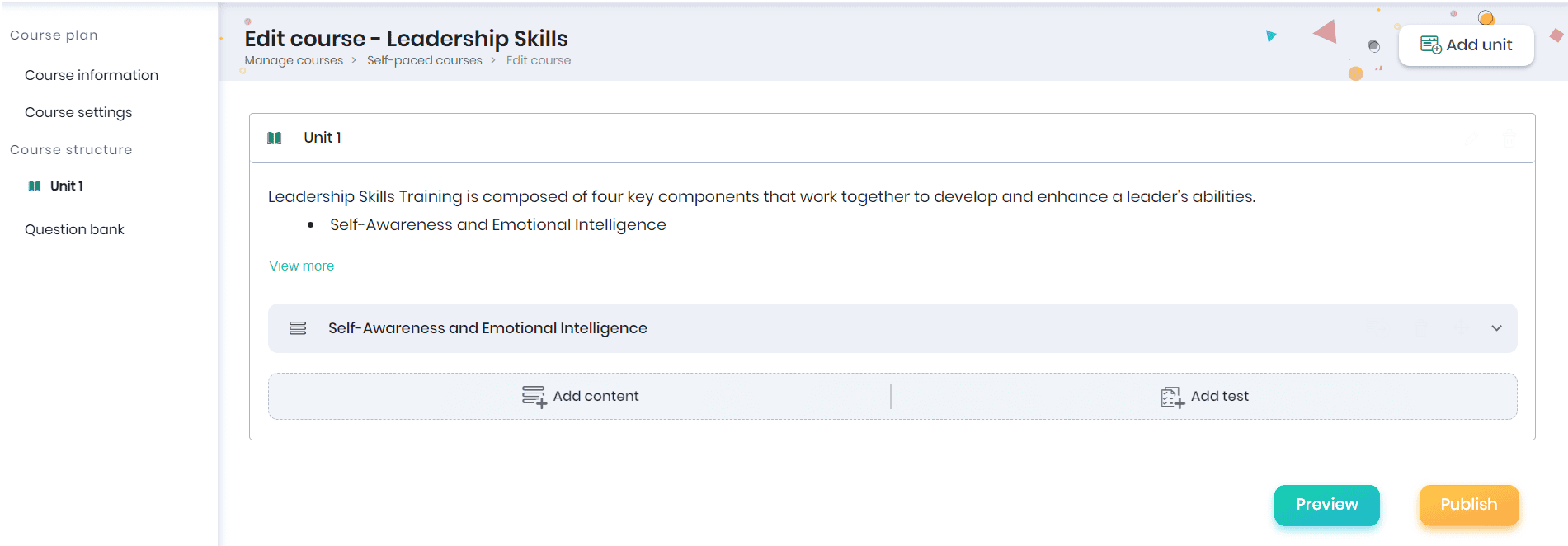
- Click the Publish button to publishthe course when you are done (provided you have the required roles and permissions).
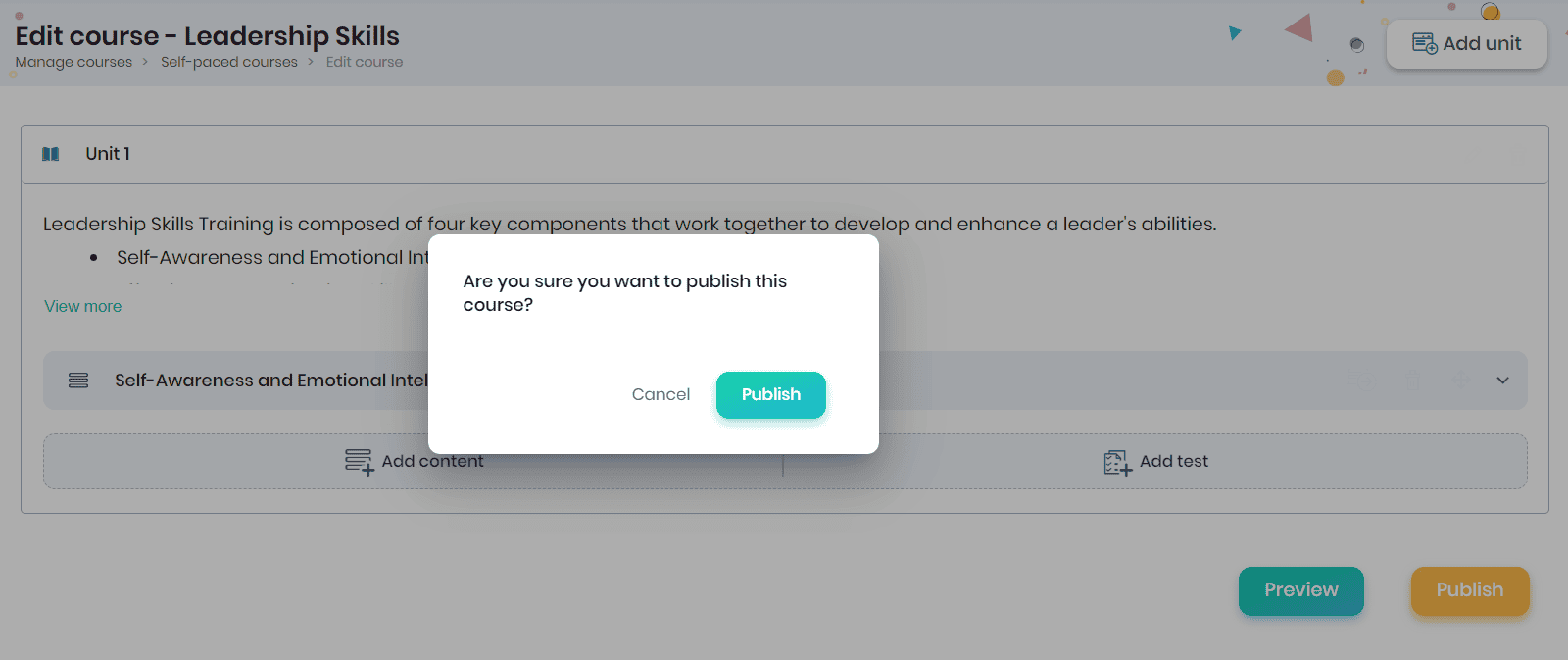
- A confirmation message appears, where you have to click on the Publish button.
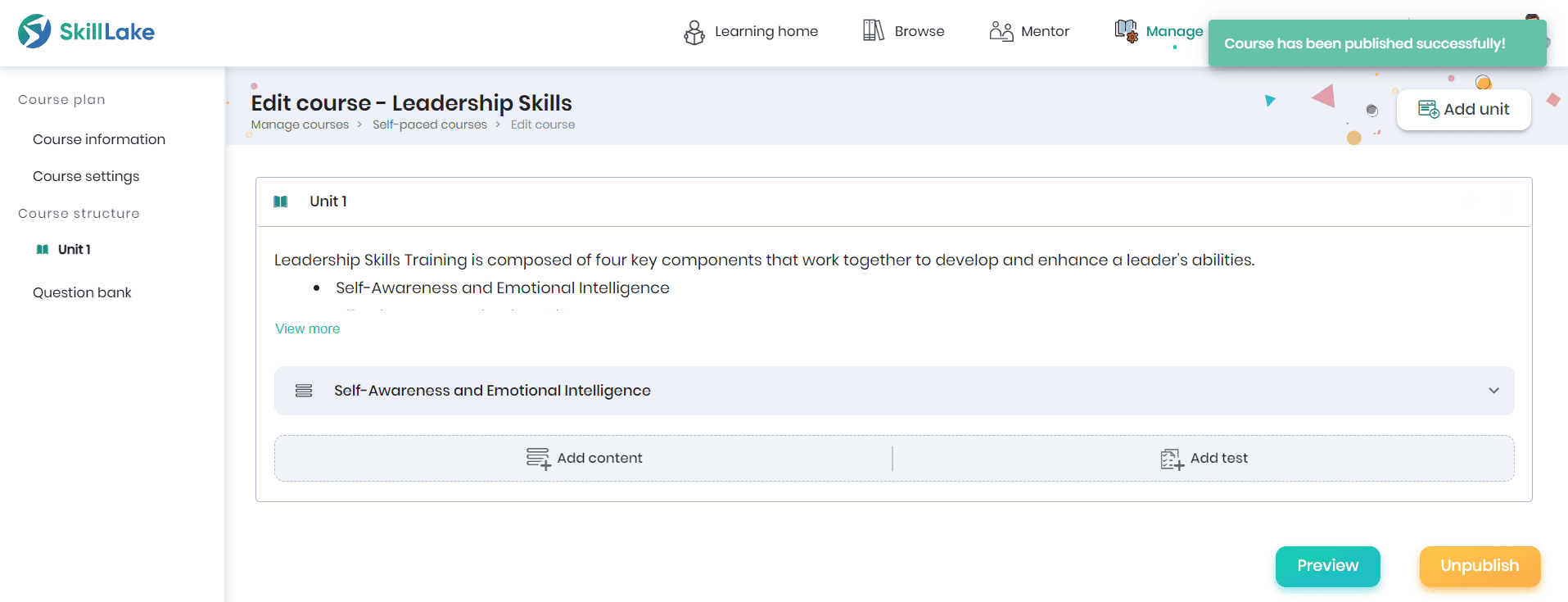
- The published courses will be listed for the assigned groups/sub groups/learning groups in the Manage Courses tab.
Note: The course visibility is based on the roles and permissions set through Administration > Settings > Roles and permissions.
- The user can view all the courses created by their group members provided he has ‘All’ permissions.
- The user can view all the courses he has created in the Manage > Self paced courses.
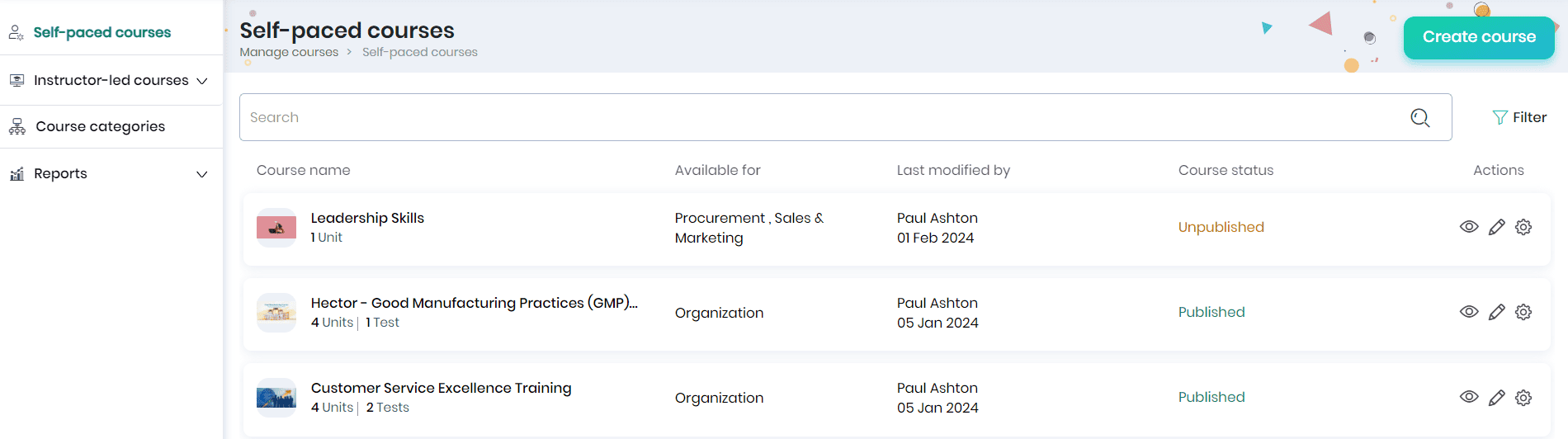
- You can view the course name, available for, last modified by, course status and various actions that can be performed for this course.
- You can search for a particular course and also filter the course based on the course category, course status, course level, and available for.
- Click on the Preview icon to get a preview of the self paced course.
- To edit the course details, click on the Edit icon.
- Click on the Settings icon and click
- ‘Unpublish’ option to unpublish this course.
- ‘Duplicate’ to make a duplicate copy of this course.
- ‘Archive’ option to archive this course.
- ‘Delete’ option to delete this course.
Note: All the above actions can be performed if the user has the required roles and permissions.