Skip to content
Logo
search
  • Features
    • Overview
    • AI Role Play
    • Content Authoring Tools
    • AI Course Generator
    • SCORM Compliant LMS
    • Integrations
    • Pre-Loaded Courses
  • Solutions
    • Learning Management System
    • LMS Mobile App
    • Learning And Development Platform
    • Learning Experience Platform
    • People Development Platform
    • Corporate Training Platform
    • Training Management System
    • Content Creation Services
    • Performance Review System
  • Resources
    • Case Studies
    • Blogs
    • Help
    • Use Cases
    • videos
    • Downloads
    • Release Notes
  • Industries
    • Info Tech
    • Construction
    • Manufacturing
    • Non-Profit
    • Hospitality
    • Energy
    • Insurance
    • Retail
    • Automotive
    • Franchise
    • Telecom
    • Healthcare
    • Restaurant
  • Pricing
  • Company
    • Partners
    • About Us
  • Contact Us
  • search
  • Request A Demo
×
  • Features
    • Overview
    • AI Role Play
    • Content Authoring Tools
    • AI Course Generator
    • SCORM Compliant LMS
    • Integrations
    • Pre-Loaded Courses
  • Solutions
    • Learning Management System
    • LMS Mobile App
    • Learning And Development Platform
    • Learning Experience Platform
    • People Development Platform
    • Corporate Training Platform
    • Training Management System
    • Content Creation Services
    • Performance Review System
  • Resources
    • Case Studies
    • Blogs
    • Help
    • Use Cases
    • videos
    • Downloads
    • Release Notes
  • Industries
    • Info Tech
    • Construction
    • Manufacturing
    • Non-Profit
    • Hospitality
    • Energy
    • Insurance
    • Retail
    • Automotive
    • Franchise
    • Telecom
    • Healthcare
    • Restaurant
  • Pricing
  • Company
    • Partners
    • About Us
  • Contact Us
  • search
  • Request A Demo

Category: Blogs

Top Learning Management Systems

Suppose you’re having trouble managing a costly training setup or can’t arrange a large number of courses in a short time. In that case, Learning Management System (LMS) software is the way to go. 

A learning management system (LMS) is intended to assist individuals or organizations in developing, managing, and delivering online courses and learning programs in a  streamlined manner. It provides a platform for learners and instructors to study and showcase their abilities anytime and wherever they choose, at their convenience. 

Read more: How Does an Enterprise LMS Software Enable Market Success for Businesses Today?

What is the objective of LMS? 

LMS has the potential to address all of the primary learning challenges an organization or institution foresees.

  • Employee training is a mandate in every industry, whether software, educational, corporate, or government. We need to train the staff to meet our requisites, which an LMS can readily achieve. It automates most of the tasks and paves the way for the organization to save time and money by tracking employee learning curves.
  • An LMS can design learning programs, courses, and tutorials, making it readily available and effortless for learners to use and improve their skill set.
  • Easily educate the workforce by developing training initiatives and tutorials around several topics.

Some of the most popular and budget-friendly LMSs available in the market are described below. 

1. Skill Lake

Skill Lake distinguishes itself from the competition by providing a platform for people development. It enables businesses to foster an employee-centric learning culture that promotes learning holistically. 

Features:

Accountability

  1. Entails establishing and tracking time-sensitive competence development goals to enable accountability.
  2. Tracks competence at the individual, department, company, and intermediate tiers, making it a perfect training development platform.
  3. Allocate mentors or coaches to harness specialist knowledge or provide additional support.
  4. Provides administrators with data about learning aspects.
  5. Map the entire workforce’s competencies.

Drive Learner Engagement

  1. Allows learning anywhere, at any time via intuitive, secure mobile apps accessible on both, iPhone and Android.
  2. Allows learning through gamification with virtual rewards and offers additional content mashups or guided tests to nudge learners to achieve learning goals.
  3. Build personalized learning journeys for individuals catered to their particular needs.
  4. Higher learning retention rate.

Learning Delivery and Content Creation

  1. Provide self-paced learning, instructor-led courses, or a hybrid of the two.
  2. Powerful and lightweight-free content production tools for creating mashups, assessments, tests, and more.
  3. Recognizes skill gaps and promptly assigns training based on business requirements.
  4. Life skill training and character-building activities, in addition to regular job-based learning.
  5. Self-enrollment and course enrolment at team and organizational levels, along with course assignments.

User Management, Library, and Learner Dashboard

  1. Centralized knowledge repository of courses.
  2. Allows instructors to monitor training progress on the learner dashboard.
  3. User privileges in the organizational hierarchy.

Enterprise IT-ready

  1. Delivered on private cloud, public cloud,  Infince, or on our enterprise-ready servers.
  2. Customizable to your brand, organizational structure, and processes. It can also integrate with the applications you already use and includes SSO and granular role-based controls. 

Read more: Why Corporate E-learning Is the Future of Organizational Training?

2. Mindflash

Mindflash – an ideal LMS platform for training clients, partners, resellers, or employees of large organizations. It enables you to edit live courses and use existing content such as voice, video, animation, and more. 

Features: 

  1. Provides fast onboarding, virtual classroom, and compliance training.
  2. Provides course building and web conferencing capabilities to enhance learning and make it more engaging.
  3. Provides blended learning, mobile learning, and good interaction with relevant systems. 

3. SkyPrep 

This training software can help small and big businesses which employ more than thousands of staff. SkyPrep enables enterprises to create and save an infinite number of courses and evaluations.

Features:

  1. Integration capability to improve the learning experience. 
  2. Supports several languages, advanced reporting, and easy tracking of learner progress.
  3. Provides course-building tools for endless training content with real-time reporting.
  4. Enables tailored training for customers. 

4. Tovuti LMS 

Tovuti is an all-in-one eLearning software platform that enables businesses and individuals of all sizes to maximize their organization’s potential. Tovuti provides cutting-edge course authoring tools and personalized learning portals, along with websites, directories, live video conferencing, reporting and analytics, eCommerce, event management, gamification, social communities, content marketplace, subscription management, and everything in between.

Features:

  1. SCORM compliance
  2. Build your own content
  3. Lesson gating
  4. Integrated course content library
  5. Personalized learning portals
  6. Leaderboards
  7. Virtual meetings

5. LearnWorlds

LearnWorlds is a powerful, user-friendly, dependable training solution for customers and businesses. A completely configurable white-label solution for training staff and associates, educating customers, or selling online courses to a large audience. This cloud-based e-learning platform provides professionals, entrepreneurs, and training managers with a solution adapted to their individual needs, and a team of specialists to assist in achieving their objectives.

Features:

  1. Video interaction stats
  2. Blended learning
  3. Learner portal
  4. Branded digital certificates
  5. Mobile learning
  6. Video conferencing

Read more: Why Do Corporate LMS Training Practices Need To Go Beyond Traditional LMS?

6. TalentLMS 

TalentLMS meets the learning needs of any enterprise or academic institute, regardless of size or type of training. In addition, it makes the onboarding training experience possible by automatically issuing certifications and re-assigning training at appropriate times.

Features: 

  1. Its automation engine feature allows the creation of automatic events without supervision.
  2. It offers a sophisticated course-building tool that can construct courses in just a few clicks. You can make it more fascinating by utilizing its best features such as gamification, blended learning, personalized learning route, and others.
  3. It has improved mobile accessibility, a user-friendly interface, and extensive flexibility in creating custom reports. 

7. Easy LMS

Easy LMS, founded in 2013, is a user-friendly, intuitive, and simple-to-distribute Learning Management System and a one-of-a-kind solution for enterprises. It provides a competitive quiz solution, an educational course solution, and an entertaining assessment solution, including certification. 

Features: 

  1. eCommerce
  2. Learning paths
  3. Automatic certificates
  4. Timer on course slide
  5. Immediate feedback
  6. Concise progress reports
  7. Multiple admin support 

8. Adobe Captivate Prime 

Train your employees with Adobe and provide an exceptional learning experience to individuals seeking a unique learning experience. Reduce the gap between your learners’ skills and your organization’s requirements with this sophisticated LMS.

Features:  

  1. SFDC integration
  2. Comprehensive tracking
  3. Learner Portal
  4. Learner transcripts
  5. Auto-generated groups
  6. Role-based reporting
  7. Seamless migration from old LMS

Read more: Regulating On-the-Job Training and How People Development is the Answer

9. Blackboard LMS 

Blackboard LMS is another significant LMS system that provides virtual classrooms, a comprehensive technology stack, sophisticated data and analytics, a multichannel community engagement program, professional development tools, and other services to governments and companies.  

Features:  

  1. View course items and course announcements
  2. Take online assignments and tests
  3. Participate in discussions
  4. Interact with instructor and class in Blackboard Collaborate
  5. Activity stream

Final Words

We discussed the impact of LMSs on organizations. We also learned how the different LMS platforms improve employees’ learning experience and uplift an organization’s training. Users can now upgrade and refine their skill set anytime they want, according to their convenience, thanks to LMS. Along with this, we discovered the dependability, deployment modes, and unique features of each LMS. If you want to select the finest platform for your business and get the most out of an LMS, you should start with your core criteria. Once you’ve determined your “must-have” features, it’s time to examine the top LMS tools available. Based on these considerations, we hope finding the LMS for your organization is easy as ever.

To learn how Skill Lake can streamline your training process, connect with us today!

Ashmitha Chatterjee

Ashmitha is a learning and development enthusiast who shares her insights on e-learning. She loves to create engaging and informative content and is dedicated to helping people learn and grow through her deep expertise in the field.

Other Reads from Skill Lake

  • Top 10 Best LMS Software Systems for Modern Workforces

    Top 10 Best LMS Software Systems for Modern Workforces

    Scaling a business in 2026 requires scaling its workforce’s knowledge and performance readiness. Workplace dynamics have shifted and traditional employee training software doesn’t cut it anymore. Today’s market demands an AI-powered LMS that automates personalized learning journeys and delivers measurable ROI. In this LMS software comparison guide, we analyze the top 10 platforms designed to

    Read More
  • Top LMS Training Platforms for 2026: 10 Best Solutions for Corporate Learning

    Top LMS Training Platforms for 2026: 10 Best Solutions for Corporate Learning

    Legacy corporate training frameworks are failing to solve contemporary skill gaps. To build an agile, future-ready workforce, organizations need a modern corporate training LMS that drives active capability mastery. This post evaluates the top LMS training platforms for 2026 currently delivering measurable operational ROI. Top 10 LMS Training Platforms for 2026 Note: Pricing and features

    Read More

    Stay up to date on the latest in HR and L&D


    Highlights of Skill Lake

    • AI/ML Powered Course Recommendations
    • Courses with AR/VR Experiences
    • Competency & Course Management
    • Multiple Learning Modes
    • Mentoring & Feedback
    • Gamification
    • Learning Bytes
    • Mobile App
    • SCORM Compliance
    REQUEST A DEMO

    Highlights of Skill Lake

    • Sell-Paced & Instructor-Led Learning
    • Tracking & Reporting
    • Mentoring
    • Gamification
    • Learner Dashboard
    • Course Library
    • Enterprise IT Ready

      [recaptcha]

      Highlights of Skill Lake

      • AI/ML Powered Course Recommendations
      • Courses with AR/VR Experiences
      • Competency & Course Management
      • Multiple Learning Modes
      • Mentoring & Feedback
      • Gamification
      • Learning Bytes
      • Mobile App
      • SCORM Compliance
      • Multi-Cloud Hosting

        Watch Skill Lake in Action!

        REQUEST A DEMO

        remote workforce solutions

        A decade ago, remote work was uncommon, typically only accessible as a special arrangement to assist people in certain circumstances. However, in 2022, it’s a different ball game altogether. The essence of work has shifted dramatically with the rise in remote working or work-from-home.

        Cultivating a robust remote work culture is becoming routine in daily life. Organizations have started increasingly focusing on work done rather than hours worked or necessitating tools and apps to oversee remote employee performance. Continuous feedback while overseeing work, on the other hand, has become increasingly requisite as managers attempt to assist employees in navigating their job tasks and meeting performance objectives. Therefore, it is vital to rethink how goals get created and determine crucial performance metrics when handling remote workers in today’s work environment.

        The perks of remote work for businesses are that it is more business-oriented. Among the benefits include:

        1. Cost savings – The overhead expenses for organizations drop by half due to lower or zero costs for office space, utilities, office supplies, etc.
        2. Employee well-being – Remote employees are happier and healthier, and they are relaxed and more concentrated, which equates to improved business in general.
        3. Global access – By utilizing remote work, firms can invite global talent to join their organization regardless of location.

        As the pandemic settles, many businesses are considering a new hybrid virtual model in which some employees work on-site and others work from home. The new model offers individuals and smaller teams enhanced productivity, greater individual flexibility, and better employee experiences. 

        Keeping Your Remote Team Engaged: Conquering Training Challenges

        Remote training comes with its own set of challenges, regardless of its convenience. Some of the most frequent issues you may encounter include:

        1. Trainees’ lack of attention

        2. Technical issues

        3. Distractions at home

        4. Feelings of social isolation

        5. Scheduling

        Remote Workforce Solutions: 7 Easy Tips to Train Your Team Anywhere

        Establishing an effective remote training program can be intimidating initially, but that doesn’t mean it can’t succeed! Here are some effective practices for remote staff training.

        1. Use a range of training formats and file types 

        The best method is to combine different training formats. For example, you can use synchronous learning methods like conference calls or online meetings, where people can interact and learn from each other. On the other hand, asynchronous or on-demand learning is self-paced and involves employees learning from online materials at their convenience.

        2. Make the training accessible via mobile devices 

        Remote employees need not constantly work from home and might not always be in front of their computers or laptops. It is critical to ensure that training is mobile-friendly and always accessible.

        Learning on the Go

        3. Establish a learner community 

        Tools for communication and productivity, such as Slack, Asana, and Trello, make remote working and training more straightforward than ever before. In addition, such solutions establish a space for several employees participating in the same remote training session to engage in discussions and share ideas and expertise.  

        4. Assess the effectiveness of training

        Tracking the efficacy of your remote training is critical for several reasons. It assists in determining which courses and training are most successful and which need improvement or replacement. Also, it helps to identify the learners’ progress. 

        5. Make remote training self-paced 

        Consider making some aspects of the remote training self-paced to give your employees additional flexibility. For example, offering them a completion deadline and letting them choose when to work through it based on their schedule and preferred learning style.

        6. Incorporate gamification

        Gamification in LMS is an excellent approach to increasing interactivity, engagement, and motivation among your learners while reducing distraction. 

        Learning Home 11

        7. Utilizing training software 

        If you have a large corporation, remote training software or learning management system (LMS) targeted toward remote settings will help you successfully plan, implement, and deliver your training program.

        8. Promote a learning culture

        Instilling a concept of learning in your employees when they join your firm is imperative. Your remote training programs should be ongoing rather than a one-time event.

        Remote Workforce Training Made Easy: Reap Big Benefits with Simple Solutions!

        Many organizations may use traditional classroom learning, but this may not be practical in the present climate. A holistic Learning Management System software can assist the modern work culture. One of the primary advantages of an LMS is e-learning, which eliminates the time and distance constraints that foster efficient learning and allows employees to complete training courses at their leisure. In addition, employees can select between blended learning and self-paced learning, depending on their preferences. Benefits of LMS include: 

        1. Reduces training time significantly – Traditional classroom training requires employees to leave their workstations and attend training in a conference room. However, according to Brandon and Hall’s research, remote training saves employee time by 40% to 60%.
        2. Provides employees with flexibility – One impressive characteristic of eLearning is its potential to provide employees with flexibility. Employees can start the course anytime they want and complete it at their own pace. They can also choose their comfortable learning modes across various materials such as files, documents, videos, links, etc. 
        3. Limitless access to learning resources – This allows employees to access training materials at any time, whenever they need them. 
        4. Improves employee retention – According to a Gallup study, 87% of millennials believe that learning and development opportunities are crucial in their workplace. Implementing an effective and easy learning program can enhance employees’ abilities and improve the organization’s performance.
        5. Encourages debate and discussion – Real-time exchanges with peers and instructors allow your staff to clarify course-related doubts and better comprehend the course materials.
        6. Easier assessment – Ensuring that every employee gets the most out of their training sessions is vital. LMSs can administer tests and assignments to determine whether your employees have grasped the training sessions.
        7. Enables feedback – Constructive criticism from instructors and managers assists employees in improving their skills. In exchange, employees can also submit feedback on the courses and teachers. This allows you to increase the quality of employee training and tailor it to their tastes and needs. 

        Having discussed the benefits of modern LMS, it is vital to adopt an ideal learning management system to ensure organizational and employee growth.  

        The Remote Training Advantage: How Skill Lake Can Help

        Skill Lake is an efficient and holistic LMS solution that aids organizations in providing remote training. It navigates any industry challenges at scale, irrespective of the organization’s size. Skill Lake enables businesses to create an employee-centric learning culture in which learning occurs holistically and helps your organization achieve its goals. Some interesting features of the platform include interactive learning (live webinars), immediate feedback (guided tests), self-paced learning, gamification, and many more. Skill Lake is a dynamic product that can satisfy the needs of present and future workforces. Explore more about Skill Lake by taking a quick demo here. 

        Alphons Xavier

        Alphons is a seasoned HR professional with a specialized focus on talent management and development. With a particular expertise in learning and development, Alphons excels in designing and executing tailored L&D activities that align with the organization's objectives. Driven by a strategic mindset and a passion for fostering continuous learning cultures, Alphons is dedicated to instigating behavioral and cultural shifts within the organization. She collaborates closely with business leaders to identify areas for improvement and develops innovative strategies to bring about meaningful change.

        Other Reads from Skill Lake

        • Top 10 Best LMS Software Systems for Modern Workforces

          Top 10 Best LMS Software Systems for Modern Workforces

          Scaling a business in 2026 requires scaling its workforce’s knowledge and performance readiness. Workplace dynamics have shifted and traditional employee training software doesn’t cut it anymore. Today’s market demands an AI-powered LMS that automates personalized learning journeys and delivers measurable ROI. In this LMS software comparison guide, we analyze the top 10 platforms designed to

          Read More
        • Top LMS Training Platforms for 2026: 10 Best Solutions for Corporate Learning

          Top LMS Training Platforms for 2026: 10 Best Solutions for Corporate Learning

          Legacy corporate training frameworks are failing to solve contemporary skill gaps. To build an agile, future-ready workforce, organizations need a modern corporate training LMS that drives active capability mastery. This post evaluates the top LMS training platforms for 2026 currently delivering measurable operational ROI. Top 10 LMS Training Platforms for 2026 Note: Pricing and features

          Read More
        On-the-Job Training Method

        While one of the benefits of implementing accountable on-the-job training is that it uses existing resources to train individuals to do their tasks, it also offers other organizational benefits. Responsible on-the-job training hugely impacts the organization’s overall performance. Studies have proven that on-the-job training, or OJT, is substantially connected with increased creativity and invention, along with improvement in overall work quality.

        The move to a remote/hybrid workforce has prompted particular training considerations. Teams may be divided between remote and in-office contingents, making it cumbersome to give regular and meaningful training to both groups. In addition, L&D will need to establish a consistent culture and decide how to implement new regulations. It also implies a strong emphasis on learning and development adapted to the needs of a hybrid workplace and each employee. With 61% of remote employees believing they require additional training to perform effectively in their role, the need for excellent and accountable remote/hybrid training is even greater.

        Challenges of On-the-Job Training for Remote and Hybrid Teams

        In this section, we will look at the issues that organizations encounter when educating remote/hybrid workers, such as: 

        1. Culture & Communication Gaps

        2. Learning Disruptions

        3. Limited Resources

        4. Work-Life Balance & Teamwork

        5. Lower Employee Satisfaction

        Organizations can take several steps to aid employees in performing their best work in personal and shared digital workplaces, including guaranteeing cybersecurity, enabling seamless collaboration with the right digital tools, and investing in training resources to create digital competence.

        A well-designed and masterful corporative learning platform like Skill Lake makes training content available on mobile devices, making it available to anybody, anywhere, at any time, significantly influencing the training provided to remote/hybrid workers. The system also facilitates communication between learners and instructors, reducing the risk of misunderstanding and ambiguity. Skill Lake users may build mashups, assessments, exams, and more using powerful, lightweight, distraction-free content production tools. It also facilitates feedback and remedial action that results in accountability in L&D. 

        The Balancing Act: Challenges of Managing On-the-Job Training

        When allocating resources, most organizations prioritize boosting the effectiveness of their on-the-job training programs. This is hardly unexpected, given that training is designed to reduce time (and money) while delivering on all learning promises that benefit both executives and learners.

        Despite carefully allocating resources, many organizations find ventures useless in accomplishing their objectives. These can be due to reasons like: 

        1. Differences in learning styles

        The current workforce includes at least three generations, each with a fundamentally different relationship with technology. As a result, assuming that all employees are similarly tech-savvy or have the same knowledge levels and learning habits will make on-the-job training less successful. 

        Skill Lake enables accountability for people development by enabling individual accountability, carried out by setting and tracking time-sensitive competence development goals at the individual, department, organization, and intermediate levels. The platform assigns mentors or coaches to leverage specialized knowledge or provide extra support, overcoming differences in learning styles.

        2. Engagement

        The importance of engagement can be divided into three categories: cognitive, emotional, and behavioral. Without all three, poor knowledge retention, passive learning, and a lack of commitment lead to on-the-job training issues. Furthermore, behavioral change is impossible in the absence of learning engagement. When instruction feels irrelevant or useless, most students mentally and emotionally “drop out” and refuse to participate. A study on employee engagement conducted in the United States states that disengaged employees cost businesses between 450 and 550 billion dollars annually, highlighting employee engagement’s importance and impact on your business. 

        Skill Lake drives learner engagement by enabling learners to learn anywhere, at any time. The system uses gamification, content mashups, or the creation of “guided tests” to nudge learners to achieve learning goals and easily create personalized learning journeys for individuals based on their specific needs. In comparison to other learning frameworks, Skill Lake has a greater learning retention rate.

        3. Overload of Information 

        When an organization hires a new employee, they must be onboarded. The goal is to successfully train new employees on your corporate software to be productive. Organizations flood them with too much material from the start of a training session and expect their employees to grasp it all. Employees may become overwhelmed, disconnect from training, and abandon your organization. Studies reveal that less than 35% of the US workforce is engaged in work.  

        Skill Lake primarily offers self-paced learning, instructor-led classes, or a mix of the two. On the learning platform, the student can choose between self-paced and instructor-led learning. In both cases, the student benefits from the guidance of an instructor or mentor.

        4. Inadequate feedback and support structure

        Most training programs are organized such that there is minimal room for employee feedback or involvement in terms of what works and what doesn’t. Outwardly, this may appear to be a simple remedy, but in practice, providing a sufficient feedback mechanism for off-the-job training can be difficult. According to Forbes, employees who believe their views get heard are 4.6 times more likely to do their best work. Furthermore, 89%of Human Resource leaders feel that regular peer feedback and frequent check-ins are critical for success. 

        Skill Lake tracks learning behavior at the granular level. It provides administrators with data on various learning metrics, allowing them to assist students who are falling behind.

        formalize performance reviews

        5. Assessing training efficiency

        Many L&D professionals believe assessing how on-the-job training initiatives affect their firm quantitatively is critical. Determining which metrics to employ might be strenuous, how to incorporate them into post-training assessments, when and how to follow up, and how to alter future training depending on the results.

        Skill Lake allows instructors to observe training progress on the learner dashboard, effectively sanctioning user rights in the organizational hierarchy and tracking top and average performers. This allows for easy evaluation of training efficiency.

        Learning Home 7

        The Future of Learning: How On-the-Job Training is Evolving

        On-the-job training should ultimately result in employees being more prepared to do their tasks, more engaged, and actively contributing to the company’s overall goals. Employees can benefit from accountable on-the-job training by learning and practicing new skills, having learning tools to refer to when doing duties, and building productive working relationships with co-workers.

        The emergence of L&D technologies has the potential to be a game-changer in the on-the-job training setting. Skill Lake takes collaborative learning to a new level of involvement and participation. As a result, the future of on-the-job training is practically here, with learning experiences becoming more responsive and robust.

        Skill Lake helps the organization navigate hurdles as it surfaces while fostering a learning culture throughout the organization.

        Laptop screen

        Get in touch with us today for a Free Demo! 

        Sachin Krishna

        Sachin is a passionate advocate of e-learning with a profound knowledge of the field. He regularly writes compelling content that captivates readers and works to spread awareness of learning solutions.

        Other Reads from Skill Lake

        • Top 10 Best LMS Software Systems for Modern Workforces

          Top 10 Best LMS Software Systems for Modern Workforces

          Scaling a business in 2026 requires scaling its workforce’s knowledge and performance readiness. Workplace dynamics have shifted and traditional employee training software doesn’t cut it anymore. Today’s market demands an AI-powered LMS that automates personalized learning journeys and delivers measurable ROI. In this LMS software comparison guide, we analyze the top 10 platforms designed to

          Read More
        • Top LMS Training Platforms for 2026: 10 Best Solutions for Corporate Learning

          Top LMS Training Platforms for 2026: 10 Best Solutions for Corporate Learning

          Legacy corporate training frameworks are failing to solve contemporary skill gaps. To build an agile, future-ready workforce, organizations need a modern corporate training LMS that drives active capability mastery. This post evaluates the top LMS training platforms for 2026 currently delivering measurable operational ROI. Top 10 LMS Training Platforms for 2026 Note: Pricing and features

          Read More
        Franchise LMS

        Ever wondered how some small businesses turn into big franchises? Simply because they have a great product, strong brand, or sizable investment? Beyond all these, there’s a secret sauce to their success. Any guesses? You read it right! The magical component is nothing but effective franchise training. Data shows that franchise training improves product awareness (70%) and customer relationships (60%).

        Picture this. You’ve come up with a great training program for your franchise partners. How about rendering it to them? That’s when you need a learning management system software (LMS). How does a franchise LMS improve the effectiveness of your training? What are the key factors to consider when implementing a franchise LMS? This article is your essential guide to selecting the right franchise LMS.


        In this article:

        • Why choose an LMS for franchise training?
        • Benefits of using a franchise LMS
        • Must-have features in a franchise LMS
        • Considerations for choosing a franchise LMS
        • Final thoughts

        Why Choose an LMS for Franchise Training?

        Technology is the biggest driver of efficiency in franchise training. 80% of companies say technology helps enhance the effectiveness of their franchise training. 60% of businesses state using a franchise training LMS to train their franchisees.

        A modern LMS for franchise helps solve the common challenges in training, such as:

        • Inconsistency in training franchisees across various locations
        • Lack of appropriate methods to measure the efficiency and impact of franchise training
        • Difficulties in tracking course completion status and progress made by learners
        • Outdated training materials that can make franchisees less competitive and relevant
        • Spending more time, money, and resources to create courses or update training materials
        • Manual effort (administrative workload) involved in content structuring and course creation
        • Lack of personalized (customized) learning content catering to individual or team needs
        • Risks of non-compliance among franchise staff that can affect your operations and credibility
        • Inability to scale franchise training programs to accommodate new locations and participants

        How does a franchise LMS solve these challenges? Read on.

        What Are the Benefits of a Franchise LMS?

        A franchise LMS enhances your extended enterprise learning. It helps deliver, track, and manage training content across your franchise network. Here are the benefits of using a franchise LMS:

        1. Boost Brand Recognition

        A franchise LMS plays an important role in building brand recognition by:

        • Providing standardized, consistent training to all franchisees across many locations
        • Onboarding new franchise staff and aligning them with the brand’s values and cultures
        • Keeping franchisees up-to-date with the latest skills and knowledge required to excel in their roles

        2. Flexible Learning Options

        A modern LMS makes learning more flexible and convenient for franchise professionals.

        • Cloud-based hosting ensures instant access to courses and training materials. Learners can access their courses anytime on an internet-connected device.
        • Mobile learning promotes learning on the go. Learners can take up courses even during breaks and non-working hours.

        3. Motivate and Engage Franchise Staff

        An LMS incorporates various engaging activities to make training more interesting for learners.

        • Gamification to motivate franchise staff to meet their learning goals faster
        • Certification to ensure the legitimacy of courses and credibility earned by franchisees
        • Learning feeds and microlearning bytes for users to receive and digest information faster

        4. Reduce Administrative Workloads

        A franchise LMS allows you to train as many franchisees and staff members as you want. The learning management system:

        • Makes hiring and onboarding processes easier and faster for your team
        • Helps create and launch your franchise training materials in a few clicks
        • Reduces your trainers’ administrative workloads by automating repetitive tasks
        • Allows your L&D experts to focus on more strategic objectives

        5. Track the Progress and Performance of Learners

        An LMS helps track how well the franchise professionals have absorbed your training. Using the reporting and analytics feature in the franchise LMS, you can:

        • Identify the most-liked aspects of your courses and training materials
        • Find out specific areas that need improvement
        • Assess the efficacy of course materials and update them as needed
        • Help employees understand their job responsibilities

        6. Ensure Compliance with Regulatory Standards

        Monitoring compliance among franchises and their staff is crucial for brands. The right franchise LMS makes it easy to:

        • Deliver up-to-date compliance training to a vast network of franchise teams
        • Ensure franchisees across locations are measured by the same set of standards
        • Verify whether all franchisees are compliance-certified to operate legally
        • Track who is in compliance and who isn’t

        7. Reduce Training Costs and Efforts

        With a customizable franchise LMS, you can:

        • Improve franchise training programs across the board
        • Reduce the time and resources spent on tedious, in-person training
        • Enable faster learner onboarding with easy-to-manage learning tracks, courses, and lessons

        8. Scale Training to Meet Evolving Needs

        Every franchisee needs a scalable training solution to accommodate new locations and participants. With a franchise LMS, you can:

        • Manage and distribute content to franchise staff across all locations
        • Ensure all franchisees have access to the most current and relevant training content

        What Are the Key Features to Look for in a Franchise LMS?

        An ideal LMS offers the right mix of features to make training engaging and user-centric. Here are the top 10 features to look for in a franchise training LMS.

        1. Centralized Content Management

        A centralized repository to keep all your training materials in one location. Here’s how it helps:

        • All franchisees and their teams will have access to the same resources, guidelines, and updates
        • Promotion of uniform quality standards and brand integrity among all franchise units
        • Maintain consistency in franchise training across all locations

        2. Tracking and Reporting

        The right franchise LMS supports you with eLearning tracking and progress reporting. Make sure the LMS you’re planning to adopt helps you with the following:

        • Analyze how franchise professionals have performed in training sessions and post-lesson assessments
        • Generate custom progress reports displaying real-time insights on every aspect of franchise training
        • Track course attendance, module-wise progress, course completion, and learners’ performance

        3. Skills and Competency Management

        Track and manage the competencies of your franchise professionals.

        • Custom-graded assessments to evaluate the competence levels of franchise owners and staff
        • Ability to set and track time-sensitive competence development goals
        • Ability for mentors to identify skill gaps and specific areas that need to be improved
        • Recommend courses and training materials to learners to improve their skills

        4. Multiple Learning Modes

        The best franchise LMS is one that facilitates different learning modes, such as the following: 

        • Self-paced learning: Allows learners to consume the training material at their own pace and on their own schedule. Absorbing the content does not require the immediate intervention of an instructor. 
        • Instructor-led training: Learners and instructors can interact and discuss the training material on the LMS, either individually or in a group setting. Instructors may deliver training in a lecture or classroom format, or even virtually, using video conferencing.
        • Blended learning: Also known as hybrid learning, this approach combines online learning materials and online interaction opportunities with physical location-based classroom methods.
        • Synchronous learning: Synchronous learning refers to a learning event in which both learner(s) and instructor(s) are in the same place, at the same time, in order for learning to take place. Live online meetings and live interactions or discussions are examples of synchronous learning.
        • Asynchronous learning: This approach refers to instruction and learning that do not happen in the same place or at the same time. Examples include watching pre-recorded training lectures or demo videos. 
        • Microlearning: This learning strategy focuses on breaking down complex concepts and topics into bitesize training modules that are easy and quick for learners to consume. Examples include short and snappy quizzes and one-stop scrolling pages. 

        5. Mobile Learning

        A franchise LMS optimized for mobile devices allow franchisors to

        • Deliver consistent training experiences to franchise networks across all locations
        • Empower learners to access training materials whenever and wherever they need
        • Save the money spent on in-person training and development
        • Track training progress and performance of franchisees on the go

        6. Learning Personalization

        Modern LMSs use AI to personalize learning for each learner. An AI-powered LMS can help:

        • Personalize course recommendations for each learner
        • Customize learning paths for each learner
        • Tailor learning feeds to match the interests, job roles, and skills of learners

        7. AI-Powered Course Generation

        AI can help automate course creation, publishing, and delivery. A franchise LMS with in-built AI course maker:

        • Allows you to get started by just specifying the course topic and a short description
        • Enables clear, structured planning of course outline and content, with vivid modules
        • Easy to review your training content at each phase of course generation
        • Reduces manual workload, saving your time to focus on enhancing the course

        8. Gamification in LMS

        A franchise LMS that supports learning gamification allows you to:

        • Engage and incentivize franchise professionals with virtual incentives, badges, and points
        • Cultivate a sense of competition and accomplishment among your franchise partners
        • Boost franchise engagement, knowledge retention, productivity, and profitability

        9. Certification Management

        Several franchise LMSs help certify learners once they complete a course or a test.

        • Professional certificates prove the legitimacy of franchise partners
        • Certificates serve as a token of recognition
        • Certificates motivate learners and increase their commitment toward the brand

        10. Mentoring and Feedback

        Look for a franchise LMS that allows you to:

        • Assign Mentors or Coaches to train and support your franchise professionals
        • Directly map subject matter experts to learners to facilitate personalized learning and guidance
        • Share knowledge, suggest courses, and track the progress of learners regularly
        • Provide continuous feedback to boost knowledge retention and learning accountability among franchisees

        Factors to Consider When Choosing a Franchise LMS

        The franchise LMS you choose can either make or break your training efforts. Here are some key factors to consider when making your choice:

        • Assess your needs and challenges in franchise training. Ensure the LMS you choose aligns with your requirements and goals.
        • Decide on the kind of training you want to provide. Is it offline, online, or a combination of both? Choose a format that suits your learning style and logistical convenience.
        • Consider the time you need to complete training before launching a franchise unit. Ask your franchise partners about post-training support and resources.
        • Think about your training customization requirements. Find out if the LMS helps personalize training to suit your unique requirements.
        • Ease of setting up and deploying the LMS on your private servers or on a public cloud server. Aligning the LMS with your IT specifications.
        • Intuitiveness of the LMS. Can users explore and use the LMS regardless of their level of technical know-how? Is the platform easy to navigate?
        • Compliance and security. Does the LMS conform to the standards governing your operations? What measures do they have to protect your IP and data?
        • Look for an LMS that integrates with the business applications you use, such as CRM, ERP, other eLearning platforms, partner portals, and so on.
        • Cost of the LMS: Pricing and subscription model
        • Migration support: Does the LMS allow migrating and updating your old content?
        • Customer reviews: Feedback and testimonials from other LMS users belonging to your industry

        Final Thoughts on Selecting a Franchise LMS

        Effective training ensures that franchisees and their staff are up-to-speed on the latest policies, procedures and best practices dictated centrally by the corporate brand. An intuitive, personalized learning journey is critical to give franchise networks the knowledge and information they need when they need it.

        Skill Lake is a modern franchise LMS that helps train your employees, customers, and extended enterprise network. With Skill Lake, you can deliver a personalized learning experience that encourages discovery and consumption among franchise learners.

        See Skill Lake in Action

        We would be happy to show you how Skill Lake LMS can help your company with franchise training.


        Book a Demo


        Sachin Krishna

        Sachin is a passionate advocate of e-learning with a profound knowledge of the field. He regularly writes compelling content that captivates readers and works to spread awareness of learning solutions.

        Other Reads from Skill Lake

        • Top 10 Best LMS Software Systems for Modern Workforces

          Top 10 Best LMS Software Systems for Modern Workforces

          Scaling a business in 2026 requires scaling its workforce’s knowledge and performance readiness. Workplace dynamics have shifted and traditional employee training software doesn’t cut it anymore. Today’s market demands an AI-powered LMS that automates personalized learning journeys and delivers measurable ROI. In this LMS software comparison guide, we analyze the top 10 platforms designed to

          Read More
        • Top LMS Training Platforms for 2026: 10 Best Solutions for Corporate Learning

          Top LMS Training Platforms for 2026: 10 Best Solutions for Corporate Learning

          Legacy corporate training frameworks are failing to solve contemporary skill gaps. To build an agile, future-ready workforce, organizations need a modern corporate training LMS that drives active capability mastery. This post evaluates the top LMS training platforms for 2026 currently delivering measurable operational ROI. Top 10 LMS Training Platforms for 2026 Note: Pricing and features

          Read More
        boiler safety lms

        Knowledge is power, and it helps protect both employees and revenue. Seeking out training and education is one of the best ways to guarantee that staff has the information and skills to keep themselves and others safe. 

        Employers must guarantee that boilers are maintained and used within safe limits. Because the boiler is the component with the largest risk of failure in most facilities, boiler operator training is vital for ensuring the facility’s overall safety. They must also guarantee that the staff is given enough information and instructions about the usage, safety operation, foreseeable anomalous situations, what to do during an emergency, and other conclusions from experiences with the equipment.

        Far too many facilities expect that training will commence informally on the job. Most facilities define this as information passed down from employee to employee in the cafeteria or over coffee. While new equipment installations may demand additional formal training, once formally trained employees retire or resign, personnel are left to rely on information passed down.

        The number of injuries increased slightly from l995, about 3%, in keeping with a three-year trend of increases. This rise is understandable when incident figures also increase, but it is a disturbing statistic when there is a reduction in the number of incidents.

        As a result, an alarming proportion of facilities lack appropriately qualified people in combustion equipment maintenance, shutdown procedures, equipment operations, or start-up procedures. However, training a group of staff or a designated employee on main boiler functions is critical.

        Operating ability necessitates fundamental knowledge and an appropriate training and experience background. To prevent the loss of these skills, auto-manual changeover, manual operation, and mock emergency drills can be conducted regularly. Unfortunately, most training programs disregard these instructions, particularly troubleshooting procedures and emergency simulation exercises, although it’s evident that they are among the most critical things operators and maintenance staff should grasp. 

        How can a Boiler Safety LMS help?

        Today’s learning management systems can be made to create several self-paced Boiler Operation and Maintenance courses. These courses can be designed to learn at the convenience of both the employer and the employee. These courses can be self-managed or mentor-managed, allowing learners to complete all components at their leisure and at their own pace. These courses may also include social features that enable participants to collaborate and exchange knowledge. Programs can be designed to provide active learning opportunities by imitating real-world boiler house tasks and providing adequate opportunities for learners to prepare for tests.

        Such LMS training programs can ensure that the learner obtains a thorough understanding of commercial, industrial, and utility boiler systems. Boiler inspections, testing of functioning controls, and troubleshooting advice can all be included. Overall, subscribing to an LMS improves reliability and efficiency to prolong boiler life, boost boiler efficiency, save energy expenses for the employer, and foster a culture of safe work practices among employees. 

        Most importantly, training can dramatically improve safety. Improved safety will impact the bottom line by cutting workers’ compensation payments, saving millions of dollars annually. Furthermore, fewer injuries and accidents cut insurance costs. Some insurance brokers provide discounted prices to businesses that implement training programs. 

        Skill Lake’s Standout Features for Boiler Safety Training

        Skill Lake has all the elements boiler safety programs look for in a learning management system (LMS). It is a “perfect match” for boiler safety training from the start.

        Skill Lake includes characteristics such as: 

        1. Accountability for People Development 
        2. Boost Learner Engagement 
        3. Learning Delivery and Content Creation 
        4. User Management, Library, and Learner Dashboard 

        Skill Lake enables dual training modes, holistic learning, tracking & reporting, and gamified learning. All the while allowing learners to achieve higher learning retention. Our enterprise-ready system is both robust and lightweight. The system enables access to training material on mobile devices, making training available to anyone, anywhere, at any time. It also helps organizations map the competencies of their entire workforce. In addition, the corporate learning management system enables communication between learners and instructors with no room for confusion or ambiguity.

        The Training Center’s Success with Skill Lake Boiler Safety LMS

        Due to an outdated CRM that lacked process efficiency, a complex and extensive LMS that failed to deliver the best user experience, and a lack of integration between the CRM and LMS, the “Training Center Group” struggled to effectively deliver its range of plant operations training programs over the years. However, the organization also recognized that its competitors had made significant progress by adding LMS frameworks, giving them an advantage. These sparked their search for a solid LMS framework capable of meeting all of the requirements they were looking for. 

        “The Training Center” wanted a better way to train their personnel on boiler safety and give them the general protocol to follow.

        Take a look at our successful customer stories and learn why Skill Lake is the most trusted and reliable LMS software today!

        Is Your Boiler Safety Training Scalable Enough? Skill Lake’s LMS Grows with Your Needs!

        Skill Lake implemented all of the features “The Training Center” sought.  

        1. Easy to Use Interface
        2. Custom CRM integration
        3. Scalable for Enterprise Needs
        4. White-Labeled for Your Brand
        5. Mobile Accessibility

        Laptop screen

        Following the deployment and implementation of Skill Lake at “The Training Center,” they observed a significant increase in course enrolment and improved course accessibility on mobile. There was also a spike in new course inquiries, which tremendously enhanced the operating effectiveness of CRM-LMS integration.

        To know more about Skill Lake features and how they can assist your business, reach out to our team today!

        Ashmitha Chatterjee

        Ashmitha is a learning and development enthusiast who shares her insights on e-learning. She loves to create engaging and informative content and is dedicated to helping people learn and grow through her deep expertise in the field.

        Other Reads from Skill Lake

        • Top 10 Best LMS Software Systems for Modern Workforces

          Top 10 Best LMS Software Systems for Modern Workforces

          Scaling a business in 2026 requires scaling its workforce’s knowledge and performance readiness. Workplace dynamics have shifted and traditional employee training software doesn’t cut it anymore. Today’s market demands an AI-powered LMS that automates personalized learning journeys and delivers measurable ROI. In this LMS software comparison guide, we analyze the top 10 platforms designed to

          Read More
        • Top LMS Training Platforms for 2026: 10 Best Solutions for Corporate Learning

          Top LMS Training Platforms for 2026: 10 Best Solutions for Corporate Learning

          Legacy corporate training frameworks are failing to solve contemporary skill gaps. To build an agile, future-ready workforce, organizations need a modern corporate training LMS that drives active capability mastery. This post evaluates the top LMS training platforms for 2026 currently delivering measurable operational ROI. Top 10 LMS Training Platforms for 2026 Note: Pricing and features

          Read More
        lms for healthcare

        Continuous education, regular training, and skill improvement are vital for healthcare practitioners. Healthcare businesses use numerous training methods to deliver the best possible service and stay up-to-date with the newest and most relevant treatment techniques. One of the most efficient means is an LMS for healthcare.

        An LMS in healthcare helps businesses in a variety of ways, including streamlining hospital staff and medical professionals, helping learners to study anywhere, at any time, allowing them to respond rapidly to changes in training demands and trends, and providing a variety of tools that help professionals assess their efficiency.

        Challenges are ubiquitous in healthcare, ranging from workforce development to enhancing treatment quality and outcomes in large and small medical institutions. Managers and other healthcare leaders’ efforts to use training strategically to develop staff abilities are thwarted by structural obstacles, rapidly changing government laws, technology advancements, and patient expectations. These have created a new climate in which maintaining a medical practice is no longer only about treating patients.

        How does LMS in Healthcare address key challenges in staff development and retention?

        1. Increase Engagement, Reduce Turnover

        One unresolved issue is the need for a more tailored approach to people development. To retain top talent, one must transform people’s feelings about their jobs. If used to promote a culture of learning, have more self-directed growth, and instead, give promotion chances for individuals. Technology may be a constructive component of engaging staff. 

        2. Bridge the Training Gap

        Employees with insufficient training may become irritated and perplexed about their work responsibilities. In-house training is more limited, with less than half of the workforce indicating they might benefit from training in other areas. 

        3. Foster a Culture of Learning

        Poor culture is a hassle, with nurses citing it as a problem compared to other healthcare professionals. 

        4. Empower Learning in a Busy Environment

        Conflicting educational objectives range from achieving regulatory and certification standards and continuously improving results to recording competency at scale and employing technology as strategically and broadly as possible for training and education. In addition, given the current state of the healthcare workforce, there is a pressing need to reduce time to competency. 

        5. Lack of Mentoring

        25% of healthcare employees believe their organization provided insufficient mentoring. Only 37% of employees said their firms offered the opportunity to mentor others, compared to 59% of employers. This disparity shows that mentoring possibilities exist but are not widely acknowledged. 

        LMS for Healthcare: Solving Training & Retention Issues

        Healthcare is a constantly changing sector. The norm is to adopt new medical practices, compliance standards, and technologies. To keep up with these advances, medical practitioners must upgrade their abilities with a healthcare training LMS to scale their learning to hospital employees and respond quickly to new medical training demands. 

        1. Support for Instructor-Led Training

        LMS provides excellent support for the classroom and instructor-led training. It enhances learning by providing new inputs, research, data, peer reviews, and up-to-date information that traditional approaches do not always cover.

        2. Single Window strategy

        An LMS solution offers an integrated view of numerous activities across the healthcare spectrum. The learning management system software centralizes compliance management and serves as a knowledge library for skill evaluation and development, onboarding and talent management, certification, testing procedures, SOPs, and patient management.

        3. Ensures Training Consistency

        Regular training for healthcare professionals can help them stay informed and recall overlooked facts. Through an healthcare LMS, exceptional learning experiences are delivered consistently to the workforce.

        4. Versatile learning experience

        Healthcare professionals find it difficult to attend sessions routinely; hence, they require flexibility in their training schedules. Therefore, they look for a learning approach that helps to create timetables. Learners can use mobile learning, start their courses whenever they choose, and finish them at their own pace.

        5. Reduced learning time

        Employees don’t have to take their time away from work when using healthcare learning management system. It allows your institution to train multiple employees, rendering our system useful in hospitals/clinics where workers work in shifts.

        6. Facilitates compliance

        One of the most regulated businesses, healthcare, undertakes training to educate personnel on health rules and regulations. Therefore, one may be confident that employees will be ready to satisfy regulatory criteria when using a cloud-based LMS.

        7. Assists in Analytics and Reporting

        Modern LMS for healthcare now have analytics and reporting features that allow you to track learner progress and communicate the results via built-in reports. For example, learning technology aids in determining how many healthcare personnel finish the necessary training, how well they perform, and whether they match industry standards. The LMS also creates automated reports that show how well the results meet the training objectives.

        8. Content authoring

        One can quickly design and update healthcare courses on the LMS to maintain their compatibility with current healthcare trends and regulations. Also, it enables the upload of third-party training content into it.

        scorm 3

        9. Gamification

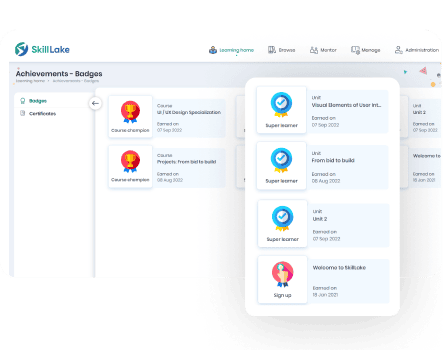
        Gamification in LMS uses game-design features in non-game settings, such as granting learners credits for completing courses or an achievement badge for passing the quiz on the first try.

        10. Cloud deployment

        Could-based systems are made available via the Internet. One can open your browser and type in the required address, eliminating the need for updates and maintenance, as the provider handles everything.

        11. Saves costs

        Remove or significantly cut learning management costs and the costs of offline instructors and physical classrooms with learning automation and remote training. 

        How can Skill Lake assist your organization?

        Skill Lake provides unique healthcare workforce solutions incorporating machine learning, artificial intelligence, and augmented and virtual reality. Our system allows you to conduct healthcare staff assessments, deliver tailored education, and address long-standing clinical workforce challenges.

        Skill Lake analyses skill gaps and promptly assigns training based on business requirements. This learning management system enables the organization to adjust training requirements in response to changes in company strategy. Skill Lake’s overall learning retention is superior to other learning frameworks. You get to assign periodic examinations and assignments by instructors and mentors to track and evaluate knowledge retention. 

        Using our LMS for healthcare is the most effective approach to training personnel on uniform regulations and system upgrades, tracking all employees, and providing individually tailored and personalized content for each of your learners. With Skill Lake, unlock your organization’s full potential today! 


        Laptop screen

        Contact our experts for a walkthrough of Skill Lake LMS.


        Ashmitha Chatterjee

        Ashmitha is a learning and development enthusiast who shares her insights on e-learning. She loves to create engaging and informative content and is dedicated to helping people learn and grow through her deep expertise in the field.

        Other Reads from Skill Lake

        • Top 10 Best LMS Software Systems for Modern Workforces

          Top 10 Best LMS Software Systems for Modern Workforces

          Scaling a business in 2026 requires scaling its workforce’s knowledge and performance readiness. Workplace dynamics have shifted and traditional employee training software doesn’t cut it anymore. Today’s market demands an AI-powered LMS that automates personalized learning journeys and delivers measurable ROI. In this LMS software comparison guide, we analyze the top 10 platforms designed to

          Read More
        • Top LMS Training Platforms for 2026: 10 Best Solutions for Corporate Learning

          Top LMS Training Platforms for 2026: 10 Best Solutions for Corporate Learning

          Legacy corporate training frameworks are failing to solve contemporary skill gaps. To build an agile, future-ready workforce, organizations need a modern corporate training LMS that drives active capability mastery. This post evaluates the top LMS training platforms for 2026 currently delivering measurable operational ROI. Top 10 LMS Training Platforms for 2026 Note: Pricing and features

          Read More
        L&D Management

        What is L&D Management?

        L&D ignites employee growth by tailoring training to unlock their full potential, aligning personal goals with the organization’s success.

        Training and development can open up new labor avenues, train individuals to thrive with new skills, and enable businesses to prosper in a new world. Organizations must provide appropriate training to develop an attitude of lifelong learning at the organizational, team, and individual levels. Employee engagement gets boosted through dedicated learning and development. A more productive, competitive, and engaged staff is imperative to your company’s financial performance.

        L&D’s strategic role benefits your organization in the following areas:

        • Attract and retain talent

          Providing professional development opportunities helps employees generate a sense of importance inside the firm and develops loyalty, resulting in higher staff retention and a 59% lower staff turnover rate. One of the primary reasons employees quit a company is the lack of proper L&D.
        • Build people capacities

          In order to keep value, human capital necessitates continuing investments in L&D. Companies who invest in the next generation of leaders get a significant return.
        • Increases job satisfaction

          Proper employee training and development should influence employee career advancement. Employees feel motivated when they believe their company is assisting them in improving their skills and knowledge base, which boosts their job satisfaction and morale.
        • Foster a value-based organizational culture

          As many firms’ workforces become increasingly virtual and geographically scattered, L&D can assist in the development of a values-based culture. Along with a feeling of community.
        • Improve employer brand

          Effective investments in L&D can help to improve a company’s brand and reputation. It is critical to strengthen your brand through an employer value proposition.

        How Strategic L&D Management Benefits Your Organization

        According to LinkedIn’s 2021 Learning Report, 83% of Gen-Z in the workplace want to learn how to do their jobs efficiently. Furthermore, 76% believe that continuous learning is essential for a successful profession. These data show that employees are looking for ways to improve their performance and add more value to the organization.

        As technology evolves and work strategies improve, organizations and employees must align knowledge, skills, values, and capabilities for a better tomorrow.

        1. Set training objectives with business strategy

        An effective learning plan attempts to support professional growth and create competencies on schedule and within budget across the organization. L&D must examine employee competencies and determine which are most critical to supporting the execution of the company’s business strategy.

        2. Identify competency gaps 

        Once organizations have identified their business priorities, they must ensure that their staff is capable of delivering. Therefore, it is critical to undertake a capability assessment planned and systematic. Companies should examine how people rate in these areas after selecting principal competencies for particular functions or job descriptions. These capability shortages should then be addressed by L&D interventions.

        Screenshot 2023 11 15 112006
        Competency Mapping on Skill Lake

        3. Create learning journeys

        Many L&D functions are shifting away from stand-alone programs in favor of building learning journeys—continuous learning opportunities that occur across time. The goals of the learning journey must be to assist people in developing the necessary competencies effectively and efficiently, as well as to facilitate the transfer of learning to the workplace.

        4. Implement and scale-up 

        It is vital to implement L&D initiatives on time and under budget to gain and maintain the support of business executives. To secure the necessary resources and support, L&D leadership must nurture an ongoing discussion with business executives about initiatives and goals.

        5. Track progress and repeat 

        Organizations should concentrate on outcome-based indicators such as employee engagement, team effectiveness, and business process advancement. Then, with areas for improvement in mind, go through the process again.

        To assist your employees in making meaningful contributions to the achievement of your company’s goals, you must go beyond simply publishing those goals. Everything your staff performs must be in line with these goals.

        How L&D Management Can Align Skills with Business Needs

        Training costs do not directly correlate to employee or company success. So, in truth, firms must be deliberate when it comes to L&D programs.

        Organizations must:

        Determine the objective of training

        Identifying the purpose of training is the first step in designing a successful staff training program. Training managers must grasp the organization’s goals completely.

        Blended Learning

        One strategy to improving workplace training is to use a mixed training approach that combines Instructor-Led Training (ILT) with regular eLearning, a form known as blended (or “hybrid”) learning.

        Monitor the progress of the training program 

        It is paramount to evaluate your training progress during the experience and as you near the end of it. As previously indicated, your learners should conduct self-assessments as part of their instruction. This self-evaluation will help them comprehend what they know, what they’ve learned, and where they need to enhance their learning.

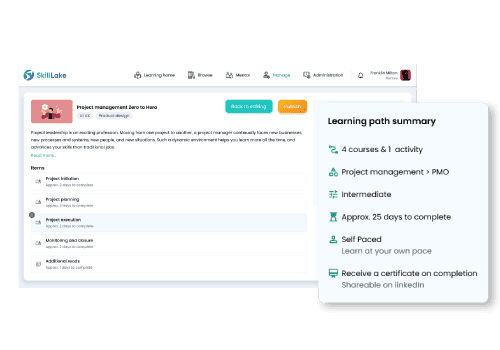
        Create learning paths 

        A well-thought-out training program will provide employees with numerous learning paths based on their existing abilities and future career ambitions. The primary goals of learning paths should be to assist people in developing the necessary skills effectively and efficiently and facilitate the transfer of learning to the workplace.

        learning
        Learning Path on Skill Lake

        Gamification and rewards

        Combine rewards, psychological recognition, and practical rewards to foster and sustain a learning culture. Your aim is for employees to see skill development as an essential part of their professional development rather than a nuisance that interferes with their actual work.

        L&D Management at Work: Tips for Building Effective Training Programs

        With so many possibilities, organizations can no longer afford to overlook people’s development. People development platforms are now at the forefront of achieving the best workforce possible. When employees get effectively trained, they can better serve your customers and provide a superior customer experience. It also shows your readiness to invest in your staff. As a result, your employees will be rewarded with increased loyalty and improved performance.

        How does Skill Lake help achieve organizational goals?

        Skill Lake enables you to grow L&D programs to meet your organization’s rising goals while staying within budget. Our system connects learning to both individual aspirations and organizational needs.

        Skill Lake provides an integrated learning management system software that aids in the resolution of large-scale corporate challenges. It boosts corporate productivity, effectiveness, and agility while also serving as a people development platform. Our solution assists in achieving total visibility throughout the workforce to spot gaps and take appropriate action. It even helps the organization navigate hurdles while fostering a holistic learning culture. Take a demo of Skill Lake LMS to learn about establishing a culture of continuous learning and growth while keeping up with the organizational goals.

        Roshna R

        Roshna is a passionate enthusiast of all things about learning and development. She has an innate flair for crafting thoughtful content and is inspiring eager minds on their learning journey.

        Other Reads from Skill Lake

        • Top 10 Best LMS Software Systems for Modern Workforces

          Top 10 Best LMS Software Systems for Modern Workforces

          Scaling a business in 2026 requires scaling its workforce’s knowledge and performance readiness. Workplace dynamics have shifted and traditional employee training software doesn’t cut it anymore. Today’s market demands an AI-powered LMS that automates personalized learning journeys and delivers measurable ROI. In this LMS software comparison guide, we analyze the top 10 platforms designed to

          Read More
        • Top LMS Training Platforms for 2026: 10 Best Solutions for Corporate Learning

          Top LMS Training Platforms for 2026: 10 Best Solutions for Corporate Learning

          Legacy corporate training frameworks are failing to solve contemporary skill gaps. To build an agile, future-ready workforce, organizations need a modern corporate training LMS that drives active capability mastery. This post evaluates the top LMS training platforms for 2026 currently delivering measurable operational ROI. Top 10 LMS Training Platforms for 2026 Note: Pricing and features

          Read More
        Choose the Perfect LMS for your Organization

        For every business to survive and thrive, it is essential to manage its resources wisely. Although many are eager to adopt new technologies, others are hesitant. Whatever your expertise or the number of employees in your company, LMS is an instrument that can significantly enhance your revenues, broaden your consumer base, and, most importantly, assist you in achieving your organizational goals. We have listed out few reasons and tips to choose the perfect LMS for your organization that must employ a learning management system.

        • Reduced expenditure of education and training – Learning management system (LMS) allows for a high degree of flexibility in attending lectures since the actual presence of the teacher and learners can be bypassed.
        • Reduced learning duration – The learner may already have gained knowledge or skills of some of the course’s subjects. In this regard, the LMS allows learners to access courses directly they intend to learn.
        • Provides centralized data storage – A learning management system helps maintain a wealth of business information and learning data in one place.
        •  Allows customization – One of the simplest and salient features of an LMS is the ability to be customized to meet your organizational needs.
        • Learners progress tracking – An LMS allows you to track learners’ progress through the course content. More specifically, you can follow their understanding of the topic, measure their engagement with the provided content, determine if it meets all of their needs, and augment it with text, audio, or video files.
        • Keeps current with updates & policies – If your organization has policies or regulations that you want your employees to be aware of, an LMS is a tool that may help you keep your workforce to stay updated more quickly and conveniently.
        • Enhances customer service – Proper employee training leads to better customer service. It is because your workforce will have all of the skills and knowledge needed to represent your brand and understand the fundamentals of customer service.

        Read more: The Essential Guide to Choosing the Best LMS for Your Organization

        7 tips to finding the perfect LMS for your organization

        Almost four out of every ten organizations in the United States that employ an LMS are dissatisfied with their LMS. According to Brandon Hall Group’s Research LMS Trends, 38% of the firms polled a system change.

        When seeking an LMS, the goal is to pick one that promises the functions and capabilities your business requires. Before narrowing down potential LMS vendors, an organization must be clear about its training requirements, expected business impact, degree of support, and budget. Aside from the features, there are several more considerations to review before making your pick.

        1. Identify your primary goals

        Set defined goals for your LMS for a better understanding of your requirements. Once you have defined your ideal LMS, it will be a lot easier to zero down an LMS that meets your needs.

        2. Consider your L&D team’s skillsets

        Knowing the personal strengths and skillsets of your L&D team will allow you to select an LMS with the functionality and creative control you desire, as well as the usability you require. 

        3. Room for growth

        Remember that your organization is not static, and neither should your LMS. Sure, the LMS you have chosen is probably a fantastic fit for your firm at the moment, but what about in a few years? There are systems available that will allow you to add users and courses as needed, giving you the freedom to extend your LMS as your business grows and expands.

        4. Implementation

        Implementation is critical when acquiring a learning management system software compatible with your organization. You would not want to spend energy figuring out how to integrate your new LMS with your existing software, and you won’t appreciate choosing something that will be arduous for employees to use. 

        5. Support services offered

        Does the LMS offer round-the-clock support? Will they be able to troubleshoot any issues you may have with the LMS in the future? Enquire with the LMS vendor about the support services included with your LMS package to ensure that you have access to the assistance you require to make the most of your new LMS. 

        6. Adaptability and upkeep

        An LMS may match all of your objectives in terms of features and technical specifications, but you will also need to consider your long-term LMS strategy. Is the LMS simple to maintain if it needs to be updated frequently?  Will it be able to adapt to your organization’s requirements in the future? You don’t want to spend your budget on a new LMS to learn that it won’t meet your corporation’s L&D objectives a year from now. 

        7. Curation and creation of content

        A solid LMS should also assist the firm in managing, producing, and curating material for the benefit of its learners. When comparing LMS platforms, look for a solution that allows you to develop the material, capture information, and transfer expertise within your organization.

        Choosing an LMS can be tedious, but following these 7 tips will make the process much easier. In addition, keeping all of these helpful hints in mind will save you costly trial-and-error.  

        Read more: The Ultimate Guide To Online Employee Training

        Get the best LMS for effective employee training

        Invest in an LMS that contributes to the long-term success of your organization rather than merely addressing short-term issues. Be sure your organization and workforce are expected to change in the months and years ahead.

        Skill Lake delivers an integrated learning management system that helps navigate business challenges at scale. It improves organizational productivity, effectiveness, and adaptability while being a people development platform at its core. Skill Lake empowers businesses to generate an employee-centric learning culture where learning occurs holistically, promotes efficacious learning, and assists organizations in realizing their goals.

        Skill Lake offers interactive learning (live webinars), instant feedback (guided tests), self-paced learning, gamification, and other interesting features. Skill Lake is a dynamic product that is constantly evolving to meet the sensitivities of current and future generations. Redefine your learning for tomorrow’s workforce with Skill Lake.

        We hope this gives plenty of food for thought when choosing an LMS for your organization. If you want to dig deep on how Skill Lake can help your business, simply request a demo and we’ll get back to you soon.

        Alphons Xavier

        Alphons is a seasoned HR professional with a specialized focus on talent management and development. With a particular expertise in learning and development, Alphons excels in designing and executing tailored L&D activities that align with the organization's objectives. Driven by a strategic mindset and a passion for fostering continuous learning cultures, Alphons is dedicated to instigating behavioral and cultural shifts within the organization. She collaborates closely with business leaders to identify areas for improvement and develops innovative strategies to bring about meaningful change.

        Other Reads from Skill Lake

        • Top 10 Best LMS Software Systems for Modern Workforces

          Top 10 Best LMS Software Systems for Modern Workforces

          Scaling a business in 2026 requires scaling its workforce’s knowledge and performance readiness. Workplace dynamics have shifted and traditional employee training software doesn’t cut it anymore. Today’s market demands an AI-powered LMS that automates personalized learning journeys and delivers measurable ROI. In this LMS software comparison guide, we analyze the top 10 platforms designed to

          Read More
        • Top LMS Training Platforms for 2026: 10 Best Solutions for Corporate Learning

          Top LMS Training Platforms for 2026: 10 Best Solutions for Corporate Learning

          Legacy corporate training frameworks are failing to solve contemporary skill gaps. To build an agile, future-ready workforce, organizations need a modern corporate training LMS that drives active capability mastery. This post evaluates the top LMS training platforms for 2026 currently delivering measurable operational ROI. Top 10 LMS Training Platforms for 2026 Note: Pricing and features

          Read More
        AR VR in eLearning

        Online learning, also referred to as eLearning, has grown significantly in the recent decade as the internet and education have merged to give individuals the option to acquire new skills. In the wake of the COVID-19 pandemic, people’s lives have centered around online learning. The pandemic has prompted organizations to use remote working, which has increased online learning through learning management systems.

        But what precisely is a Learning Management System? A Learning Management System (LMS) is a platform for tracking and managing employee training and development through self-directed learning, mandated training courses, or regular evaluations.

        The Impact of AR VR in eLearning on the Corporate Learning Landscape

        eLearning is a trend that is positively improving corporate training. Employees profit from eLearning to satisfy their training obligations. According to today’s savvy corporate managers and executives, online training is beneficial to businesses of all sizes and industries. Moreover, a new marketplace for eLearning tools is emerging. Corporate leaders have started grasping that instead of creating courses that need page-turning, they must provide ‘learning on demand’ – comprising methods for delivering adaptive, online education, systems for assessing learning, and identifying skill gaps.

        A rundown of the top trends that indicate the future of eLearning.

        • Learning in the flow


          One of the predominant challenges of corporate training is translating training into practical work. Employees are on their own to apply what they learn in training to their tasks without a manager or mentor looking over their shoulder to provide guidance, which is where learning in the flow comes into play. Learning in the flow helps to provide information about a skill to employees in real-time on the job using AI, chatbots, and integrations with other systems.
        • Adaptive Learning


          Adaptive learning is a type of training in which materials, exercises, projects, and assignments get adapted to the specific requirements of each student. In the context of eLearning, adaptive learning will be implemented by defined algorithms and assessments rather than possibly arbitrary decisions made by teachers. Adaptive learning will reach new heights in the coming years when it gets linked with artificial intelligence.
        • Social Learning


          Social learning applies the fundamentals of human interaction and group dynamics to the present age of technology. Because of online forums and file-sharing platforms, digital collaboration has never been more productive and efficient. With social learning, colleagues can provide insight and assistance from anywhere.

        • Gamification


          Gamification in eLearning is a new phenomenon that entails using gaming mechanics to engage the audience in the learning process. With gamification in LMS, 83% of workers are more motivated to complete their objectives. By 2025, revenue from game-based learning may increase to $28.8 billion worldwide. 

        gamification 3
        Gamification on Skill Lake
        • Learning Analytics

          Learning analytics is a crucial aspect that drives eLearning trends. Given the future of artificial intelligence, having actionable insights and understanding the components necessary to measure the performance of your learners is critical. The more knowledge you inherit, the better insights will be.
        • Microlearning

          Tailor-made to individual skill requirements, microlearning provides a more agile and cost-effective approach to staff training. Thanks to the mobile revolution. More learners are turning to microlearning as their preferred mode. Microlearning will also enable students to choose and use courses relevant to their requirements. The student-driven approach boosts learner engagement and improves training and work efficiency.
        • Big Data

          In the eLearning sector, big data gets generated when students enroll in an eLearning course or training module. Big data will have a significant influence on eLearning. First and foremost, it will influence by collecting and analyzing learner’s steps. It can be perceived if they make mistakes or are learning inadequately. Following this, one can propose improvements to rectify the situation as an aid. Learners’ demands are evolving, necessitating more individualized attention. eLearning will require a firm grasp of big data analytics to deliver a tailored learning environment.

        As the eLearning market expands, it’s vital to pay close attention to these new changes – rethink your training programs and re-evaluate your strategy to account for the changing demands of your learners, particularly during times of uncertainty.

        Read more: The Essential Guide to Choosing the Best LMS for Your Organization

        How AR and VR in eLearning Platforms are Transforming Training

        Artificial Intelligence has risen in the eLearning industry, just as it has in any other field.

        The last five years have seen significant advances in VR and AR in LMS for training. Instructional designers can now create real-life and interactive learning experiences by incorporating virtual surroundings and circumstances into eLearning. A simulated office environment or job role scenarios now aid in developing real-world expertise for the workforce. Using virtual reality, they may also engage with what they encounter on the job, such as sales terminals, machines, and safety equipment. 

        Currently, AI is playing a critical role in gathering and analyzing data from LMS systems, such as learners’ strengths, shortcomings, interests, and competency. The learning paths of users may be studied and examined in great detail with the aid of AI. Corporations and large enterprises utilize AI to create voice-enabled bots to help search for content. It will make it easier for students to find the courses they want and enhance their learning experience.

        Practical Ways for Using AR VR in eLearning

        1. Enhanced Online Training Simulations  

        AR and VR are being used in online compliance safety training simulations, allowing learners to enter a virtual learning environment and interact with virtual components in real-life scenarios to avoid workplace accidents and injuries. For example, you can run a compliance safety scenario simulation and see how your learners perform.

        2. Advanced Learning Analytics

        Collecting data in eLearning has never been easy, thanks to AR/VR technology. It is now possible to track learners’ eye contact to determine their interest in the training program, assisting in courses that more accurately evaluate learner engagement and use it to create a learner-worthy course.

        3. eLearning Assessments with Visual Feedback

        VR technologies encourage the use of branching scenarios, online simulations, and other forms of assessment to improve evaluation. When your students miss a stage in a procedure, they may be shown how to do it right and repeat the exam later, leaving no space for uncertainties or misconceptions.

        4. Immersive Gamification in eLearning Courses

        Using AR and VR technology, your learners may earn tangible badges and awards and literally progress up leader boards, enabling learners to engage with points and badges and even touch them in their hands.

        5. Customized Learning Paths

        AR and VR can allow learners to walk down a learning path and engage with learning resources, allowing the learner to select courses and activities that focus on decision-making skills improvement.

        These are just five of the various options for introducing AR and VR into eLearning. You can also choose from virtual walkthroughs of your workplace, interactive product demos, virtual case studies, problem-centric scenario-based learning, and more. While augmented and virtual reality may seem out of reach for many as of now. With recent advancements in AR and VR, these immersive learning experiences will be open to all. By 2030, VR and AR will be used to enhance 23 million jobs, resulting in a £1.4 trillion boost to the world economy. 

        learning
        Custom Learning Path on Skill Lake

        Elevate eLearning to new heights with the right LMS

        Choosing a suitable LMS allows the employer to document, track, administer, and deliver training courses for their employees at the appropriate time. In addition, it helps to grow a business’ learning culture and identify training needs.

        Skill Lake is a one-of-a-kind LMS platform with all the tools you need to engage learners and foster a holistic learning culture. Our goal is to be a creative partner who recognizes demands and provides solutions and systems to assist corporations to new heights. Skill Lake provides clients with future concepts such as learning analytics, microlearning, and gamification. Our system has evolved to keep up with shifting trends and be interoperable with all the latest tech. 

        To know more about Skill Lake and its exclusive features, sign up now and discover how to lead your workforce into the future.

        Roshna R

        Roshna is a passionate enthusiast of all things about learning and development. She has an innate flair for crafting thoughtful content and is inspiring eager minds on their learning journey.

        Other Reads from Skill Lake

        • Top 10 Best LMS Software Systems for Modern Workforces

          Top 10 Best LMS Software Systems for Modern Workforces

          Scaling a business in 2026 requires scaling its workforce’s knowledge and performance readiness. Workplace dynamics have shifted and traditional employee training software doesn’t cut it anymore. Today’s market demands an AI-powered LMS that automates personalized learning journeys and delivers measurable ROI. In this LMS software comparison guide, we analyze the top 10 platforms designed to

          Read More
        • Top LMS Training Platforms for 2026: 10 Best Solutions for Corporate Learning

          Top LMS Training Platforms for 2026: 10 Best Solutions for Corporate Learning

          Legacy corporate training frameworks are failing to solve contemporary skill gaps. To build an agile, future-ready workforce, organizations need a modern corporate training LMS that drives active capability mastery. This post evaluates the top LMS training platforms for 2026 currently delivering measurable operational ROI. Top 10 LMS Training Platforms for 2026 Note: Pricing and features

          Read More
        Online Employee Training

        The Challenges of Traditional Employee Training

        When it comes to allocating training resources, most organizations stress enhancing the effectiveness of the training. Despite careful resource allocation, many organizations find their training ineffective to reach their objectives. No organization is immune to training issues, similarly as no two firms will confront the same set of roadblocks. The obstacles that any L&D team faces alter as the company’s size and growth accelerate. Regardless, studies have identified characteristics in practically all organizations. These include:

        • Information Overload – Generally, the priority for any organization after hiring the right employee is to get them on board. Unfortunately, what they end up doing instead is flooding them with too much material from the start of a training session and expecting their staff to understand it all. Employees may become overwhelmed, disconnected from training, and abandon the organization.
        • Lack of Engagement – The significance of employee engagement includes cognitive, emotional, and behavioral engagement. Without these three, poor information retention, passive learning, and a lack of conviction all contribute to challenges.
        • Feedback and Support – According to Forbes, employees who believe their opinions are heard perform 4.6 times better. Furthermore, HR leaders feel that regular peer input and frequent check-ins are critical for organizational success.
        • Inconsistent training – When a company is multinational or geographically spread, offering continuous training becomes more difficult. Geographic limits, language obstacles, translation issues, and virtual training are pain points to consider.
        • Learning ineffectiveness – It is imperative that training takes place successfully. There are numerous topics to cover, and many necessitate specific delivery methods for solid skill development. When organizing any training session, it is critical to ask the correct questions and establish the desired results.
        • Costs – As funds get slashed year after year, corporate trainers adapt to accomplish more with less. Total costs not considered will make organizations cut corners affecting the whole L&D.

        Online Employee Training: Easing Organizational Stress

        Online employee training saves your organization money and time compared to other methods and does a lot more. If you’re putting together a case for online training, consider the following key advantages for your workforce and organization:

        • Flexibility and self-paced learning – Online training courses are available at any time and from any location. The only prerequisite would be access to stable internet.
        • Mobility – Earlier online training had hassles of a typical registration procedure, followed by a user log-in page. But now that browsers are compatible on phones, tablets, and laptops, online courses are no longer limited to desktops; and are designed to work on all sorts of devices.
        • Accessibility – Employees learn better and quicker when they have access to downloadable online notes, online assistance, online engagement, training materials that support replaying, and assessments/quizzes at any time during the course. It is available 24 hours for an increasingly global and remote workforce. Your workforce may access training whenever there is time and capacity to do so, regardless of where your employees are.
        • Access to Updated Content – A major benefit of online training is that it keeps you in sync with the current learners, allowing access to updated information whenever they desire.
        • Quick delivery of content – Online training is a method of delivering education quickly. This mode has relatively short delivery cycles as compared to standard classroom teaching methods. The time necessary to study is decreased by 25% to 60% of that in traditional learning.
        • Increased consistency – Online training allows mentors to obtain greater coverage when transmitting the message to their target audience, i.e., your workforce, in a consistent manner.
        • Ongoing access to resources – Training allows employees to access reference resources such as new product specs or updated specs immediately when they need them. 
        • Risk-free environment – One of the most significant disadvantages of instructor-led group training is that some employees will resist participating in the class out of fear of failing. Employees can go wrong in a safe setting while using online learning tools.
        • Timely feedback – Traditional training methods required the management to devote significant effort in grading tests and responding to employee queries. Employees frequently need to wait for feedback to accomplish their tasks appropriately. With online learning, you can say goodbye to this forever.

        Assigning to do list to learners 18

        Drive Organizational Success with Skill Lake’s Online Employee Training Platform

        The success of your organization following Covid-19, and the development of your organization, is dependent on concerted efforts to reinvent your workplace conditions through people development and training. You will flourish by empowering great leaders and supporting your workforce through training and development as you adapt and reinvent your operational methods.

        Skill Lake provides you with: 

        • Multiple Learning Modes
        • Content Authoring Tools
        • Library, Learner Dashboard & User Management
        • Enterprise IT Readiness
        • Gamification

        Skill Lake enables organizations to establish an employee-centric learning culture in which learning occurs holistically. The product essentially supports participatory learning across hierarchies where training is not limited to functional skills alone but towards life/soft skills that improve the career prospects of your workforce. Skill Lake makes it easy to deliver self-paced learning, instructor-led programs, or a mix of the two. Our system can help customize your brand, enhance the organizational structure and processes, and interface with existing apps. The system also aids in tracking top and average performers, all of which contribute to improving growth in your organization. With Skill Lake, drive your growth with integrated learning and training. 

        To know more about Skill Lake and how to get started with it, reach out to our experts.

        Alphons Xavier

        Alphons is a seasoned HR professional with a specialized focus on talent management and development. With a particular expertise in learning and development, Alphons excels in designing and executing tailored L&D activities that align with the organization's objectives. Driven by a strategic mindset and a passion for fostering continuous learning cultures, Alphons is dedicated to instigating behavioral and cultural shifts within the organization. She collaborates closely with business leaders to identify areas for improvement and develops innovative strategies to bring about meaningful change.

        Other Reads from Skill Lake

        • Top 10 Best LMS Software Systems for Modern Workforces

          Top 10 Best LMS Software Systems for Modern Workforces

          Scaling a business in 2026 requires scaling its workforce’s knowledge and performance readiness. Workplace dynamics have shifted and traditional employee training software doesn’t cut it anymore. Today’s market demands an AI-powered LMS that automates personalized learning journeys and delivers measurable ROI. In this LMS software comparison guide, we analyze the top 10 platforms designed to

          Read More
        • Top LMS Training Platforms for 2026: 10 Best Solutions for Corporate Learning

          Top LMS Training Platforms for 2026: 10 Best Solutions for Corporate Learning

          Legacy corporate training frameworks are failing to solve contemporary skill gaps. To build an agile, future-ready workforce, organizations need a modern corporate training LMS that drives active capability mastery. This post evaluates the top LMS training platforms for 2026 currently delivering measurable operational ROI. Top 10 LMS Training Platforms for 2026 Note: Pricing and features

          Read More

        Posts navigation

        Older posts
        Newer posts

        Solutions

        • Learning Management System
        • LMS Mobile App
        • Learning & Development Platform
        • People Development Platform
        • Corporate Training Platform
        • Training Management System
        • Content Creation
        • Learning Experience Platform
        • Performance Review System

        Industries

        • Info Tech
        • Manufacturing
        • Hospitality
        • Insurance
        • Automotive
        • Telecom
        • Restaurant


        • Construction
        • Non-Profit
        • Energy
        • Retail
        • Franchise
        • Healthcare

        Resources

        • What is an LMS?
        • Case Studies
        • Blogs
        • Help
        • Use Cases
        • Videos
        • Downloads
        • Release Notes

        Company

        • About Us
        • Partners
        • Contact Us
        • Terms of Use
        • Privacy Policy
        alternet text alternet text alternet text alternet text

        © 2026 Skill Lake | All rights reserved. Skill Lake is developed and supported by Fingent.