Skip to content
Logo
search
  • Features
    • Overview
    • AI Role Play
    • Content Authoring Tools
    • AI Course Generator
    • SCORM Compliant LMS
    • Integrations
    • Pre-Loaded Courses
  • Solutions
    • Learning Management System
    • LMS Mobile App
    • Learning And Development Platform
    • Learning Experience Platform
    • People Development Platform
    • Corporate Training Platform
    • Training Management System
    • Content Creation Services
    • Performance Review System
  • Resources
    • Case Studies
    • Blogs
    • Help
    • Use Cases
    • videos
    • Downloads
    • Release Notes
  • Industries
    • Info Tech
    • Construction
    • Manufacturing
    • Non-Profit
    • Hospitality
    • Energy
    • Insurance
    • Retail
    • Automotive
    • Franchise
    • Telecom
    • Healthcare
    • Restaurant
  • Pricing
  • Company
    • Partners
    • About Us
  • Contact Us
  • search
  • Request A Demo
×
  • Features
    • Overview
    • AI Role Play
    • Content Authoring Tools
    • AI Course Generator
    • SCORM Compliant LMS
    • Integrations
    • Pre-Loaded Courses
  • Solutions
    • Learning Management System
    • LMS Mobile App
    • Learning And Development Platform
    • Learning Experience Platform
    • People Development Platform
    • Corporate Training Platform
    • Training Management System
    • Content Creation Services
    • Performance Review System
  • Resources
    • Case Studies
    • Blogs
    • Help
    • Use Cases
    • videos
    • Downloads
    • Release Notes
  • Industries
    • Info Tech
    • Construction
    • Manufacturing
    • Non-Profit
    • Hospitality
    • Energy
    • Insurance
    • Retail
    • Automotive
    • Franchise
    • Telecom
    • Healthcare
    • Restaurant
  • Pricing
  • Company
    • Partners
    • About Us
  • Contact Us
  • search
  • Request A Demo

Category: Blogs

LMS Software

Business approaches to employee training have evolved along with their continued evolution in the digital world. The demands of contemporary business cannot be met by traditional learning management techniques. For a few years, an effective LMS has been the foundation of corporate training. But now, with advances in technology, AI powered LMS is gaining more traction and proving to be more beneficial for corporate training, enabling a streamlined platform for organizing, monitoring, and distributing training materials.

Artificial Intelligence’s (AI) Increasing Contribution to Workplace Education

Even though the majority of businesses invest in AI, only 1% believe the technology is mature, according to McKinsey studies and research. In the next three years, more than 92% of businesses intend to raise their AI budget.

The workplace learning environment has completely changed as a result of AI’s incorporation into LMS software. By 2026, AI-powered learning management systems will transform learning experiences.

AI greatly impacts employees’ workplace experiences and improves workplace engagement and satisfaction. AI powered LMSs assist in providing employees with tailored feedback to enhance their abilities.

Additionally, hiring and onboarding procedures can be streamlined in HR by utilizing Gen AI. Personalized learning improves employee engagement and fosters a positive work environment.

Let’s examine how learning is being revolutionized in 2026 by AI-powered learning management systems.

Personalization of Learning Paths

Personalization is one of the biggest trends driving the evolution of LMS software. In traditional LMS platforms, training programs often deliver the same content to all. This approach resulted in disengaged learners and wasted resources.

AI has solved this by enabling LMS software to create personalized learning paths. AI helps analyze employees’ learning histories and preferences and suggests required training modules. This personalized learning experience improves engagement and increases knowledge retention.

Advanced Analytics and Predictive Insights

Advanced analytics and predictive insights are two of the most powerful features of AI powered LMSs. These LMSs enhance the learning journey by providing actionable insights into employee learning behavior.

With these specific patterns and predictive insights, businesses can identify potential skill gaps or improvement areas quickly. This helps businesses make data-driven decisions and enhance training effectiveness.

AI-Powered Content Development

Another major benefit of AI-driven LMS is that it can create relevant learning content. Due to the large amount of online data, finding the right resource is not easy. AI can simplify this process by creating content that meets employees’ learning path development needs.

For example, an AI powered LMS like Skill Lake can suggest videos, eBooks, and other multimedia resources. AI can suggest relevant industry content to keep employees updated in their domain. By delivering targeted content, AI makes learning more engaging and impactful.

Real-Time Feedback and Dynamic Evaluations

Traditional training methods often depend on static evaluations that offer limited feedback. Employees may get results but not get much insight into their strengths.

This can prevent learning and hinder employees from understanding their focus areas. AI powered LMS software addresses this issue by providing real-time feedback during training.

AI can identify patterns in employees’ performance and offer dynamic and continuous real-time feedback. This feedback enables employees to adjust their learning methods in real-time.

AI powered LMS can create adaptive assessments that change based on an employee’s performance. If a learner demonstrates interest in a particular area, the assessment can suggest more advanced topics.

Enhancing Engagement with Gamification

Employee engagement is also a big challenge in corporate learning. Traditional training may lead to minimal information retention. AI powered LMS like Skill Lake utilizes gamification to make learning more engaging and interactive.

Modern LMS like Skill Lake can easily keep employees motivated with intuitive features like badges, rewards, and leaderboards. Such innovations fuel friendly competition and boost engagement among employees, enhancing learning outcomes.

Improved interaction with Natural Language Processing (NLP) Techniques

Practical applications of NLP in LMS systems can be revolutionary. NLP allows more interaction with users, thus enabling employees to have more sophisticated, intuitive learning sessions. Employees have the ability to talk to the system using Natural language for clarification or inquiry.

An employee can pose a query like, “When do I need to renew my certificate?” ‘’Are there any suggestions for a leadership development course?’’ With an NLP system configured with the proper logic, it will respond using Natural Language Processing to accurately understand the question and respond to it correctly. It ensures employees are able to receive the information they require in a responsive manner.

Social and Collaborative Learning

It is not just about training; it is about collaboration and knowledge sharing among employees. An LMS can identify employees with similar skills and recommend collaboration opportunities. It increases engagement knowledge sharing, and creates a more connected learning environment.

Conclusion

Of course, AI powered LMS is reshaping the future of learning! Whether be it to add personalization to the learning journey or bring convenience in training management, AI is enhancing organization capabilities to drive successful outcomes.

A modern LMS like Skill Lake simplifies the learning journey with AI course recommendation and AI content generation abilities. Explore Skill Lake’s AI capabilities today and discover how it enhance learning paths and improves personalization, training efficiency, and knowledge retention rate. Request a Free Demo today!

Aarathy Jayakrishnan

Aarathy is an e-learning professional and enthusiast with a keen understanding of learning and development concepts. She writes insightful content, unraveling the possibilities that e-learning holds, and strives to make education open for all.

Other Reads from Skill Lake

  • Top LMS Training Platforms for 2026: 10 Best Solutions for Corporate Learning

    Top LMS Training Platforms for 2026: 10 Best Solutions for Corporate Learning

    Legacy corporate training frameworks are failing to solve contemporary skill gaps. To build an agile, future-ready workforce, organizations need a modern corporate training LMS that drives active capability mastery. This post evaluates the top LMS training platforms for 2026 currently delivering measurable operational ROI. Top 10 LMS Training Platforms for 2026 Note: Pricing and features

    Read More
  • How AI Simulation Training in LMS Prepares Teams for Real-World Scenarios

    How AI Simulation Training in LMS Prepares Teams for Real-World Scenarios

    Traditional corporate training methods often fall short when preparing employees for high-stakes, real-world challenges. Today’s business landscape demands a drastic shift from passive consumption to active mastery. This is why forward-thinking business leaders are adopting simulation-based learning in LMS to bridge the gap between theory and execution. By integrating advanced AI role play training, organizations

    Read More

    Stay up to date on the latest in HR and L&D


    Highlights of Skill Lake

    • AI/ML Powered Course Recommendations
    • Courses with AR/VR Experiences
    • Competency & Course Management
    • Multiple Learning Modes
    • Mentoring & Feedback
    • Gamification
    • Learning Bytes
    • Mobile App
    • SCORM Compliance
    REQUEST A DEMO

    Highlights of Skill Lake

    • Sell-Paced & Instructor-Led Learning
    • Tracking & Reporting
    • Mentoring
    • Gamification
    • Learner Dashboard
    • Course Library
    • Enterprise IT Ready

      [recaptcha]

      Highlights of Skill Lake

      • AI/ML Powered Course Recommendations
      • Courses with AR/VR Experiences
      • Competency & Course Management
      • Multiple Learning Modes
      • Mentoring & Feedback
      • Gamification
      • Learning Bytes
      • Mobile App
      • SCORM Compliance
      • Multi-Cloud Hosting

        Watch Skill Lake in Action!

        REQUEST A DEMO

        hospitality LMS software

        There has always been competition in the hospitality sector. Among the most significant issues are rising expenses, irregularities, and employee turnover. Managing and keeping a talented and skilled workforce is a challenge for even businesses with a turnover rate of over 70%. Can an LMS for hospitality improve employee onboarding and address these problems? You’ll learn everything you need to know from this blog!

        Traditional methods of employee training are no longer successful in upskilling, empowering, and engaging employees. One-module-fits-all is not relevant in today’s customer-focused environment. Hospitality LMS software is becoming inevitable for hospitality firms today, enabling easy course assignments, quick performance tracking, effective training management, and more. Modern AI-powered LMS combines role-based models and on-the-job training for skill development.

        The Learning Management System revolutionizes how workers are onboarded, trained, and managed. Here’s a deeper dive into how LMS for Hospitality is transforming employee onboarding!

        Importance Of Employee Onboarding In Hospitality

        It is not ideal to choose a formal onboarding program for new hires. It may result in increased employee turnover, disengagement, and lower productivity. On the other hand, a positive onboarding experience makes employees 69% more likely to stay for three years or more.

        Employee onboarding in hospitality is vital for setting goals to achieve success. A strong onboarding process helps employees feel confident and deliver exceptional service. It also helps reduce turnover by ensuring employees feel supported in their roles. Proper onboarding can set a positive tone, boost morale, and enhance guest experiences. This is key in the competitive hospitality industry.

        Top Employee Onboarding Challenges in Hospitality

        The hospitality industry faces several challenges in training employees. Let’s check employee onboarding challenges for the hospitality sector:

        • Service excellence & soft skills
        • High employee turnover
        • Diverse workforce & learning needs
        • Compliance & safety training

        Challenges That LMS Solves in Hospitality Onboarding

        Streamlining Onboarding with Digital Access

        When companies use traditional onboarding approaches, they need to schedule many meetings, extended paperwork, and instructor-led training sessions. It negatively impacts organizational productivity.

        New employees using an LMS for hospitality can access their onboarding content anytime and anywhere. A hospitality LMS can help them access their training sessions without difficulty. The accessibility feature for training materials enhances operational flow while minimizing HR team administrative responsibilities. The LMS systems contribute to time reduction and establish better training environments for new employees, which results in enhanced operational efficiency.

        Reducing Training Time and Costs

        The implementation of traditional onboarding creates two major obstacles: timing and expenses. Trainers dedicate themselves to providing one-on-one training periods to all new employees as a requirement of in-person training. Training duration becomes longer, and organizational expenses grow higher when this approach is used.

        On-screen access to training materials enables organizations to diminish traditional on-site workforce training requirements. An LMS makes it possible to decrease expenses associated with training costs and printed materials. Hospitality organizations can implement high-quality training standards as LMS programs can provide uniform training experiences.

        Personalized Learning Paths

        Individual organizational requirements along with personal learning preferences makes one-size-fits-all training ineffective. When training for new hires is not efficient, it leads to poor performance and worker dissatisfaction.

        Through LMS for Hospitality software, staff members can follow their own customized learning paths. This method of training delivery suits the needs of employees performing specific roles in each department. Customized training helps organizations transform their workforce into seasonally skilled and effective professionals.

        Real-Time Tracking

        Tracking employee progress during onboarding is vital for identifying knowledge gaps. In traditional methods, manual tracking often creates errors and inefficiency. It leads to inconsistencies in progress reporting.

        Hospitality LMS software allows managers to track employee progress in real time. It provides them instant access to performance metrics and improvement areas. With this data, businesses can address the issues before the time.

        Engaging Training Content

        Conventional training techniques, like using printed manuals, can get boring. Employee disengagement could result from it as well. Training in the hospitality sector needs to be dynamic and interesting.

        Businesses can incorporate different kinds of interesting content, such as interactive modules and videos, using an LMS. It increases training engagement, which enhances memory of the material. Additionally, it fosters a culture of ongoing learning and raises employee retention rates.

        Easy Scalability

        As hospitality businesses grow and expand, the onboarding process should be enhanced. An LMS offers scalability that ensures consistency in training across all team locations to teams. Regardless of location, new employees can receive the same training experience. The scalability of an LMS helps businesses maintain a standardized training process.

        Continuous Learning Beyond Onboarding

        The first step in an employee’s journey is onboarding. Ongoing education is crucial to employee success and development, and opportunities for ongoing learning enhance employee retention.

        An LMS serves as a useful instrument for continuous training. LMS ensures that staff members keep improving their abilities, whether through leadership development or customer service training. Employee engagement and motivation are maintained through regular access to fresh training materials. As a result, they become competent and prepared to handle the rigors of their positions.

        Conclusion

        Employee onboarding is an essential element of the hospitality industry. However, traditional methods are costly, time-consuming, and ineffective. Integrating hospitality LMS software like Skill Lake can be the best bet to overcome these challenges.

        Such LMS software helps in the onboarding process and reduces training times. An LMS helps in creating engaging and personalized training programs, improving employee satisfaction and performance.

        Businesses should adopt an LMS for employee onboarding to reduce employee turnover. The future of hospitality training is digital, and LMS solutions are a tool for thriving in this ever-evolving industry.

        Skill Lake is the best LMS for the hospitality industry. The AI-powered LMS goes beyond outdated or traditional training methods. It offers personalized and data-driven training to boost employee engagement and development. Now, it is the time to rethink your workforce development to build a future-ready and skilled team.

        No more traditional training methods! Skill Lake LMS can streamline your onboarding and training. Get started today!


        Aarathy Jayakrishnan

        Aarathy is an e-learning professional and enthusiast with a keen understanding of learning and development concepts. She writes insightful content, unraveling the possibilities that e-learning holds, and strives to make education open for all.

        Other Reads from Skill Lake

        • Top LMS Training Platforms for 2026: 10 Best Solutions for Corporate Learning

          Top LMS Training Platforms for 2026: 10 Best Solutions for Corporate Learning

          Legacy corporate training frameworks are failing to solve contemporary skill gaps. To build an agile, future-ready workforce, organizations need a modern corporate training LMS that drives active capability mastery. This post evaluates the top LMS training platforms for 2026 currently delivering measurable operational ROI. Top 10 LMS Training Platforms for 2026 Note: Pricing and features

          Read More
        • How AI Simulation Training in LMS Prepares Teams for Real-World Scenarios

          How AI Simulation Training in LMS Prepares Teams for Real-World Scenarios

          Traditional corporate training methods often fall short when preparing employees for high-stakes, real-world challenges. Today’s business landscape demands a drastic shift from passive consumption to active mastery. This is why forward-thinking business leaders are adopting simulation-based learning in LMS to bridge the gap between theory and execution. By integrating advanced AI role play training, organizations

          Read More
        best LMS for small companies

        Employee training needs are epic, no matter whether you run a small or large business. Companies that provide employees with ongoing learning opportunities enjoy higher retention. 88% of SMBs are retaining their top-tier talent by delivering continuous employee training. Achieving this goal requires adopting the best LMS for small businesses. Today’s corporate LMS market is profuse with a vast array of options. From this extensive platter, how can you choose the best LMS for small companies?
        If your startup or small business is planning to make an LMS investment, this piece is for you. In this blog, our LMS expert discusses how to evaluate and implement the best LMS for your small company.

        7 Steps to Note When Picking the Best LMS for Small Businesses

        The very thought of selecting an LMS could swamp you with a horde of considerations. Here, we have summed up the most relevant aspects into seven easy steps.

        Step 1: Define Your Company’s Training Needs

        The first step is to analyze and determine your organization’s specific training requirements. Find out what skills your team lacks and what you need them to gain through training. Understand your employees’ learning preferences, needs, and interests. This will help define the goals and objectives of your training initiatives. Also, consider the size of your team and the different formats/ modes of training required.

        Step 2: Review the Available LMS Options

        Next, you need to scrutinize the different LMS solutions available in the market. Review each tool’s usability, functionality, features, and web and mobile compatibility. Also, look for aspects such as customization, pricing, scalability, and integration with existing systems. If you have any platform-specific requirements, consider the same when evaluating the vendors.

        Step 3: Test Each LMS With a Free Trial or Demo

        Following the review and research phase, shortlist potential LMS providers. Shortlisting vendors can ease your decision-making process. At this juncture, try to engage in product demos offered by the LMS vendors. Use free trials to get hands-on experience with the LMS platforms. Review the usability and functionality of each LMS. Seek feedback from current users to gauge the effectiveness of each platform.

        Step 4: Compare and Make Your Choice

        Create a comparison chart of shortlisted LMS options. Analyze the advantages and drawbacks of each LMS. Compare the findings with your business demands and user opinion. Find out how far each vendor can help you with customization. Make an informed decision on the best LMS for your organization.

        Step 5: Map Out the LMS Implementation Plan

        You can get started with the implementation plan once you have selected a suitable Learning management system software. During the process, you need to configure the LMS, upload or migrate content, and create user accounts. Set up a realistic timeline for the LMS rollout. Assign roles and responsibilities within your company to manage the implementation smoothly. Ensure the LMS integrates well with your existing business applications.

        Step 6: Train and Support All Users

        User training is essential for hassle-free LMS adoption and utilization. Chart a training plan for your team members without affecting their working shifts. It helps them get used to the LMS in no time. Provide ongoing support and resources for LMS users within your organization. Seek their feedback and reviews to improve the training experience.

        Step 7: Oversee and Optimize Training Process and Outcomes

        Regular monitoring and gathering of user feedback are essential to determine the effectiveness of the LMS. It allows you to make changes and adapt training to suit the growing demands. Define metrics to gauge the effectiveness of the LMS. Review user engagement and training outcomes periodically to optimize the learning experience.

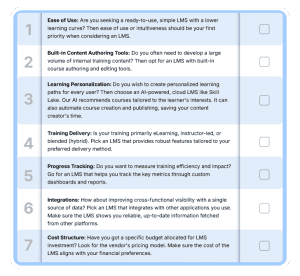
        10-Step LMS Implementation Checklist for Small Businesses

        Treat this checklist as a structured template for your LMS rollout plan. The checklist details the critical milestones you must achieve while implementing your LMS. Simply check off each step as you complete it.

        Checklist for Small Businesses

        It’s Time to Plan LMS Implementation

        The Future of AI and Mobile learning in your LMS

        The best LMS solutions available today including Skill Lake extend beyond course hosting. They combine AI to provide smart course recommendations, personalized learning journeys, and access to mobile applications that are convenient to your lifestyle as a team. Think about a LMS that delivers to your employees at where they work (office or on-the-go), anywhere, to better engagement and retention.

        Many small businesses experience resource limitations when it comes to scaling internal training. Choosing a flexible and scalable LMS enables you to:

        The best LMS for small companies helps nurture a skilled and responsive workforce that propels your business forward. Skill Lake is a leading AI-powered LMS designed for businesses of all sizes and natures. We help businesses foster a culture of continuous learning and improvement through effective end-to-end training management. Get your learning hub up and running immediately with Skill lake. Contact us to discuss and discover how Skill Lake can augment your employee training efforts.

        Maximizing ROI: The Way to Grow Small Business with the Right LMS

        LMS is not only the tool but also a strategic resource. When choosing an LMS that is automated using AI and allows mobile access, small businesses can achieve a lower training price, faster onboarding, and improved employee performance. The advanced analytics and reporting in Skill Lake will allow you to keep track of progress and optimize the learning results, transforming training into quantifiable business returns.

        Real Success Stories: How Small Businesses Succeed with Skill Lake LMS

        The selection of the appropriate LMS has an ability to turn around your small business. Skill Lake has helped many organizations to record impressive outcomes:

        • Five Brothers, a 50-year-old asset management company, digitized their training programs, improved compliance delivery, and empowered flexible learning through the powerful e-learning mobile application of Skill Lake.
        • One hospitality chain improved employee performance through bite-sized, customized courses that are easy to fit in a busy schedule, which generate their interest and accelerate skill acquisition.
        • The retail franchise concentrated all their training resources in Skill Lake which streamlined the onboarding, enhanced knowledge maintenance, and helped in cutting down on training overhead.

        These success stories demonstrate how the AI-powered LMS at Skill Lake assists small businesses in developing skilled and motivated teams using flexible and effective learning solutions to achieve growth and also minimize the complexities and expenses involved in training. By selecting an LMS that matches the needs of the modern work environment, your business will get similar advantages.

        Read more Skill Lake success stories here.

        Discover how Skill Lake can align employee training with your desired business outcomes.

        Aarathy Jayakrishnan

        Aarathy is an e-learning professional and enthusiast with a keen understanding of learning and development concepts. She writes insightful content, unraveling the possibilities that e-learning holds, and strives to make education open for all.

        Other Reads from Skill Lake

        • Top LMS Training Platforms for 2026: 10 Best Solutions for Corporate Learning

          Top LMS Training Platforms for 2026: 10 Best Solutions for Corporate Learning

          Legacy corporate training frameworks are failing to solve contemporary skill gaps. To build an agile, future-ready workforce, organizations need a modern corporate training LMS that drives active capability mastery. This post evaluates the top LMS training platforms for 2026 currently delivering measurable operational ROI. Top 10 LMS Training Platforms for 2026 Note: Pricing and features

          Read More
        • How AI Simulation Training in LMS Prepares Teams for Real-World Scenarios

          How AI Simulation Training in LMS Prepares Teams for Real-World Scenarios

          Traditional corporate training methods often fall short when preparing employees for high-stakes, real-world challenges. Today’s business landscape demands a drastic shift from passive consumption to active mastery. This is why forward-thinking business leaders are adopting simulation-based learning in LMS to bridge the gap between theory and execution. By integrating advanced AI role play training, organizations

          Read More
        Compliance training LMS

        Compliance training is imperative for most organizations. These training programs are designed to familiarize employees with critical company policies, build a culture of awareness, reduce legal risks, and improve productivity. Ensuring mandatory competition of these training courses throughout the organization is vital for maintaining adequate working conditions.

        Although effective compliance training is essential for organizations, ensuring streamlined and regular training is challenging. That’s why modern companies are adopting compliance LMS to ensure streamlined training assignments, course completion, performance tracking, and more. How far can modern LMSs help mitigate legal risks through effective compliance training? This blog explains it all!

        The Importance of Compliance Training Software in Mitigating Legal Risks

        Studies show that non-compliance is 2.71 times more expensive than compliance. Non-compliance costs organizations $14.82 million each year, while compliance costs $5.47 million annually. Non-compliance can lead to legal penalties and damage to a company’s reputation.

        Compliance training LMS helps reduce these risks by providing:

        • Uniform training for all employees, ensuring they know all regulations.
        • Automated training reporting and tracking to simplify legal audits.
        • Certifications and assessments to confirm employee eligibility and competence.
        • Real-time monitoring to detect compliance gaps before they become problems.
        • Minimizing Business Risk with a compliance training LMS.

        Potential Legal Risks Businesses Face Without Proper Compliance

        As per KPMG reports, 94% of organizations report that compliance needs are embedded within their policies. Only 29% assess compliance on an ongoing basis. Effective compliance training programs are essential to bridge this gap.

        But implementing such programs comes with a range of challenges, such as:

        • Monetary Fines
        • Legal Liability
        • Loss of Licensing or Authorization
        • Loss of Customer Confidence
        • Reputational Damage
        • Loss of Consumer Trust
        • Negative Media Attention
        • Forced Work Stoppages
        • Lawsuits and Legal Actions
        • Security Breaches
        • Increased Scrutiny
        • Increased Oversight

        The Role of Compliance Training LMS in Reducing Risks:

        A compliance LMS helps track, manage, and deliver training programs. It helps businesses manage the process, reduce human error, and ensure employees meet essential regulations.

        Centralized Compliance Training Records

        A significant challenge businesses face is keeping accurate records of employee training. A Compliance LMS centralizes and stores all records in one place. It tracks employee training completion, certifications, and renewals. These centralized records provide proof of compliance during audits or legal reviews. It also helps organizations minimize penalties for incomplete training.

        Ensuring Consistency and Standardization

        Employees may get different levels of training without a streamlined process. This can create knowledge gaps and increase the chances of legal risks.

        A Compliance LMS ensures all employees get the same training, even at remote locations. This consistency is essential for compliance regulatory frameworks, and legal issues. It enables employees in getting accurate and up-to-date information.

        Tracking and Reporting for Regulatory Compliance

        Regulatory bodies often need businesses to provide detailed training reports. A Compliance LMS generates comprehensive reports on training completion, employee progress, and certifications.

        These reports are valuable during audits or inspections. All these reports show that the business meets all required regulatory requirements. These reports also highlight where your employees need more training. Also, with proper tracking, businesses can respond to compliance requests.

        Automating Training Reminders and Certification Renewals

        Want to stay updated about certification renewals and training deadlines? It can be typical, but not if you have a Compliance Training LMS. An LMS simplifies these complexities by sending reminders to employees before their certification expires. Also, it reduces the risk of non-compliance due to expired credentials.

        Automated reminders help businesses stay on schedule with required training sessions. It ensures that employees never miss a required certification renewal or course.

        Customized Training for Industry-Related Compliance

        All industries have varied compliance requirements. Every business needs to follow these compliances and provide the training accordingly. A Compliance LMS enables businesses to create customized training programs as per their needs.

        Like, healthcare organizations follow HIPAA regulations, while financial institutions follow anti-money laundering (AML) compliance. An LMS enables businesses to design courses that address these unique compliances and makes employees well-versed in the rules.

        Reducing Human Error in Compliance Training Delivery

        Human errors are unavoidable, but they can have serious consequences in compliance training. From miscommunication to administrative oversight, human errors always hinder the delivery of correct information.

        A compliance LMS reduces these errors by automating key processes. Employees always receive accurate and consistent training with an LMS like Skill Lake. It also reduces the chances of mistakes that lead to fewer or no legal issues.

        Facilitating Compliance in Remote Work Environments

        Indeed, remote work culture is highly popular. Maintaining compliance across a dispersed workforce is more challenging. Here, compliance training LMS like Skill Lake comes into play.

        It provides access to training material anytime, anywhere. Thus, remote workers can complete the required compliance courses and stay updated with the necessary certifications regardless of location.

        Help Mitigate Risk with Ongoing Learning

        Compliance regulations are evolving. So, businesses need to stay updated with the latest legal changes. A Compliance LMS helps you get ongoing learning opportunities. It also ensures that employees remain informed and compliant.

        Ongoing learning also helps businesses reduce risk by preventing knowledge gaps. With an LMS, businesses can keep their workforce ahead of changing laws and regulations. And avoid all potential legal issues.

        Conclusion:

        Legal risk management is an essential strategy for all organizations. By identifying and reducing legal risks, businesses can protect their financial health. It also helps to protect your reputation and operational continuity. Integrating compliance training LMS leads to improved resilience and sustainable growth.

        A compliance LMS offers benefits like standardized training, centralized record-keeping, automated reminders, etc. Investing in an LMS like Skill Lake is a decent approach to risk management. It helps your organization remain on the right side of the laws. Skill Lake transforms compliance training into an efficient and engaging experience.

        Want to simplify compliance and safeguard your business? Skill Lake LMS is here to help. Get started today!

        Aarathy Jayakrishnan

        Aarathy is an e-learning professional and enthusiast with a keen understanding of learning and development concepts. She writes insightful content, unraveling the possibilities that e-learning holds, and strives to make education open for all.

        Other Reads from Skill Lake

        • Top LMS Training Platforms for 2026: 10 Best Solutions for Corporate Learning

          Top LMS Training Platforms for 2026: 10 Best Solutions for Corporate Learning

          Legacy corporate training frameworks are failing to solve contemporary skill gaps. To build an agile, future-ready workforce, organizations need a modern corporate training LMS that drives active capability mastery. This post evaluates the top LMS training platforms for 2026 currently delivering measurable operational ROI. Top 10 LMS Training Platforms for 2026 Note: Pricing and features

          Read More
        • How AI Simulation Training in LMS Prepares Teams for Real-World Scenarios

          How AI Simulation Training in LMS Prepares Teams for Real-World Scenarios

          Traditional corporate training methods often fall short when preparing employees for high-stakes, real-world challenges. Today’s business landscape demands a drastic shift from passive consumption to active mastery. This is why forward-thinking business leaders are adopting simulation-based learning in LMS to bridge the gap between theory and execution. By integrating advanced AI role play training, organizations

          Read More
        LMS for software companies

        The IT LMS is revolutionizing the way organizations approach employee training and development. Investing in a Learning Management System (LMS) has become essential for companies. It keeps their teams updated with the latest technologies and industry practices. With a focus on efficiency and accessibility, an LMS offers a structured platform for continuous learning.
        At a global level, the LMS market is expected to reach USD 40.95 billion by 2029 at a 14.2% CAGR. The future of LMS for software companies holds exciting possibilities, particularly with advancements in Artificial Intelligence (AI) and personalized learning pathways, which in turn are reshaping employees’ engagement with required content and business practices.

        Importance of LMS in the Software Industry

        Constant learning is vital for staying competitive in today’s software industry. LMS for software companies offers a centralized system for training. It enables businesses to deliver consistent, up-to-date learning across teams. IT LMS assists software companies in streamlining training, reducing operational costs, and enhancing employee performance. It also provides easy access to relevant resources and courses anytime, anywhere.

        The Role of AI in Modern LMS

        Indeed, LMS for software companies are facing an incredible evolution, particularly with the integration of Artificial Intelligence (AI). Of course, it is not limited to tracking progress and managing course materials.
        Because LMS platforms are advancing personalized, interactive, and intelligent learning experiences. AI in LMSs is unlocking new levels of engagement, efficiency, and accessibility. It further sets a new standard for digital learning.
        AI-enabled LMSs like Skill Lake can enhance learning experiences by enabling users to remain updated with new technologies and trends in the field. They can also recommend relevant content that aligns with the learning journey and effectively sharpens skills.

        With the potential for continuous improvement, AI ensures that the learning process evolves alongside employee needs and technological advancements. It makes IT LMS an invaluable tool for software companies.

        How LMS Enhances Personalization in Learning for Software Companies

        The LMS market is expected to reach approximately $30 billion (29.9 billion) by 2025, with a yearly growth rate of 21.1%. LMSs are undoubtedly now the training choice for IT companies. This is mainly due to their personalized learning experiences, which are free of hassle or effort. Modern LMSs like Skill Lake allow users to choose from various learning modes, making training convenient and knowledge retention rates high.
        Professionals with an IT background have less time to read through heavy materials. However, these are the skills that are required to be hampered from time to time. That’s why modern LMSs are built to enhance convenience, engagement, and interactiveness. Skill Lake is an LMS that enriches the learning journey with synchronous, asynchronous learning modes, instructor-led and self-paced learning, and mobile learning abilities. Enabling multiple content delivery modes like videos, webinars, AR/VR content, and gamification spikes knowledge grasping levels, enriching learners’ learning journey experience.

        Benefits of an LMS for the IT Industry

        Easy Identification Of Skill Gaps

        The IT industry is fast-growing and highly competitive. To stay ahead of the market, companies need to ensure they have the right skills and a future-ready workforce. This requires continuous monitoring of performances and identification of skill gaps. A modern LMS with continuous monitoring and competency mapping features can help organizations quickly identify and rectify skill gaps with specified training courses. An AI-powered LMS makes the process even more seamless by enabling easy content creation that targets a specific skill development or training objective.

        Personalized Learning

        IT professionals need highly motivating and engaging learning experiences to keep them hooked on the learning journey. An IT LMS built with AI features can easily recommend course materials and content that aligns with the user’s learning preferences, job roles, career paths, and skill development needs, keeping them active on their learning path.

        Employee Engagement

        Data published by CertifyMe.net revealed that 72% of companies trust that e-learning helps them stay updated and remain competitive. LMS for software companies provides a dynamic, interactive experience that engages employees.
        Modern LMS like Skill Lake feature learning journals, interactive feeds, gamification, course credits, and learning bytes that keep learners on track in their learning journey. AR/VR and gamification learning elements make learning more exciting and interactive, enhancing learner engagement and experience.

        Gamification Features

        Gamification in an LMS includes game mechanics such as points, leaderboards, and achievements. These mechanics help boost employees’ motivation. IT companies can encourage continuous engagement through competition and rewards.
        Employees track their progress, earn badges, and set goals as they complete tasks. Gamification also increases retention rates and makes learning more enjoyable. It drives higher participation in training programs and enhances the learning journey.

        Emerging Trends in LMS for 2025

        Microlearning

        Microlearning delivers content in focused, small chunks that employees can easily use. This makes learning more manageable and improves knowledge retention.
        It makes short and engaging training sessions accessible. It enables employees to learn and improve their skills at their own pace. Microlearning is very suitable for mastering dedicated skills without overwhelming learners.

        Mobile-First Learning

        According to a report, employee performance can increase by 15 to 25% if you enable them to learn at their convenience. Learning through mobile devices enables employees to access training materials anywhere, anytime.
        This makes learning more convenient for remote employees. The mobile-first design also makes learning more dynamic and increases learner engagement.

        AI-Powered Mentorship

        AI-powered mentorship is revolutionizing employee development. Using AI-based LMS, employees get mentors based on their learning needs. LMS for software companies makes mentorship more accessible and scalable. Personalized, real-time feedback from AI-driven LMS helps employees improve and stay engaged.

        Blockchain for Enhanced Security

        LMS for software companies integrates blockchain to enhance transparency and trust. Blockchain technology is transforming LMS security.
        Using decentralized records, blockchain ensures everything is verifiable, secure, and tamper-proof. This simplifies the verification process and removes the risk of fraudulent credentials.

        Conclusion

        Integrating AI and personalized learning in LMS is transforming learning in organizations. AI enables responsive, adaptive training that suits individual learning styles, enhancing engagement. Also, it offers continuous improvement in employees’ learning. Meanwhile, personalized content enables employees to meet their career goals. It motivates and makes the workforce competitive in the organization.
        The global LMS market was valued at USD 24,879.82 million in 2023 and is estimated to reach USD 1,21,789.87 million by 2032, with an increasing CAGR of 19.30% from 2022 to 2032. LMS for software companies focuses on promoting collaboration and strengthening relationships.
        Peer learning opportunities and enhanced communication create a sense of strong community. Top IT LMSs like Skill Lake can increase retention rates, job satisfaction, and success.
        Skill Lake is built to transform training approaches with AI and personalization. It helps learners receive relevant content based on their skills and learning patterns. Several learning modes and gamification help employees stay engaged and motivated. This results in improved learning outcomes and continuous skill development.


        Get started today and revolutionize your training methods with Skill Lake. Contact us now or request a free demo!


        Aarathy Jayakrishnan

        Aarathy is an e-learning professional and enthusiast with a keen understanding of learning and development concepts. She writes insightful content, unraveling the possibilities that e-learning holds, and strives to make education open for all.

        Other Reads from Skill Lake

        • Top LMS Training Platforms for 2026: 10 Best Solutions for Corporate Learning

          Top LMS Training Platforms for 2026: 10 Best Solutions for Corporate Learning

          Legacy corporate training frameworks are failing to solve contemporary skill gaps. To build an agile, future-ready workforce, organizations need a modern corporate training LMS that drives active capability mastery. This post evaluates the top LMS training platforms for 2026 currently delivering measurable operational ROI. Top 10 LMS Training Platforms for 2026 Note: Pricing and features

          Read More
        • How AI Simulation Training in LMS Prepares Teams for Real-World Scenarios

          How AI Simulation Training in LMS Prepares Teams for Real-World Scenarios

          Traditional corporate training methods often fall short when preparing employees for high-stakes, real-world challenges. Today’s business landscape demands a drastic shift from passive consumption to active mastery. This is why forward-thinking business leaders are adopting simulation-based learning in LMS to bridge the gap between theory and execution. By integrating advanced AI role play training, organizations

          Read More
        Learning Management System for Healthcare

        Indeed, healthcare is a fast-changing industry. Providing high-quality care to patients depends on the knowledge of healthcare professionals, and it is vital to keep them updated with the latest technologies, regulations, and practices. However, providing this training and skills efficiently is not challenging. This is where a Learning Management System for Healthcare comes into play. Healthcare learning management systems allow organizations to provide relevant training to healthcare professionals, helping them provide better patient care.


        Why Do You Need an LMS For Training in Healthcare

        The Learning Management System for healthcare market is predicted to reach $7.85 billion by 2029, with an increase of a CAGR of around 25.42%. Indeed, proper training can bring about the difference between life and death in healthcare. Regulations, medical practices, and technologies are changing quickly. So, healthcare professionals should prepare themselves for these shifts.

        By offering dedicated training programs, healthcare organizations ensure that staff are well-equipped to perform their duties. It also enables employees to deliver the best possible care to patients. Traditional training methods, like in-person workshops, can be prone to errors and inefficient.

        The Learning Management system for healthcare solves such issues by offering easily accessible training. It helps employees complete training at their own pace and ensures that training is consistent, measurable, and ongoing. In this way, it benefits both staff and the patients they serve.


        Benefits of Using Learning Management Systems for Healthcare


        An LMS offers many benefits to healthcare organizations, from reducing training costs to improving patient care. Let’s consider this statistic, for instance: The healthcare LMS market is predicted to achieve $3.5b by 2030, growing at a compound annual growth rate (CAGR) of approximately 22%.

        Healthcare jobs are predicted to grow by 16% between 2020 and 2030. The global healthcare market is worth more than $4 trillion and is predicted to reach $7 trillion by 2025.

        Here are a few key benefits of using a healthcare learning management system:

        Better Patient Care Through Continuous Education

        Healthcare is a rapidly changing field, and continuous learning is vital. An LMS helps employees stay updated with the latest medical practices and technologies.

        Regular training helps staff respond to new challenges, leading to improved patient care. With easy access to training materials, healthcare experts can deliver effective treatments. It leads to better care for patients.

        Efficient Onboarding and Training

        Onboarding new healthcare employees is a daunting and time-consuming task. An LMS simplifies this process and provides an organized platform for delivering essential training and materials. New hires can complete the necessary training according to their schedule.
        It helps them grab the required skills in less time. It saves time for trainers and project managers. Also, it accelerates the integration of new staff into the team. Ultimately, an LMS minimizes disruptions in patient care and ensures smoother transitions.

        Ensuring Compliance with Regulations

        Healthcare is a highly regulated sector. Non-compliance can jeopardize patient safety or result in penalties. An LMS helps ensure healthcare workers comply with essential regulations, such as infection control, HIPAA, and continuing training needs.

        An LMS eases and streamlines regulatory training with AI course generation, effective content authoring tools, and streamlined performance tracking systems. It helps organizations quickly find training gaps and areas for improvement. This reduces the risk of regulatory violations. Moreover, it ensures the healthcare organization functions within the law.

        Enhancing Teamwork and Collaboration

        The healthcare sector often involves collaborative efforts across different teams and specialties. An LMS like Skill Lake promotes teamwork by offering courses and modules that emphasize communication and collaboration.

        Healthcare organizations can create a more unified approach to patient care by offering learning opportunities and improving knowledge sharing. LMS platforms can encourage accountable learning and ensure a collaborative and cohesive work environment. This further benefits patients through more efficient and coordinated care.

        Improving Employee Engagement and Retention

        Employee engagement is essential for maintaining a high standard of care. Professional development makes employees more loyal to the organization. A Learning Management system for healthcare helps by providing ongoing learning opportunities.

        It encourages personal growth and increases employee satisfaction. More loyal and satisfied employees deliver quality care and contribute to the organization’s growth.

        Reducing Training Costs and Time

        Traditional training methods are often time-consuming and costly. With an LMS, healthcare organizations can reduce travel and training costs. Skill Lake, like LMS, enables self-paced learning so employees can complete courses when they are workable. This makes training less time-consuming and more efficient and cost-effective.

        Quality, Healthcare-Specific Content

        The healthcare learning management system allows trainers and instructors to easily ensure accurate and appropriate information or course content.

        This assures that all employees receive updated information using the best technologies and compliance. The LMS also helps employees access quality and healthcare-specific content and keeps them updated with changing standards or regulations within the industry.

        Use Cases of Learning Management Systems in Healthcare

        An ideal LMS for healthcare can transform training management in many ways. Let’s examine some of the use cases of healthcare learning management systems.

        Fuel Virtual Learning

        A Learning Management system for healthcare can boost virtual learning. It enables healthcare professionals to access training materials anytime, anywhere.

        With LMS, platforms like Skill Lake can offer online courses and interactive modules. It enhances staff skills and knowledge. This flexibility helps meet ongoing training requirements without needing to leave their workplaces.

        Centralize Content Offerings

        An LMS centralizes all training programs in one location and simplifies access. Centralization makes tracking learning progress easier and ensures staff complete necessary training.

        Healthcare organizations can store compliance training and medical resources in a single platform. This minimizes the risk of outdated materials and ensures that employees receive the best and most relevant information.

        Conclusion

        Incorporating an LMS into the healthcare system is a modern approach. It helps organizations address both current challenges and future needs.

        An LMS improves healthcare professionals’ performance by streamlining employee training, enhancing patient care, and ensuring compliance. It’s a wise investment that can boost staff effectiveness, patient satisfaction, and safety. Indeed, future patient care depends on continuous learning—an LMS makes that possible.

        A healthcare LMS like Skill Lake can boost modern learning with power-packed features at a cost-effective rate. With Skill Lake, you get:

        • AI/ML Powered Course Recommendations
        • AI Course Creator
        • Courses with Immersive AR/VR Experiences
        • Multiple Learning Modes
        • Learning Mobile App
        • Easy Tracking & Reporting
        • Interactive Feed
        • Gamification
        • Competency Management & Mapping
        • Integration with Learning Content Platforms

        Contact us today to bring the changes to your healthcare organization. Book your free demo with us!

        Aarathy Jayakrishnan

        Aarathy is an e-learning professional and enthusiast with a keen understanding of learning and development concepts. She writes insightful content, unraveling the possibilities that e-learning holds, and strives to make education open for all.

        Other Reads from Skill Lake

        • Top LMS Training Platforms for 2026: 10 Best Solutions for Corporate Learning

          Top LMS Training Platforms for 2026: 10 Best Solutions for Corporate Learning

          Legacy corporate training frameworks are failing to solve contemporary skill gaps. To build an agile, future-ready workforce, organizations need a modern corporate training LMS that drives active capability mastery. This post evaluates the top LMS training platforms for 2026 currently delivering measurable operational ROI. Top 10 LMS Training Platforms for 2026 Note: Pricing and features

          Read More
        • How AI Simulation Training in LMS Prepares Teams for Real-World Scenarios

          How AI Simulation Training in LMS Prepares Teams for Real-World Scenarios

          Traditional corporate training methods often fall short when preparing employees for high-stakes, real-world challenges. Today’s business landscape demands a drastic shift from passive consumption to active mastery. This is why forward-thinking business leaders are adopting simulation-based learning in LMS to bridge the gap between theory and execution. By integrating advanced AI role play training, organizations

          Read More
        AI LMS

        In today’s highly competitive business world, managers recognize the essentials of employee training and how it contributes to a productive and successful work environment. However, many companies still depend on outdated learning platforms. This may decrease the efficacy of the workplace and employees’ skills. Also, training an entire workforce on a legacy platform is cumbersome and restricts the ability to track training performances. According to Fortune Business Insights, the global market for AI LMS systems was US$23.35 billion in 2024. It may increase up to US$32 billion by 2032, with a CAGR of 17% during the forecast period. Indeed, LMS AI technology can improve technical capabilities and interactive methods.

        How AI is Shaping the Future of Learning in the Workplace

        Of course, AI is transforming how we approach learning and development in workplaces. By leveraging the power of machine learning, AI can personalize training experiences. It can also ensure employees get relevant content seamlessly, according to their unique needs and learning styles.

        This customization and personalization boosts skill acquisition and enhances engagement. AI also enables real-time tracking and analytics. It helps HR and corporate managers gain insights into employee performance and progress. This data-driven approach makes learning more effective and aligned.

        Nearly 55% of organizations have adopted AI to varying degrees. This data shows the rapid increase in automation for many businesses in the near future.

        AI Learning Management Systems can automatically recommend relevant content to users, keeping training effective and up-to-date. Employees can access on-demand learning materials, making it easier to upskill employees anytime, anywhere. As AI LMS grows, it will further empower employees to develop new competencies.

        This makes businesses more competitive and agile in an ever-evolving market. By embracing AI, companies can create a continuous learning culture to revamp the future of the workplace.

        Benefits of AI LMS for Continuous Learning in the Workplace

        Personalized Learning

        LMS AI uses data from the feedback and learners’ preferences to recognize patterns and enhance personalized learning with relevant course recommendations.

        Benefits for Learners: Personalized learning plans increase learners’ involvement, which in turn helps them gain more insights and sharpens their skills without much hassle.

        Benefits for Trainers: AI LMS enables effortless content generation and content recommendation and eases trainers’ jobs, allowing them to focus on more core learning and development activities.

        AI Course Creation

        AI helps companies create more impactful and personalized courses, empowering them to improve skill sets. AI simplifies course creation by generating content based on specified topics, training needs, audience categories, and more. The flexibility and ease of generating content help organizations to scale their training programs while maintaining personalization and effectiveness.

        Driving Engagement

        AI Learning Management Platforms increase employee engagement by providing personalized learning experiences. The platform tracks learners’ journeys, content preferences, and skill gaps to recommend relevant courses, making the training more interactive and relevant. Modern LMSs like Skill Lake feature easy performance tracking, which, when combined with AI course recommendation features, powers a streamlined and productive learning journey.

        Read More: How Can LMS Integrations Maximize Your Learning Outcomes

        Continuous Learning

        According to an IBM survey, 40% of organizations are considering AI, whereas 42% of businesses have already integrated AI into their operations. With rapid growth, changes in continuous learning become essential for success. AI LMS delivers a culture of continuous learning through easy course generation and course recommendation abilities. It offers employees access to relevant learning materials at any time.
        With personalized learning paths, employees can progress at their own pace. The AI system adapts as they advance, suggesting new content based on their growth. This approach ensures employees are always learning and improving.

        It enables them to stay current with industry trends and develop new skills. AI-based LMSs like Skill Lake support ongoing professional development, keeping employees competitive and agile.

        Maximizing Knowledge Retention

        AI-powered LMS tracks a learner’s journey and identifies courses or content materials to enhance each user’s learning experience. It helps reinforce learning, enabling an active and motivated learning journey. Learning becomes more personalized and engaging when AI Learning Management Systems features combine with modern LMS systems that offer innovative learning modes.

        Imagine the convenience when learners can opt for self-paced learning or instructor-led learning modes based on their learning preferences. Flexible learning options like synchronous and asynchronous learning boost the knowledge retention rate, making every training experience effective and profitable.

        Conclusion

        AI-powered Learning Management Systems (LMS) like Skill Lake have become more useful in corporate training. Transitioning from legacy LMS to AI Learning Management Platforms provides several benefits, like enhanced engagement, accessibility, personalization, etc. All these advantages enhance workplace efficiency and make employees more productive. By integrating AI Learning Management System Software into the workplace, businesses can make their workforce more innovative. Here’s a quick rundown of how Skill Lake AI LMS can boost learning experiences for your organization:

        • AI/ML Powered Course Recommendations
        • AI Course Creator
        • Courses with Immersive AR/VR Experiences
        • Multiple Learning Modes
        • Learning Mobile App
        • Easy Tracking & Reporting
        • Interactive Feed
        • Gamification
        • Competency Management & Mapping
        • Integration with Learning Content Platforms

        However, when choosing the best AI-powered LMS, it’s essential to identify needs and business goals. This will help you choose the most suitable AI LMS for your business and positively impact the learning experience. Also, consider factors like security, implementation, user interface, integration, and support.

        Skill Lake Modern LMS guarantees ease of use, data security, and seamless integration. Why not request a Free Demo today and see for yourself?


        Aarathy Jayakrishnan

        Aarathy is an e-learning professional and enthusiast with a keen understanding of learning and development concepts. She writes insightful content, unraveling the possibilities that e-learning holds, and strives to make education open for all.

        Other Reads from Skill Lake

        • Top LMS Training Platforms for 2026: 10 Best Solutions for Corporate Learning

          Top LMS Training Platforms for 2026: 10 Best Solutions for Corporate Learning

          Legacy corporate training frameworks are failing to solve contemporary skill gaps. To build an agile, future-ready workforce, organizations need a modern corporate training LMS that drives active capability mastery. This post evaluates the top LMS training platforms for 2026 currently delivering measurable operational ROI. Top 10 LMS Training Platforms for 2026 Note: Pricing and features

          Read More
        • How AI Simulation Training in LMS Prepares Teams for Real-World Scenarios

          How AI Simulation Training in LMS Prepares Teams for Real-World Scenarios

          Traditional corporate training methods often fall short when preparing employees for high-stakes, real-world challenges. Today’s business landscape demands a drastic shift from passive consumption to active mastery. This is why forward-thinking business leaders are adopting simulation-based learning in LMS to bridge the gap between theory and execution. By integrating advanced AI role play training, organizations

          Read More
        Hospitality LMS

        Excellence in customer service is pivotal to success in the hospitality industry. Achieving this goal requires a high level of dedication and skill. With regular and comprehensive training, hospitality employees can stay on their toes. One important question to consider is: How does a hospitality LMS help in this regard?

        New data shows the growing demand for hospitality LMS in the industry. 83% of hospitality leaders say their employees access e-learning on their smartphones. 77% are planning to increase e-learning usage within their company in the next year. There are plenty of ways a hospitality LMS adds value to your business.

        In this post, we look at the benefits of using an LMS for hospitality training. We also cover some success stories highlighting the importance of hospitality LMS.

        What Is a Hospitality LMS?

        A hospitality learning management system (LMS) is a training software specifically designed for the hospitality industry. It’s a centralized platform to train your staff on various aspects of customer service, operations, and compliance.

        Using a hospitality LMS, you can:

        • Manage and deliver employee training tailored to the unique needs of your hospitality business
        • Enable streamlined onboarding of new staff members
        • Track the learning progress of hospitality staff
        • Assess how the employees perform in various training sessions
        • Ensure consistent quality across the workforce through current and relevant training

        In short, a hospitality LMS is an essential tool to manage employee training within a hospitality setting.

        Benefits of Using a Hospitality LMS

        Ever wondered how a learning management system can specifically help hospitality employees? Employees in the hospitality sector need to constantly interact with customers. The first impression that customers get from your staff members really matters. Most hospitality businesses operate seasonally. Many hotels and resorts hire and onboard more employees at certain points in the season. It’s important to streamline and automate training to keep the process moving. A modern hospitality LMS helps simplify and speed up all these processes. How else does a hospitality LMS add value? Let’s check out:

        1. Standardized

        A hospitality LMS offers a centralized training system for the entire organization. It helps ensure all employees can see and access the same set of training materials. There is no confusion about which training path to take or where to find course materials.

        2. Customized

        Employees in the hospitality industry spend most of their time interacting with customers. Individualized training allows employees to master different scenarios of customer interaction. They get to learn relevant courses and examples specific to each situation.

        3. Flexible

        A hospitality LMS offers the flexibility to set up training in different languages and time zones. The LMS helps customize training materials based on your linguistic and cultural preferences. You can also provide virtual training to hospitality staff located anywhere.

        4. Scalable

        Training through a hospitality LMS works well regardless of the number of staff you hire. And the LMS allows you to quickly scale up if you need to hire and train more staff during the busy season. You can train any number of personnel with a single LMS platform.

        5. Compliant

        A hospitality LMS helps ensure your training content remains current and relevant. Up-to-date training makes it easy for employees to follow industry standards and regulations. The LMS allows you to update and announce new hospitality policies and procedures faster.

        6. Cost-Efficient and Time-Saving

        Using an LMS, hospitality organizations can significantly reduce the training costs and duration. Traditional in-person training often involves time-consuming travel, venue booking, and instructor fees. An LMS eliminates many of these costs, providing a more affordable solution for holistic training.

        7. Tracking and Reporting

        Using a hospitality LMS, you can track employee training progress and generate reports on their learning performance. Managers can access reports to identify who has taken the training, assess their knowledge and skills through tests and quizzes, and evaluate their scores.

        8. Adaptable

        By housing all your courses and training materials on a hospitality LMS, you can easily update the content based on new training demands. You can also find out how the training materials are absorbed by learners, identify areas for improvement, and make reasonable changes.

        Success Stories: What Brands Say About Hospitality LMS?

        How has hospitality LMS adoption helped hotels, resorts, and other hospitality groups? Let’s see five success stories from the real-world.

        1. Marriott International: Building a Global Learning Culture

        The story of Marriott showcases the difference a culture of learning can make in the hospitality business. Here’s how Marriott has established a distinct culture of learning in the industry.

        • Provide nano-byte learning and video-based training refreshers in the moment on the job. It helps employees stay nimble and up-to-date.
        • Encourage learners to engage in regular, team-based solutioning exercises. It helps employees learn about the specific topic involved and think through the challenge.
        • Marriott’s mobile app. An easy-to-use platform for employees to create and share user-generated learning content worldwide.
        • Use learning and social collaborative technology to create innovative solutions that can solve business challenges.

        2. The Ritz-Carlton: Elevating Service Excellence

        The Ritz-Carlton’s service excellence is backed by comprehensive training and development.

        • Extensive onboarding and training. New employees at The Ritz-Carlton undergo a rigorous onboarding process. It includes extensive training on the company’s Gold Standards, service values, and brand philosophy. This training ensures all employees are aligned with the company’s commitment to excellence in customer service .
        • Continuous training and development opportunities. It gives employees more room for professional growth and advancement. Employees attend regular training sessions, workshops, and mentorship programs to refine their skills. It also helps them stay updated on the latest hospitality trends and best practices.

        3. Hilton: Empowering Employees Through Microlearning

        Hilton Worldwide University (HWU) is a classic example that shows the effectiveness of microlearning in hospitality staff training. What’s special about Hilton’s award-winning microlearning program?

        • Bite-sized learning modules tailored to specific job roles and departments
        • Empower employees to learn at their own pace and on their own time
        • Consistent improvement in employee engagement, retention, and performance

        4. Four Seasons Hotels and Resorts: Fostering a Culture of Innovation

        The culture at Four Seasons Hotels and Resorts encourages innovation and risk-taking. They foster a culture of innovation through learning. Here’re a few strategies they have adopted:

        • Redefined learning strategy by using interactive videos to engage hospitality staff
        • Replaced traditional in-class trainings with bite-sized, digestible key information
        • Placed the focus on interactive learning modules with on-the-job training applications

        5. Hyatt Hotels Corporation: Driving Operational Efficiency

        Hyatt harnesses learning and development to foster employee growth and career progression. They trust employees to act on opportunities or problems arising from day-to-day operations. Hyatt invests in modern technology tools to drive consistent and scalable operations worldwide. Some of their top L&D investments are:

        • Learning management system to provide engaging, personalized, and social learning experiences to employees
        • Micro-learning modules. Bite-sized learning modules for skills like conflict management, delegation, time management etc.
        • LMS mobile app. A one-stop learning platform providing 24/7 access to courses, manuals and resources.
        • Collaboration with external partners to diversify online learning resources
        • Online performance reviews with customizable templates and goal-setting features

        What Next?

        Looking at the above success stories, what do you think? Great hospitality training results in improved customer experience, staff loyalty, performance, and profits. Now it’s time to set something into motion – to invest in a modern hospitality LMS that works the way you expect. Your people are hungry to learn – so let’s give them the opportunity.

        Skill Lake is a modern LMS built to help hospitality brands centralize, manage, and scale learning. From training employees and customers to partners and franchisees, Skill Lake is the only platform you need for all your learning. Explore your opportunities with Skill Lake today! Request a Free Demo!


        Aarathy Jayakrishnan

        Aarathy is an e-learning professional and enthusiast with a keen understanding of learning and development concepts. She writes insightful content, unraveling the possibilities that e-learning holds, and strives to make education open for all.

        Other Reads from Skill Lake

        • Top LMS Training Platforms for 2026: 10 Best Solutions for Corporate Learning

          Top LMS Training Platforms for 2026: 10 Best Solutions for Corporate Learning

          Legacy corporate training frameworks are failing to solve contemporary skill gaps. To build an agile, future-ready workforce, organizations need a modern corporate training LMS that drives active capability mastery. This post evaluates the top LMS training platforms for 2026 currently delivering measurable operational ROI. Top 10 LMS Training Platforms for 2026 Note: Pricing and features

          Read More
        • How AI Simulation Training in LMS Prepares Teams for Real-World Scenarios

          How AI Simulation Training in LMS Prepares Teams for Real-World Scenarios

          Traditional corporate training methods often fall short when preparing employees for high-stakes, real-world challenges. Today’s business landscape demands a drastic shift from passive consumption to active mastery. This is why forward-thinking business leaders are adopting simulation-based learning in LMS to bridge the gap between theory and execution. By integrating advanced AI role play training, organizations

          Read More
        Learning and development

        Employers are trying to attract and retain employees by focusing on new-age technology. Many industries today are facing skill gaps and labour shortage. Retaining and strengthening the workforce is turning out to be a cumbersome job.

        The general lack of digital maturity is one essential reason why companies are critically looking to improve their learning and development in the workplaces. Research done by Formstack and Mantis Research revealed that only 4% of today’s organizations have achieved a fully digitized and automated workplace. Today, companies need to grow up digitally to avoid inefficient redundant processes that impact their work productivity. And to ensure employees combat with the rising organizational changes,  effective L&D processes are inevitable. 

        This blog will take you through the shifts in the corporate Learning and Development paradigm and how L&D training in workplaces impacts business value!

        The Shift in Corporate Learning and Development Paradigm 

        The paradigm shift has hit the rock bottom in the way people work, the way customers prefer things, and in a larger picture, the world as a whole. When your organization fails to be digitally ahead, there is a pullback on employee productivity, employee retention, customer satisfaction, and henceforth your business value.

        Post-COVID, companies in all spectrums are trying to stay afloat to make spontaneous decisions. But it is time now that companies address their gaps and reach digital maturity through proactive strategic decisions. 

        How?

        Culture, workflow digitization, futuristic technologies, and team collaboration all play pivotal roles in your organization’s automation efforts. Planning is important to determine where your organization lands on a digital maturity model. Then identify changes you can make to achieve the goal of workflow automation, employee empowerment, improved customer experience, and other goals that build your business value.

        When an employee learns a new skill, its period of effectiveness is limited, say five years or so. Moreover, there is no assurance that your employees will stick with you for that long. In this digital age, companies have to break their function silos, and the employees must quit efforts to build linear career paths.

        How can a modern workplace like yours pace up with such paradigm shifts?

        An always-on, collaborative learning and development experience is the answer! Don’t give your employees a long ladder, and ask them to climb to the top all at once. Make them take small progressive steps, give them time to pause and evolve, and guide them in collecting a large cluster of capabilities and experiences on their way up. 

        The question is: Can you provide a hassle-free, iterative learning experience for supporting a rapidly evolving workforce? While doing so, can you ensure your organization’s agility and digital maturity?

        You can, if you have an innovative corporate learning platform in place that can assure the delivery of actual employee and business value.

        How is Learning & Development Impacting Business Value

        Providing your employees the chance to learn and grow makes them feel invested in your organization. In a rapidly evolving skill market, your employees should be given new challenges to push beyond expectations. This will help your employees remain content and interested in the work they undertake.

        Employees are trying to pace up with the rapidly shifting modern workplace through agile and ‘responsive to change’ kind of learning. Therefore, a focus on the learning and development strategy of your organization makes a strong case for the wide-ranging impacts it has on business values.

        Now let us look through a few business areas that can be impact from effective learning and development!

        Talent Attraction and Retention

        While it is important to follow the traditional learning approach of improving productivity at the both individual and organizational levels, now it has wider impacts on employability. The work landscape has taken a dramatic twist when it comes to employees staying long-term in one company.

        Employees will stay only till the time they feel valued in the company, feel the value for the role and positively contribute to their career development. In such a situation, you might find employee attraction and employee retention complex. One of the main reasons employees joined your organization is the tremendous opportunities you offer. When the opportunities get exhausted, employees do too!

        Grow Your People and Their Abilities

        The skill market fastly evolves, and this has necessitated employee skill polishing now more than ever. Even if an employee has a good personality or strength, without skills he/she can become unimportant. But when you have training and development opportunities, your employees will stay on top of the changes as it happens. When you invest in developing leaders in the workplace through learning, you will see increased ROIs. This will make your organization more likely to achieve performance targets.

        Build A Value-based Culture

        The values and morals your organization has been built upon the need to be understood by the employees you recruit. Only a learning and development program can help communicate and practice company values better. Even when your employees are scattered or remotely working or distributed, value-based culture training can help in building a sense of community or connection among your employees. 

        Build Your Brand

        As already said, fostering a company value-based training is your organization’s ‘mantra’ to build a brand among Gen Y professionals. When it comes to other prospective employees, your brand identity is the first thing they care about and they will also look into the position you hold in the business landscape. Communicating your company as a brand through L&D training programs can help you in improving your organization’s status.

        Employee Engagement and Motivation 

        Again opportunities are what employees need to stay happy and connected with your organization. For this make sure you have a proper L&D training strategy. When employees are engaged and motivated, then they are definite to give their 100% effort, more creativity to their work, and more focus on innovative approaches. 

        How L&D Platforms Can Help

        Investing in Learning and Development training can harvest great rewards for your company. Just needing one in place is not enough. You also need to have an understanding of the measure to which these changes are impacting your employees and the company as a whole. Measuring just the employee satisfaction and completion rates like the conventional ways won’t do. 

        A result-based matrix is also needed to assess the impacts of these changes on employees, their learning engagement, and the impact these changes have on teams and the whole business process. To ensure your organization adopts these business values properly, ensure you have a review framework that checks for strategic alignment, people’s capabilities, organizational health, individual peak performance, and similar such. What’s better than an L&D software to help streamline the entire learning and development process!

        How Skill Lake Makes an Apt L&D Platform

        Skill Lake is a unified platform for all your learning and development programs in the workplace. When your business expands, training a large number of employees can be painstaking. But with Skill Lake you can achieve this task hands down, maximizing your chances of building a dedicated workforce and unique business value.

        Skill Lake offers several benefits that can help your company easily tackle the quickly evolving L&D training programs. Some of them are:

        • Driving business growth
        • Promoting learning and accountability
        • Organizing course materials
        • Boosting learner engagement
        • Offering continuous learning and growth

        The features and benefits of Skill Lake catalyze your business value, improve your ROI and make your company go places through one simple step- Continuously making your employees future ready! Connect with us now!


        Aarathy Jayakrishnan

        Aarathy is an e-learning professional and enthusiast with a keen understanding of learning and development concepts. She writes insightful content, unraveling the possibilities that e-learning holds, and strives to make education open for all.

        Other Reads from Skill Lake

        • Top LMS Training Platforms for 2026: 10 Best Solutions for Corporate Learning

          Top LMS Training Platforms for 2026: 10 Best Solutions for Corporate Learning

          Legacy corporate training frameworks are failing to solve contemporary skill gaps. To build an agile, future-ready workforce, organizations need a modern corporate training LMS that drives active capability mastery. This post evaluates the top LMS training platforms for 2026 currently delivering measurable operational ROI. Top 10 LMS Training Platforms for 2026 Note: Pricing and features

          Read More
        • How AI Simulation Training in LMS Prepares Teams for Real-World Scenarios

          How AI Simulation Training in LMS Prepares Teams for Real-World Scenarios

          Traditional corporate training methods often fall short when preparing employees for high-stakes, real-world challenges. Today’s business landscape demands a drastic shift from passive consumption to active mastery. This is why forward-thinking business leaders are adopting simulation-based learning in LMS to bridge the gap between theory and execution. By integrating advanced AI role play training, organizations

          Read More
        Skill Lake LMS integration

        Modern businesses need to focus on optimal training. Most companies invest in LMS platforms, expecting swift transformation in learning cultures. However, simply adopting an LMS application would not be enough to enable learning efficiency. When an LMS is integrated with other tools, its full potential is unlocked. These integrations drive efficiency, enhance functionality, and create a seamless learning environment. Integrated learning technology assists organizations in increasing engagement, saving time, and providing an integrated learning experience to employees. This blog post describes how LMS integrations drive seamless learning.

        What is LMS Integration?

        As per GlobeNewsWire, the LMS market is predicted to reach $28.1 billion by the end of 2025 and $70 Billion by 2030, with an increasing CAGR of 19.2%. LMS integration connects an LMS with other tools or systems used within an organization. These integrations can range from customer relationship management (CRM) platforms to content libraries.  Seamless integration with the ecosystem can enable companies to access data, share reports, ease onboarding employees, and enable a more effective learning culture. These integrations when properly done bridges the gaps between systems, lessen the amount of manual work and increase the overall learning productivity.

        Why Do You Need LMS Integration?

        Businesses today operate in a hyper-connected environment. Employees access resources, training modules, and communication tools from various platforms. Without integration, employees may face issues navigating different platforms, leading to inefficiency and lower productivity.

        LMS integration addresses this challenge by creating a seamless flow of information between systems. For example, integrating an LMS with an HRMS allows for automatic user data syncing, ensuring that employees’ training progress is always current. The integrated systems also can assist the HR and the L&D teams in monitoring the learner progress, training completion, and compliance in one dashboard that makes management easier and quicker.

        Benefits of Powerful LMS Integrations

        Streamlined Data Management

        Managing employee data across various platforms is not easy. LMS Integrations with other business systems like HRMS and CRM allow real-time data synchronization. This reduces errors and eliminates the need for manual data entry. For example, when an employee completes a training module, the integration with the HRMS can automatically update their learning progress and move to the next steps. This makes data consistent throughout all departments and makes reporting easier.

        Personalized Learning Paths

        Integrations with HRMS and CRM tools allow for more personalized learning experiences. Organizations can create dedicated learning paths by syncing data on an employee’s performance metrics, job role, and career goals. This ensures that employees receive relevant training content, improves their current roles, and prepares them for future challenges.

        For instance, LMS integration with a CRM can provide sales employees with the training required for client interaction. This personalization boosts knowledge retention and employee engagement. Integrated with performance tools, LMS integrations can be used to detect learning gaps and automatically provide courses to fit the needs of the employee’s development.

        Advanced Reporting and Analytics

        Skill Lake LMS integrations help businesses with advanced reporting and analytical tools. It allows organizations to gain actionable insights into employee performance. Real-time reporting enables organizations to identify skill gaps and highlight areas for improvement. 

        Powerful LMS integrations provide detailed reports on training effectiveness, such as employee feedback and completion rates. These reports help managers make data-driven decisions to improve future training programs.

        Enhanced Collaboration

        Integrating communication tools like Microsoft Teams or Zoom with the LMS drives greater collaboration among employees and trainers. These tools enable real-time discussions, virtual meetings, and feedback exchanges, improving the training experience within the organization.

        The ability to chat or share resources in virtual training sessions without leaving the LMS platform brings a more engaging and interactive learning environment. This level of integration breaks down silos between employees and training teams. It further results in a stronger learning culture. Having everything interrelated, learners will be able to interact and exchange feedback with each other and get access to all learning materials at a single point.

        Flexibility and Scalability 

        As organizations grow, their training needs become more typical. LMS integrations allow the seamless addition of new tools, platforms, or training modules and provide the required scalability to accommodate diverse learning requirements with various content delivery methods. Regardless of whether you employ a local or global workforce, LMS integrations enable all employees to have similar training experiences, regardless of their teams, locations, or languages.

        Streamlined Compliance and Certification Management

        Compliance training is critical in industries like finance, healthcare, or manufacturing. LMS integrations with certification tools and compliance tracking streamline the management of required certifications and courses. 

        When an employee completes a certification, the integration automatically updates their compliance status in the system. It reduces administrative workload and manual oversight. This makes sure that no certifications are missed and makes organizations always audit-ready.

        Seamless User Experience

        A shattered learning environment, where employees switch systems, leads to disengagement. Skill Lake LMS integrations solve this by offering a unified and seamless experience. Training materials, communication, and instructor assessments are all accessible in one place.

        By integrating learning tools and social learning platforms, everything is available in one interface. This saves employees’ time and simplifies the learning process. The experience is uniform across all devices—iOS desktop, tablet, or mobile—and it makes learning more accessible and attractive.

        Challenges and Considerations For LMS Integrations

        While LMS integrations offer various benefits, they do come with challenges. These include potential compatibility issues and the complexity of managing several integrations. Organizations need to assess their technology stack and choose the right LMS platform that ensures smooth integration.

        Also, when LMS platforms are integrated, teams might need technical support. Thus, companies must ensure they partner with reliable LMS vendors to ensure a smooth transition. Skill Lake offers flexible integration features, which reduce the amount of work required to set up and make it easier to maintain.

        The Cost of LMS integrations

        The cost of LMS integrations varies based on vendor, system complexity, and customization. Custom integrations with existing systems (e.g., HR or CRM) increase the costs. 

        Also, expenses include testing, quality assurance, and data migration. Ongoing costs may include user support, updates, and maintenance. The level of technical expertise required for implementation also impacts your budget. 

        Scaling and future upgrades can also influence long-term integration costs. LMS integration with different platforms, such as video conferencing tools and content libraries, can increase costs. Cloud-based LMS systems may offer lower upfront costs. Yet, these systems may include higher recurring fees. The flexible integration model of Skill Lake will aid in the minimization of custom coding, allowing you to deploy it faster and pay less in total ownership.

        Conclusion

        Powerful LMS integrations are the key to providing a seamless learning experience.  Integrating your LMS with other required tools improves data accuracy and offers personalized learning paths. 

        All these enable organizations to streamline their training and boost employee engagement. These integrations contribute to the organization’s growth and success.

        Choosing Skill Lake LMS can enable effective without having any tech expertise. Skill Lake LMS integration allows HRMS and content platform integrations that ease onboarding, employee, and course management. 

        Choose Skill Lake to drive seamless learning experiences and streamline training processes. Skill Lake enables companies to develop an interconnected, effective, and scalable learning ecosystem that evolves with business requirements.

        Transform your training today—choose Skill Lake for smarter, more efficient learning solutions!


        Aarathy Jayakrishnan

        Aarathy is an e-learning professional and enthusiast with a keen understanding of learning and development concepts. She writes insightful content, unraveling the possibilities that e-learning holds, and strives to make education open for all.

        Other Reads from Skill Lake

        • Top LMS Training Platforms for 2026: 10 Best Solutions for Corporate Learning

          Top LMS Training Platforms for 2026: 10 Best Solutions for Corporate Learning

          Legacy corporate training frameworks are failing to solve contemporary skill gaps. To build an agile, future-ready workforce, organizations need a modern corporate training LMS that drives active capability mastery. This post evaluates the top LMS training platforms for 2026 currently delivering measurable operational ROI. Top 10 LMS Training Platforms for 2026 Note: Pricing and features

          Read More
        • How AI Simulation Training in LMS Prepares Teams for Real-World Scenarios

          How AI Simulation Training in LMS Prepares Teams for Real-World Scenarios

          Traditional corporate training methods often fall short when preparing employees for high-stakes, real-world challenges. Today’s business landscape demands a drastic shift from passive consumption to active mastery. This is why forward-thinking business leaders are adopting simulation-based learning in LMS to bridge the gap between theory and execution. By integrating advanced AI role play training, organizations

          Read More

        Posts navigation

        Older posts
        Newer posts

        Solutions

        • Learning Management System
        • LMS Mobile App
        • Learning & Development Platform
        • People Development Platform
        • Corporate Training Platform
        • Training Management System
        • Content Creation
        • Learning Experience Platform
        • Performance Review System

        Industries

        • Info Tech
        • Manufacturing
        • Hospitality
        • Insurance
        • Automotive
        • Telecom
        • Restaurant


        • Construction
        • Non-Profit
        • Energy
        • Retail
        • Franchise
        • Healthcare

        Resources

        • What is an LMS?
        • Case Studies
        • Blogs
        • Help
        • Use Cases
        • Videos
        • Downloads
        • Release Notes

        Company

        • About Us
        • Partners
        • Contact Us
        • Terms of Use
        • Privacy Policy
        alternet text alternet text alternet text alternet text

        © 2026 Skill Lake | All rights reserved. Skill Lake is developed and supported by Fingent.