Skip to content
Logo
search
  • Features
    • Overview
    • AI Role Play
    • Content Authoring Tools
    • AI Course Generator
    • SCORM Compliant LMS
    • Integrations
    • Pre-Loaded Courses
  • Solutions
    • Learning Management System
    • LMS Mobile App
    • Learning And Development Platform
    • Learning Experience Platform
    • People Development Platform
    • Corporate Training Platform
    • Training Management System
    • Content Creation Services
    • Performance Review System
  • Resources
    • Case Studies
    • Blogs
    • Help
    • Use Cases
    • videos
    • Downloads
    • Release Notes
  • Industries
    • Info Tech
    • Construction
    • Manufacturing
    • Non-Profit
    • Hospitality
    • Energy
    • Insurance
    • Retail
    • Automotive
    • Franchise
    • Telecom
    • Healthcare
    • Restaurant
  • Pricing
  • Company
    • Partners
    • About Us
  • Contact Us
  • search
  • Request A Demo
×
  • Features
    • Overview
    • AI Role Play
    • Content Authoring Tools
    • AI Course Generator
    • SCORM Compliant LMS
    • Integrations
    • Pre-Loaded Courses
  • Solutions
    • Learning Management System
    • LMS Mobile App
    • Learning And Development Platform
    • Learning Experience Platform
    • People Development Platform
    • Corporate Training Platform
    • Training Management System
    • Content Creation Services
    • Performance Review System
  • Resources
    • Case Studies
    • Blogs
    • Help
    • Use Cases
    • videos
    • Downloads
    • Release Notes
  • Industries
    • Info Tech
    • Construction
    • Manufacturing
    • Non-Profit
    • Hospitality
    • Energy
    • Insurance
    • Retail
    • Automotive
    • Franchise
    • Telecom
    • Healthcare
    • Restaurant
  • Pricing
  • Company
    • Partners
    • About Us
  • Contact Us
  • search
  • Request A Demo

Category: Blogs

AI Features for LMS Training Platform

Artificial Intelligence is no longer a futuristic add-on as it has become a vital component of next-gen learning systems. By the end of 2025, AI will transform how LMS training platforms function. From intelligent automation to real-time insights, LMS training platforms are elevating learning experiences for industries.

Studies show that AI-powered LMS can boost training completion rate by 30%. Elevating possibilities of personalized learning, AI increases knowledge-retention rate by 25%, and also reduces learning time by 40%. A Deloitte survey showed that 33% of HRs use AI to improve their hiring process. Moreover, 41% plan to use AI within the next two years.

Overview of AI’s Impact on Online Learning

The integration of AI in online learning is already showing measurable improvements. Learners using AI-enabled platforms report increased engagement and faster course completion times. Organizations using AI-powered LMS for training witness a 50% reduction in training time and 40% decrease in training costs.

Adaptive learning systems have shown a significant improvement in knowledge retention. With AI LMS training platforms, we are moving from conventional systems to intelligent, responsive systems.

Why Training Approaches Must Evolve with AI-Powered LMS

AI capabilities are a necessity for future-proofing training delivery. To stay competitive and impactful, LMS for Training Providers must integrate AI into their systems. AI tools help in reducing content development costs by up to 40% and manual grading time by 75%. AI also helps identify at-risk learners with 85% accuracy, allowing trainers to intervene before issues.

This blog outlines the top five AI features that will be vital for LMS Training Platforms in 2025. Know how AI enhances learner personalization, automates content generation, tracks progress, etc. AI-based LMS for training providers improves learner outcomes. Also, it increases operational efficiency, scalability, and training impact.

Top Ways AI Customizes Training Management

AI’s most effective strength is personalization. It tracks users’ learning patterns to recommend relevant content. This helps learners to remain engaged and enables trainers to foster continuous learning.

AI can help track skill gaps faster and automatically recommend the right courses. It can even predict the types of content learners would like to engage with next. This keeps learners from feeling bored or lost.
Moreover, AI is also becoming an increasingly common feature of modern training management software to improve such personalized learning experiences.

AI-based LMS measures learners’ behaviour to create unique experiences. AI-based LMS training platforms adapt content formats to meet learners’ needs. This personalization increases learner satisfaction and course completion rates.

Top AI Features To Look For In an LMS Training Platform

Integrating AI into LMS for Training Providers brings potential advantages beyond personalization. AI-based LMS like Skill Lake tracks progress in real time. It gives instant feedback and smart suggestions for learners, trainers, managers, and HRs. It helps in quick course updates and keeps the learners engaged with adaptive content.

AI spots learning gaps, reduces dropouts, and boosts results. Also, AI enables better learning results by collecting data and making informed decisions. In this way, an LMS training platform makes training efficient, focused, and flexible. Indeed, a well-optimized AI LMS leads to stronger organizational performance and a measurable return.

Smart Content Creation and Curation

In 2025, AI is transforming the way content is created. Now, you don’t need to design quizzes, summaries, or modules manually. An AI-powered LMS training platform can generate adaptive and reliable content. These systems can also frame external content from relevant resources as per your course goals.

AI-powered LMSs help users find materials based on intent and preference. It makes training more relevant and dynamic. As per a study, AI-driven content tools have reduced course development time by up to 70% and enhanced learner engagement across several sectors.

Personalized Learning Paths

Personalized learning paths are one of the most in-demand features for modern LMSs for training providers. AI analyzes learners’ preferences and behaviour to create a dedicated path through course content.

This ensures that every learner will have a unique experience. It also enhances motivation and relevance. It further improves knowledge retention rates. In a time when learners expect more control and flexibility, this feature is vital for LMS success.

Saves Time for Trainers and Content Creators

AI is a must-have technology to boost efficiency in the daily operations of LMS platforms. The time-consuming nature of content development and learner assessment is the biggest challenge for trainers. AI steps in here and provides a path to save a lot of time by automating these tasks.

AI-based LMS for training providers saves hours per week and provides faster feedback. Also, an AI-powered LMS system can manage day-to-day queries, analyze, and resolve issues. It results in reduced operational costs, faster turnaround time, and a more agile training environment.

Drive Engagement

An AI-powered LMS can help drive engagement ten times more than a regular LMS. How? AI can detect a learner’s journey based on their content consumption behavior. It can then identify similar content and craft recommendations that match a user’s interests.

Imagine your learners’ feed loaded with content that is specific to their skill sets or career paths. How engaged would they feel in their learning journey? That’s what AI-powered LMS can do for your learning management efforts and learner engagement strategies.

Accelerates Course Planning & Execution

Most training programs face failures due to delays in generating the right course content on time. Many companies even drop course plans because of limited access to the right course materials.
That’s where AI-powered LMS changes the game. An AI LMS that features AI content generation can instantly produce a bulk of content on any given topic. This enables trainers to execute training plans on time with maximum efficiency and achieve the desired training results.

Easily Create AI-Driven Assessments & Tests

AI in LMS is not just for fast course content creation. It can also help you in creating assessments and aptitude tests. With AI, easily generate questions that are apt to test the skills of the targeted audience. These questions can also be generated based on any specific course content, so that learners who have completed the course can be assessed and ranked on their achievements.

Conclusion

As learning becomes more digital and dynamic, implementing LMS training platforms has become essential. AI is setting new standards by enabling smart, personalized, and results-driven learning experiences. AI in the training market is expected to reach $25 billion by 2026.

Today’s learners expect personalization, real-time feedback, and data-informed instruction. All this can be easily achieved through an AI-powered LMS training platform. So, integrating an AI-based LMS is no longer an option, as it is vital for your training needs.

Explore your opportunities with an AI-based LMS training platform today. Book a Free Demo with Skill Lake now!

Anoop Kumar MS

Anoop Kumar MS, Product Manager of Fingent Global Solutions Pvt. Ltd., is an experienced product specialist with expertise in identifying customer needs and delivering innovative, data-driven solutions. Skilled in wireframing, UX, requirements analysis, risk assessment, team management, and root cause analysis, he excels in managing product lifecycles and fostering seamless collaboration to address real-world challenges.

Other Reads from Skill Lake

  • Top LMS Training Platforms for 2026: 10 Best Solutions for Corporate Learning

    Top LMS Training Platforms for 2026: 10 Best Solutions for Corporate Learning

    Legacy corporate training frameworks are failing to solve contemporary skill gaps. To build an agile, future-ready workforce, organizations need a modern corporate training LMS that drives active capability mastery. This post evaluates the top LMS training platforms for 2026 currently delivering measurable operational ROI. Top 10 LMS Training Platforms for 2026 Note: Pricing and features

    Read More
  • How AI Simulation Training in LMS Prepares Teams for Real-World Scenarios

    How AI Simulation Training in LMS Prepares Teams for Real-World Scenarios

    Traditional corporate training methods often fall short when preparing employees for high-stakes, real-world challenges. Today’s business landscape demands a drastic shift from passive consumption to active mastery. This is why forward-thinking business leaders are adopting simulation-based learning in LMS to bridge the gap between theory and execution. By integrating advanced AI role play training, organizations

    Read More

    Stay up to date on the latest in HR and L&D


    Highlights of Skill Lake

    • AI/ML Powered Course Recommendations
    • Courses with AR/VR Experiences
    • Competency & Course Management
    • Multiple Learning Modes
    • Mentoring & Feedback
    • Gamification
    • Learning Bytes
    • Mobile App
    • SCORM Compliance
    REQUEST A DEMO

    Highlights of Skill Lake

    • Sell-Paced & Instructor-Led Learning
    • Tracking & Reporting
    • Mentoring
    • Gamification
    • Learner Dashboard
    • Course Library
    • Enterprise IT Ready

      [recaptcha]

      Highlights of Skill Lake

      • AI/ML Powered Course Recommendations
      • Courses with AR/VR Experiences
      • Competency & Course Management
      • Multiple Learning Modes
      • Mentoring & Feedback
      • Gamification
      • Learning Bytes
      • Mobile App
      • SCORM Compliance
      • Multi-Cloud Hosting

        Watch Skill Lake in Action!

        REQUEST A DEMO

        Modern Learning Platforms

        Today, organizations are facing a big shift in how they train and develop their employees. Static training modules are quickly disappearing. In their place, organizations are trying more dynamic, continuous learning models. These models increase engagement, boost skill development, and align with long-term business goals. Can a modern learning platform help implement these changing learning models faster?

        Several companies still depend on traditional systems that are no longer enough to meet modern workforce needs. A traditional learning management system may be efficient for content delivery and record keeping. But it is not suitable for adaptability, personalization, and engagement.

        Modern organizations are aware of the value of creating a strong learning culture. So, they need platforms that support that mission. This is where the modern learning platform comes into play. These platforms are powerful tools that focus on improving experiences and impact.

        This blog will discuss the key differences between a traditional LMS and a modern learning platform. It will also explore how AI transforms learning and explain why Skill Lake stands out as the best learning platform for corporate training.

        What Is a Traditional LMS?

        A traditional learning management systems help manage learning processes in a structured and formalized way. A traditional LMS focuses more on administrative needs than learner outcomes. It can handle basic tasks like hosting SCORM content and tracking completions. But it doesn’t provide engaging learning experiences.

        In traditional LMS environments, content is static, with limited interactivity and minimal learner engagement. These systems don’t offer detailed insights into skill growth or job performance. This makes it challenging for L&D teams to measure training impact.

        What Is a Modern Learning Platform?

        A modern learning platform goes far beyond course administration. It delivers personalized and engaging learning that supports long-term employee growth. It fits into daily work and adjusts to each person’s role, goals, and learning style.

        Modern platforms understand that learning goes beyond formal courses. Learners also learn through conversations, practice, and feedback. Modern LMSs like Skill Lake are flexible and easy to use. They support videos, articles, quizzes, and more. They help teams learn together and share knowledge. Training works well on any device, especially on mobile phones.

        Where traditional systems manage learning events, modern platforms enable ongoing development. It results in a shift from compliance-driven learning to performance-driven learning.

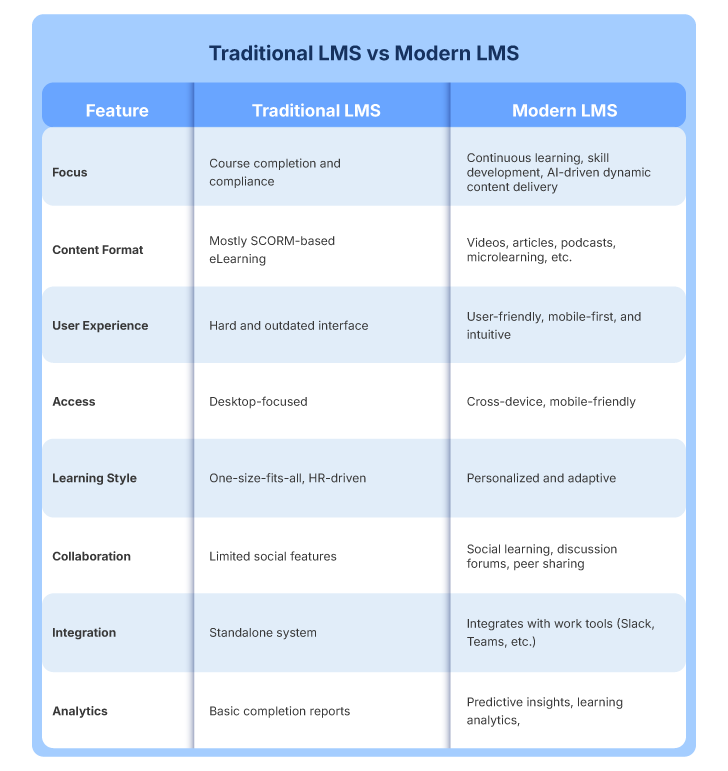
        Traditional LMS vs Modern LMS: A Comparison

        Traditional LMS platforms often function as administrative tools. Learners may find them disconnected and inefficient from their actual job roles.
        Modern learning platforms promote learners’ growth. They use AI to suggest content, analyze learning paths, and identify skill gaps. Let’s take a look at how these systems function.

        Traditional LMS vs Modern LMS infographics 1

        How AI Enhances Modern Learning Platforms

        AI can analyze a large amount of learner data, from training history to performance metrics. So, it can suggest the relevant content to the learner. This makes learning more effective and engaging. It keeps learners guided toward what suits their role and growth.

        Moreover, AI allows for predictive learning paths. It can also assist in real-time feedback and assessments. It helps managers improve learning results in less time.

        Smart AI-powered chatbots can provide 24/7 support and answer questions about courses. This continuous guidance keeps learners on track without interrupting HR managers. Indeed, AI is the key to a modern LMS that delivers training to meet individual aspirations and business outcomes.

        Why Skill Lake Is a Modern Learning Platform

        Skill Lake is developed to meet the needs of the modern workforce. It brings innovative features into a single easy-to-use platform.

        AI-Powered Recommendations: Learners receive content based on their role, skills, and performance. This reduces irrelevant overload and boosts engagement.

        AI Course Creator: L&D teams can automate content development by using auto-generated outlines and modules.

        AR/VR Training: Skill Lake supports immersive formats that increase retention and better understanding.

        Multiple Learning Modes: Skill Lake supports anytime learning, microlearning, and live sessions.

        Mentoring: Learners can easily connect with trainers, get feedback, and track growth.

        Competency Mapping: With Skill Lake, admins can map skills, analyse learners, and plan focused training.
        Interactive Feed & Journal: A live feed shares content, events, and updates with learners. It reflects and tracks their progress through journals.

        Gamification: Gamification in LMS makes learning fun. Elements like points, badges, and level-ups make learning engaging and competitive.

        Mobile & Multi-Language Support: Today’s learners focus on convenience. Mobility allows easy learning from anywhere with quick access to learning materials on Android/iOS devices. A multi-language interface improves global acceptance.

        Case Studies: How Skill Lake Helped Elevate Learning Experiences Across Industries

        Case Study 1 –

        Five Brothers, an industry leader in the “Property Preservation Business”, chose Skill Lake to make training easier, track progress, and help employees learn anytime on any device. They also wanted to make their L&D process more efficient and organized.

        Key Results After Adopting Skill Lake – Improved Training Management

        • Higher employee training completion rates
        • All training content is digitised and accessible anytime
        • Easy tracking and delivery of mandatory compliance courses
        • On-demand self-paced course library for continuous learning
        • Mobile-friendly platform improved accessibility
        • Boosted employee satisfaction

        Case Study 2 –

        The Training Center, started in 1982 by John Moscatiello, is a family-run school. It provides hands-on training for boiler operators in plant maintenance and operations.

        The Training Center Group faced low student enrollment due to an outdated CRM, a complex LMS, and lack of system integration. They needed a modern LMS to improve efficiency and stay competitive.

        Key Results After Adopting Skill Lake – Increased Enrolments

        • Higher course enrollments
        • More inquiries from new students
        • Easy mobile access to courses
        • Improved student satisfaction
        • Smooth CRM–LMS integration for better efficiency

        Final Thoughts

        Indeed, traditional LMS platforms can’t meet modern learning needs. Traditional systems may check compliance boxes, but don’t meet today’s learning needs.

        Modern learning platforms are easy-to-use and smart. They use AI-powered adaptive paths and real-time feedback. It makes learning more engaging. These systems also increase the performance and efficiency of the workforce.

        Organizations that focus on flexible and personalized learning are staying ahead. Platforms like Skill Lake help you meet today’s needs and prepare for future challenges. If you’re searching for the best corporate training platform, it’s time to look beyond the legacy LMS and try a solution built for growth.

        Want to transform learning experiences for your workforce? Try out Skill Lake today! Request a free demo now!


        Anoop Kumar MS

        Anoop Kumar MS, Product Manager of Fingent Global Solutions Pvt. Ltd., is an experienced product specialist with expertise in identifying customer needs and delivering innovative, data-driven solutions. Skilled in wireframing, UX, requirements analysis, risk assessment, team management, and root cause analysis, he excels in managing product lifecycles and fostering seamless collaboration to address real-world challenges.

        Other Reads from Skill Lake

        • Top LMS Training Platforms for 2026: 10 Best Solutions for Corporate Learning

          Top LMS Training Platforms for 2026: 10 Best Solutions for Corporate Learning

          Legacy corporate training frameworks are failing to solve contemporary skill gaps. To build an agile, future-ready workforce, organizations need a modern corporate training LMS that drives active capability mastery. This post evaluates the top LMS training platforms for 2026 currently delivering measurable operational ROI. Top 10 LMS Training Platforms for 2026 Note: Pricing and features

          Read More
        • How AI Simulation Training in LMS Prepares Teams for Real-World Scenarios

          How AI Simulation Training in LMS Prepares Teams for Real-World Scenarios

          Traditional corporate training methods often fall short when preparing employees for high-stakes, real-world challenges. Today’s business landscape demands a drastic shift from passive consumption to active mastery. This is why forward-thinking business leaders are adopting simulation-based learning in LMS to bridge the gap between theory and execution. By integrating advanced AI role play training, organizations

          Read More
        Restaurant lms

        As restaurants expand and evolve, traditional training methods struggle to keep up. That’s why many restaurant businesses are moving towards digital solutions. Quality training and strict compliance are very important in the restaurant industry. Of course, proper training makes operations smooth and easy. Also, compliance with local regulations protects your business from legal trouble and penalties. A restaurant LMS is quickly becoming a must-have for modern restaurant success.

        Importance of Training and Compliance in the Food Service Industry


        The success of the food service industry depends on consistency, safety, and customer satisfaction. Employee training is important to deliver high-quality service. Every employee needs to know their role. They need to stay updated about the changing protocols and rules.

        Compliance goes hand in hand with training. Regulatory bodies expect food establishments to follow strict safety and labor guidelines. Training verifies these expectations are met. So, effective training and strong compliance create a safer, more efficient, and profitable business. With a LMS for restaurants, achieving both becomes easier and more reliable.

        Challenges Faced in Restaurant Training & Compliance

        High Turnover

        Restaurants deal with one of the highest employee turnover rates across industries. New hiring results in consistent onboarding and difficult training. Without a structured approach, training often becomes incomplete. It results in performance gaps and repeated errors. A digital training system can help manage this ongoing challenge.

        Strict Regulations

        Restaurants must follow lots of rules such as labor laws, health inspections, and food safety protocols. These regulations differ for every location. Keeping every employee compliant is not easy especially when depending on verbal instructions or papers. Also, avoiding compliance may result in harsh penalties or shutdowns.

        Fast-Changing Environment

        Restaurants and the hospitality industry are often busy all season. Managers don’t always have time to train employees manually. It leads to knowledge gaps or training delays.
        Employees also face difficulty in retaining information received in a quick format. An accessible and self-paced learning management system for restaurants is vital in such a dynamic environment.

        LMS as a Modern Solution

        To overcome the above challenges, restaurants need a smart way to learn and manage compliance. That’s where a learning management system for restaurants comes in.

        Digital platforms like Skill Lake allow restaurants to create, deliver, and track their training programs. An LMS helps you replace outdated manuals and makes training more interactive. Staff can learn and revisit content anytime. A quick view of a learner’s performance reports can help trainers easily map competencies and identify skill gaps.

        What Is a Restaurant LMS and Why Does Your Food Business Need One?

        A restaurant LMS is a software platform designed to train and manage restaurant staff. A restaurant LMS is designed to meet the needs of the food service industry, such as menu changes, shift work, high turnover, etc. It helps restaurants deliver consistent training, easy onboarding, and track compliance.

        Irrespective of business size and reach, an LMS brings automation to your staff training process. With user-friendly interfaces, training becomes more flexible, effective, and easily accessible. Investing in a restaurant LMS is a valuable investment to bring safe and long-term growth. It hosts learning modules, quizzes, video tutorials, and compliance certifications in one place.

        Key Features of a Restaurant LMS

        • Role-based training paths for different food service roles
        • Mobile accessibility for easy accessibility of training material
        • Smooth onboarding workflows for new hires
        • Compliance tracking for certifications, health codes, and food safety training
        • Menu update modules for training on new dishes or ingredients
        • Gamification to engage learners
        • Centralized dashboards and multi-location support for chains or franchises

        All these address the high-turnover environment of the restaurant industry more effectively than a general-purpose LMS.

        Benefits of a Restaurant LMS to Food Businesses

        A modern restaurant LMS enables faster onboarding and reduces the time between hiring and productive shifts. It makes training easily accessible and standardizes across different locations.

        It further helps restaurants to offer quality service and brand consistency. It minimizes the legal risks by keeping compliance certifications up to date. A restaurant LMS improves employee performance reduces training costs, and helps identify high-potential team members for promotions. An LMS simplifies re-training and keeps everyone aligned with operational standards.

        How Does a Restaurant LMS Improve Training?

        In fact, a restaurant LMS can transform training delivery. Instead of depending on printed manuals, an LMS offers interactive and easily accessible modules to employees. This makes onboarding easier and faster, particularly for high-turnover positions. It helps trainers customize training for different roles and track progress automatically.

        Your restaurant staff can revisit and access the required material, which improves knowledge retention. Real-life examples and video content make training more engaging. It results in a more efficient, confident, and skilled team.

        How Does a Restaurant LMS Strengthen Compliance?

        In the restaurant world, compliance isn’t optional—it’s vital. A learning management system for restaurants keeps every employee trained with the food safety laws, and company policies. If internal procedures or laws change, an LMS helps you update them quickly and notify staff.

        So, during the audits, it becomes easy to provide documentation showing your team is compliant and certified. Indeed, a restaurant LMS reduces the risk of fines, shutdowns, or liability. It provides peace of mind to restaurant owners and complete control over compliance readiness.

        Why Choose Skill Lake as Your Restaurant LMS

        Skill Lake makes it easy for restaurant businesses to train their staff across all locations. Built specifically for the food service industry, this LMS uses AI to create dedicated learning paths based on roles and skills. It makes onboarding faster, along with continuous development. Its mobile-friendly platform allows staff to access training anytime.

        It further reduces downtime and improves knowledge retention. With features like performance tracking, certification, and centralized content delivery, Skill Lake helps maintain service quality, brand standards, and compliance across franchises. It helps restaurant owners make operations smooth and the workforce confident.

        Conclusion

        Training and compliance are the keys to every successful restaurant. But managing both manually is tough. It becomes more typical in a high-turnover, high-pressure environment. A restaurant LMS like Skill Lake offers a modern, scalable solution. It boosts staff performance and keeps them updated with health and safety regulations.

        With this LMS managers can save more time and focus on improving customer service and restaurant growth. Choose Skill Lake to stay compliant and build a team that’s ready to deliver excellence.

        Ready to simplify staff training and stay ahead of compliance?

        Connect for a Skill Lake LMS Demo today to get the full potential of the all-in-one restaurant LMS.


        Anoop Kumar MS

        Anoop Kumar MS, Product Manager of Fingent Global Solutions Pvt. Ltd., is an experienced product specialist with expertise in identifying customer needs and delivering innovative, data-driven solutions. Skilled in wireframing, UX, requirements analysis, risk assessment, team management, and root cause analysis, he excels in managing product lifecycles and fostering seamless collaboration to address real-world challenges.

        Other Reads from Skill Lake

        • Top LMS Training Platforms for 2026: 10 Best Solutions for Corporate Learning

          Top LMS Training Platforms for 2026: 10 Best Solutions for Corporate Learning

          Legacy corporate training frameworks are failing to solve contemporary skill gaps. To build an agile, future-ready workforce, organizations need a modern corporate training LMS that drives active capability mastery. This post evaluates the top LMS training platforms for 2026 currently delivering measurable operational ROI. Top 10 LMS Training Platforms for 2026 Note: Pricing and features

          Read More
        • How AI Simulation Training in LMS Prepares Teams for Real-World Scenarios

          How AI Simulation Training in LMS Prepares Teams for Real-World Scenarios

          Traditional corporate training methods often fall short when preparing employees for high-stakes, real-world challenges. Today’s business landscape demands a drastic shift from passive consumption to active mastery. This is why forward-thinking business leaders are adopting simulation-based learning in LMS to bridge the gap between theory and execution. By integrating advanced AI role play training, organizations

          Read More
        AI Powered LMS for training

        In today’s competitive business world, employee development has become vital. To enable prompt and effective customer service, companies must focus on strategic employee training. That’s where Learning Management Systems (LMS) come into play. With AI-powered LMS for training, adapting to new work cultures and learning expectations has become more simple and effective.

        Why Traditional Training Methods are Falling Behind

        According to Statista, organizations adopting AI for training save an average of $1.3 million annually. Conventional training methods like printed manuals and workshops are no longer effective. They may have served their purpose in the past, but they come with cons today. Know why traditional training methods are falling behind:

        • Time-Consuming & Inflexible: Employees and trainers should have a physical presence, making learning disruptive to workflow.
        • Generic Content: Traditional sessions don’t offer personalized learning styles, which often leads to disengagement.
        • Difficult to Track Progress: HR teams often face difficulty measuring effectiveness and ROI.
        • High Costs: Printed materials, trainer fees, etc., charges make in-person training inefficient and expensive.

        With an AI-powered LMS for training, businesses get a cost-effective and scalable alternative. An LMS like Skill Lake can offer benefits that go even further.

        The Role of AI in LMS for Training

        Personalized Learning Paths

        AI analyzes employees’ past performance, job roles, and skill gaps to create dedicated learning paths. This helps employees focus only on what they need to learn. It makes training faster and more reliable.

        Automated Assessments

        AI can track a learner’s course completion journey and prompt relevant tests and assessments. This helps users quickly identify skill gaps and

        Adaptive Learning

        AI LMS can adapt to learners’ behavior. It can help automate feedback based on performance. It can even help alter course difficulty levels to enhance learner engagement and enable improved knowledge retention rates.

        Relevant Course Recommendations

        AI in training LMS can suggest the best module or training based on an employee’s performance, interests, and goals.

        Predictive Performance Tracking

        AI tracks learning progress and forecasts future outcomes. It helps managers make data-driven decisions on additional training needs.

        Benefits of Using LMS with AI for Employee Training

        Investing in an AI-powered LMS for training offers lots of advantages for businesses. Indeed, AI has revolutionized how learning platforms function by adding analytics and automation into employee development. Let’s check some of the top benefits of using training LMS with AI for employee training.

        • Identifying and Closing Skill Gaps: AI can analyze users’ learning journeys and career paths. It can uncover skill gaps and recommend relevant courses. This helps companies stay ahead of skill development, remain competitive, and foster a skilled workforce.
        • Supporting Learner Needs with Real-Time Feedback: AI LMS for training offers dedicated resources and real-time feedback. It can ensure employees or learners get the right support when they need it.
        • Future Training Needs with Predictive Analytics: AI uses historical data to analyze skill gaps. It empowers organizations to address future training needs and self-directed learning.
        • Scaling Learning Through Automation: According to a report by Deloitte, automation reduces administrative burdens by up to 40%, helping HRs to focus on their core tasks. An LMS like Skill Lake automates repetitive tasks and scales personalized learning experiences for a diverse workforce. This method also empowers hybrid and remote workforces by delivering quality training.

        Modern LMS vs. Traditional LMS

        Compared to traditional LMSs, modern LMSs focus on enabling efficient, personalized, and accountable training methods. Considering the rapid changes in the market and the need for organizations to prioritize a skilled workforce, training management software techniques are taking a revolutionary turn. Modern LMSs are key to these changes in employee development.

        Efficiency

        Modern LMS automates and reduces the time taken for administrative tasks. By enabling learners to self-enroll in courses through QR codes, organizations can reduce hours of enrolment tasks to minutes. Chatbots offer 24/7 learner support and free trainers from repetitive queries. Innovative content development tools help generate the required modules quickly.

        Compared to traditional LMS, which depends on manual input, AI systems maintain workflows, minimize human error, and enable faster updates.

        Customization

        AI LMS analyzes user preferences and performance to adapt to each learner’s requirements. LMS with AI features can automatically recommend relevant content to offer more personalized learning paths. Traditional LMSs are often one-size-fits-all solutions. Offering personalized learning experiences is tough when using such platforms. AI-powered LMS supports multilingual localization and adaptive assessments with a learner-centric approach.

        Outcomes

        Employees using AI-driven LMS deliver lots of improvements over traditional systems. Microlearning and quick content delivery boosts employee’s knowledge and skills. Enhanced engagement through intelligent feedback and gamification increases productivity and ROI faster.

        Case Studies or Success Stories

        TROTB Improves Volunteer Retention by 50% with Skill Lake

        When the global pandemic affected onsite training initiatives, TROTB, an international non-profit organization, turned to Skill Lake Modern LMS. With dual-mode learning, AI personalization and content generation, easy assessment, and evaluation, the company could foster engaging training methods for their remote employees. Skill Lake also enables a safe course library and repository to store and deliver various types of content.

        The Outcome:

        • 60% reduction in the total operating costs
        • 30% improvement in training efficiency
        • 50% decline in volunteer attrition
        • 200+ volunteers across the globe

        Amazon

        Through an AI-powered LMS, Amazon offers personalized onboarding modules and robotic training simulations. The result? 50% faster training throughput and a 20% uplift in productivity.

        Future Trends of LMS with AI in Corporate Training

        The future of employee development is already taking shape. Know the future trends of LMS for training with AI:

        • Voice-Enabled Learning Assistants: Employees can interact with training modules via chatbots and voice commands.
        • AI-Generated Content: AI-powered LMS eases the generation of content in various forms. Engage learners with quizzes, videos, or flashcards within minutes using AI for content generation.
        • Emotion AI: AI can help detect user behavior. Recommend relevant courses based on the learning path. Easily understand learner confusion or frustration and provide real-time guidance or help.
        • Blockchain Credentials: Track certification for compliance-heavy industries easily. Ensure a secure and tamper-proof process for certification.
        • Integration with Wearables: Offer hands-on experience in a complex context. Utilize AR glasses and smartwatches to ease grasping knowledge and improve knowledge retention.

        Why Is an AI-Powered LMS for Training a Smart Move Forward?

        Businesses that want to stay ahead of the competition must think about developing their people. Of course, a big move has taken place in the employee training ecosystem. AI-enabled LMS is now the new norm among businesses seeking to empower their employees. LMS for training with AI improves real-world performance and reduces training time. Training LMS with AI builds a more agile and smarter workforce.
        LMS with AI offers limitless benefits for businesses, trainers, and employees as well. Skill Lake Modern LMS helps businesses stay ahead in creating effective and dynamic experiences. By using AI with LMS, you can effortlessly foster a culture of continuous learning that aligns with your business goals.

        Explore your opportunities with Skill Lake. Request a free demo today!


        Anoop Kumar MS

        Anoop Kumar MS, Product Manager of Fingent Global Solutions Pvt. Ltd., is an experienced product specialist with expertise in identifying customer needs and delivering innovative, data-driven solutions. Skilled in wireframing, UX, requirements analysis, risk assessment, team management, and root cause analysis, he excels in managing product lifecycles and fostering seamless collaboration to address real-world challenges.

        Other Reads from Skill Lake

        • Top LMS Training Platforms for 2026: 10 Best Solutions for Corporate Learning

          Top LMS Training Platforms for 2026: 10 Best Solutions for Corporate Learning

          Legacy corporate training frameworks are failing to solve contemporary skill gaps. To build an agile, future-ready workforce, organizations need a modern corporate training LMS that drives active capability mastery. This post evaluates the top LMS training platforms for 2026 currently delivering measurable operational ROI. Top 10 LMS Training Platforms for 2026 Note: Pricing and features

          Read More
        • How AI Simulation Training in LMS Prepares Teams for Real-World Scenarios

          How AI Simulation Training in LMS Prepares Teams for Real-World Scenarios

          Traditional corporate training methods often fall short when preparing employees for high-stakes, real-world challenges. Today’s business landscape demands a drastic shift from passive consumption to active mastery. This is why forward-thinking business leaders are adopting simulation-based learning in LMS to bridge the gap between theory and execution. By integrating advanced AI role play training, organizations

          Read More
        LMS for enterprise

        Every organization investing in its employees’ future aims to choose an enterprise learning platform that complements its specific objectives. With the right LMS for enterprise, you can optimize training results and business outcomes.

        Customizing an enterprise learning management system is essential for organizations to promote workplace innovation and talent retention. This post investigates the significance and benefits of LMS customization, specific areas that can be customized, and the necessary steps to customize an LMS for enterprise needs.

        Why Customize LMS for Enterprises?

        The modern enterprise LMS market is brimming with a lot of contenders. Yet, many enterprises encounter challenges when relying on generic, non-customizable LMS solutions.

        Rigid LMS structures do not align or evolve to accommodate the distinct learning needs and culture of an organization. Moreover, integrating a non-specific LMS with other enterprise systems is a backbreaking job, which results in training deficiencies and siloed learning.

        By choosing a customizable enterprise learning management system training, you can:

        • Integrate specific features and functionalities that enhance learning experiences
        • Scale and evolve the enterprise learning platform with the organization
        • Build and retain knowledge and talent to sustain business development
        • Address unique training challenges by catering to specific user needs

        Benefits of Customizing an LMS for Enterprise Training

        The ultimate purpose of a company adopting an enterprise learning platform is to provide its team a tailored and impactful learning environment that aids professional and organizational growth. Customizing an LMS for enterprise helps in many ways:

        Training Alignment With Business Goals

        Looking to design and distribute courses or learning materials that tally with the unique objectives and requirements of your organization? Then choose a customizable LMS for your enterprise. Impart the skills and knowledge your team needs to complete their jobs perfectly and quickly, and help them respond in time to the evolving market conditions

        Customized and Outcome-Focused Training

        Each employee’s learning requisites and career aspirations are different. So are the skilling requirements and training procedures of each team or department. With a customizable LMS, you can monitor employee performance and course consumption patterns. You can also recognize and map the existing competencies and skill deficiencies of your people to adjust learning paths at individual and team levels.

        Improved Learner Participation and Engagement

        Draw learners to your training programs with a custom-branded LMS that reflects your branding elements, such as logo, color palette, theme, etc. Make your LMS’s interface easy to navigate for users across the board. Encourage active learner participation by incorporating game-based learning, AI-based search, and collaboration tools.

        Data-Driven Training Enhancements and Decisions

        Tracking the effectiveness of your training activities is as important as introducing a new course. With a custom enterprise LMS, you can evaluate the efficacy and traction of your course materials and gauge how they impact your employees. Such genuine insights allow you to optimize learning strategies on the go and make informed decisions.

        Grow Your LMS With Your Enterprise

        Scalability is the hallmark of a customizable LMS. Historically, enterprise learning has never been static. Your training requirements grow just like your business. From expanding your course library to accommodating more users, a scalable LMS supports all your emerging skill development demands.

        Key Areas of LMS Customization for Enterprises

        Consider these five areas when planning to customize an LMS for enterprise. It will help you enhance training outcomes:

        AI Integration to Personalize Learning

        Picture a learner spending hours to recognize courses that match their learning targets, skill sets, and preferences. An LMS with AI personalization can offer course recommendations that match a learner’s particular choices and needs. Using AI personalization, supervisors and trainers can configure tailored learning paths for solo learners, batches, and teams. It helps boost active learner participation and information retention.

        Automate Course Development

        Imagine creating a full-fledged course in minutes by just typing in a set of minimal instructions! That’s what AI-driven course generation helps you with. Using a custom LMS featuring this capability, you can publish well-structured courses on any topic faster than ever before.

        Design Interactive Training Content

        With a custom LMS featuring technologies like AR and VR, you can set up a hazard-free training environment for your people. Through experiential learning, your employees can obtain the knowledge and exposure they should ideally possess, without risking their lives.

        Draw Learners Through Gamification

        Self-motivated learners are your organization’s greatest asset. At the same time, motivation blooms when employees feel rewarded and recognized. A custom LMS with inbuilt gamification elements will encourage learners to accomplish their targets quickly. For example, introducing badges, points, leaderboards, etc. will make your learning process more interesting and inspiring for employees.

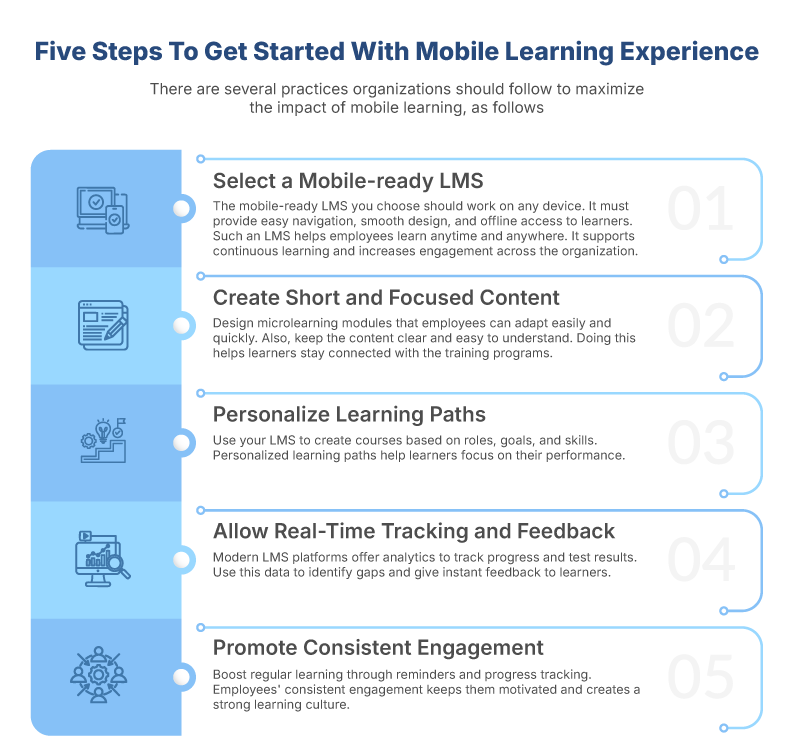
        Mobile-Friendly Learning

        With smartphones consuming a lion’s share of our screen time, enterprises cannot opt out of mobile-enabled learning. Tailoring your LMS for mobile responsiveness or instituting a mobile LMS app will allow you to let learning happen anywhere, anytime. Enterprise learning platforms customized for mobile usage support a growing number of businesses that rely on remote and deskless operations.

        Steps to Follow When Customizing an LMS for Enterprise

        Step 1: Shortlist Your Business Objectives

        • Review your current training activities and processes. Assess areas that work well and those that need improvement.
        • Identify the unique training needs of your enterprise. Discuss with your staff to gather their thoughts and ideas.
        • Come up with a list of custom LMS features you want.

        Step 2: Prioritize User Experience

        • Keep in mind how your users want to use the LMS. Do they access LMS on web or mobile?
        • Is the LMS easy to use? Can learners find courses and enroll quickly? Does the LMS engage users effectively?
        • Can you modify the LMS to reflect your brand’s look and feel? Can employees relate themselves to the platform?

        Step 3: Integrate With Other Enterprise Software

        • Link your LMS to relevant business systems, including, HR management systems, customer relationship management software, and more.
        • Sync data across your connected systems to generate unified insights and operate more reliably.
        • Secure a broad, all-round perspective on employee development and training impact by connecting relevant business software.

        Step 4: Scale Your LMS to Aid Business Growth

        • Scalability is a vital part of LMS customization. The LMS shouldn’t restrict you from adding new users, functionalities, or features.
        • The best LMS is one that promotes your business expansion efforts with multi-lingual training support.

        Step 5. Training Compliance and Security

        Configure custom security measures, such as role-based permissions and access to protect your LMS from illicit exploitation.
        Manage compliance training and certifications automatically from within your LMS.

        Step 6: Monitor and Improve Your LMS

        • Find out how happy your employees are with your LMS and courses. Spot areas for improvement.
        • Extract valuable insights from the LMS reports to enhance your enterprise training initiatives.

        Get Started With a Custom LMS for Enterprise

        If you are looking for an enterprise learning management system that provides extensive customization possibilities and adaptable configurations, we urge you to explore Skill Lake, a customizable and flexible LMS for enterprises.

        Skill Lake offers a wide range of LMS features customizable to your requirements, including white-label customization, AI course builder, individual learning paths, progress tracking, rich content options, all bundled in a single platform.


        Need an LMS you can actually customize for your business?

        Book a free demo to see Skill Lake in action


        Anoop Kumar MS

        Anoop Kumar MS, Product Manager of Fingent Global Solutions Pvt. Ltd., is an experienced product specialist with expertise in identifying customer needs and delivering innovative, data-driven solutions. Skilled in wireframing, UX, requirements analysis, risk assessment, team management, and root cause analysis, he excels in managing product lifecycles and fostering seamless collaboration to address real-world challenges.

        Other Reads from Skill Lake

        • Top LMS Training Platforms for 2026: 10 Best Solutions for Corporate Learning

          Top LMS Training Platforms for 2026: 10 Best Solutions for Corporate Learning

          Legacy corporate training frameworks are failing to solve contemporary skill gaps. To build an agile, future-ready workforce, organizations need a modern corporate training LMS that drives active capability mastery. This post evaluates the top LMS training platforms for 2026 currently delivering measurable operational ROI. Top 10 LMS Training Platforms for 2026 Note: Pricing and features

          Read More
        • How AI Simulation Training in LMS Prepares Teams for Real-World Scenarios

          How AI Simulation Training in LMS Prepares Teams for Real-World Scenarios

          Traditional corporate training methods often fall short when preparing employees for high-stakes, real-world challenges. Today’s business landscape demands a drastic shift from passive consumption to active mastery. This is why forward-thinking business leaders are adopting simulation-based learning in LMS to bridge the gap between theory and execution. By integrating advanced AI role play training, organizations

          Read More
        Employee LMS

        With technology rapidly evolving, businesses must learn to adapt and quickly deploy the benefits. But is this possible without strategic employee upskilling? When companies strategize employee upskilling, it helps them prepare their workforce better for the changing market. A study by the Korn Ferry predicts that more than 8 million jobs could remain unfilled by 2030, due to the lack of skills.

        Organizations are focusing more on upskilling their employees to increase employee engagement and productivity. Here, an employee LMS is the best tool in this journey. It empowers businesses to provide effective and structured upskilling programs.

        Employee Learning Management System acts as a robust tool to empower ongoing development. With a centralized platform for learning and training, an LMS helps organizations deliver personalized and consistent learning experiences. This increases the chances of business success and employee performance.

        Why Upskilling is Important in Today’s Market

        As per World Economic Forum, Due to tech evolution, 44% of employee’s skills are assumed to be retarded within the next 5 years. The modern workforce is undergoing a huge transformation.

        Also, industries are experiencing an increasing need for people who know cutting-edge platforms and tools. However, this is exactly where companies face a gap in finding the right skills.

        Automation and AI-powered LMSs are reshaping employee training. The speedy nature of these technologies often outpaces traditional training, leading organizations to develop their tech training programs.

        Challenges of Upskilling Employees

        Upskilling employees is essential today, yet lots of challenges obstruct its effectiveness. Time constraints, financial limitations, limited resources, etc, are some of the primary challenges.

        Time Constraints

        Employees often struggle to get time for training due to their routine obligations. Balancing jobs with training can result in less engagement and low participation in upskilling.

        Misaligned With Business Objectives

        Employee training needs to align with business objectives. Only then can employee upskilling actually benefit the company’s growth and success. Outdated or generic content can create gaps between business needs and employees’ skills.

        Limited Resources

        Indeed, small and mid-size organizations often face limited resources. It also hinders their training programs. This limitation also impacts the upskilling of the employees.

        Measuring Training Effectiveness

        Without proper tracking and analytics tools, it is not easy to track the impact of upskilling. Due to this, organizations may struggle to identify the ROI of their training programs.

        Businesses need a strategic approach, and Skill Lake, like LMS, is for an employee to level up their upskilling process.

        How an Employee LMS Facilitates Upskilling

        An Employee LMS provides an effective solution to address upskilling challenges. By utilizing technology, an employee LMS can transform the training experiences.

        Flexible Learning Options

        An LMS for employees offers the flexibility to access the training materials at their own pace. Also, they can set their learning preferences with diverse scheduling options.

        Personalized Learning Paths

        Modern LMS platforms like Skill Lake can offer interactive training experiences based on roles and skills. This type of personalization helps employees get targeted and relevant training. It further enhances knowledge retention and engagement.

        Interactive and Engaging Content

        Indulging multimedia content like simulations and videos, an LMS creates engaging learning experiences. This way of learning makes training enjoyable and improves employee skills.

        Real-Time Progress Tracking

        An employee LMS helps trainers, managers, and HRs track employee progress in real time. Using real-time analytics and reporting, organizations can track their training programs. Also, with this data, they can make data-driven decisions to get set outcomes.

        Benefits of Using an Employee LMS for Upskilling

        As Carol Patton at Human Resource Executive writes: “Reskilling or upskilling employees has become a survival approach that powers up a company’s growth.”

        Implementing an employee learning management system for upskilling offers various benefits that lead to organizational and individual growth. Check some of the top benefits of using an employee LMS for upskilling.

        Enhanced Employee Engagement

        Providing relevant and accessible training content shows the organization’s commitment to employee growth. In fact, this is a sensible investment for an organization as it increases engagement and job satisfaction.

        Boost Productivity and Job Performance

        An employee LMS like Skill Lake offers the best training programs to make your workforce productive and efficient. Enhancing existing skills will help employees do their jobs better and faster. It also empowers employees to take on new responsibilities.

        Cost-Effective Training Solutions

        Traditional training methods often need lots of expenses related to materials, travel, and fees. An LMS for employees minimizes these costs by offering digital content. Also, learners can access this content remotely, making it more affordable and accessible.

        Stay Competitive

        Can you imagine being successful without a competent workforce? Your employees are your biggest and strongest pillars who bring success to you.
        Upskilling employees help them turn their ideas and vision into superior products. So, investing in employee training is a profitable investment to make your business competitive.

        Continuous Learning Culture

        An employee learning management system creates a continuous learning culture in your organization. An employee LMS helps employees achieve personal and professional growth. It makes employees more adaptable and innovative.

        Certification and Compliance Management

        A modern LMS can recommend new courses based on your learning path. That means your workforce can readily upgrade skills, without the need to separately search for certification courses. An LMS also eases a mentor’s job in ensuring a skilled workforce. Easy competency mapping helps identify skill gaps quickly.

        Real-World Example: Upskilling with LMS

        McDonald’s adopted a mobile-friendly LMS to provide vital training to its employees. They adopted this strategy to upskill their front-line workers. The approach helped them achieve a 15% increase in customer satisfaction, improving their ratings and brand value. This result showcases the direct correlation between customer service quality and effective training.

        Also, it shows that an employee LMS helps deliver effective training programs that drive customer satisfaction and high performance.

        Another example is Amazon has launched its upskilling 2025 strategy as part of its strong commitment to make employees ready for a digitized workforce. Beth Galetti, senior VP of People Experience and Technology at Amazon says, “We think it is good to invest in our employees to help them create more professional options and gain new skills for themselves.”

        Conclusion

        Accenture CEO Julie Sweet says the company has invested $1 billion in 2021 to reskill its workforce. Indeed, in today’s era, upskilling employees is no longer an option as it is now essential for business growth and survival.

        Employee LMS is essential for upskilling and reskilling employees. An LMS can also enable the companies to address the skill gaps through personalized learning paths and AI-powered course creation facilities. It also makes your workforce competitive and skilled to meet the challenges of tomorrow.

        With Skill Lake, organizations can stay ahead of the curve. Also, due to tech advancements, the role of LMS will grow more. In fact, it provides a path for businesses to remain agile and competitive in today’s marketplace.
        Want to upskill your employees? Call the Skill Lake support team to make your employees more productive!

        Anoop Kumar MS

        Anoop Kumar MS, Product Manager of Fingent Global Solutions Pvt. Ltd., is an experienced product specialist with expertise in identifying customer needs and delivering innovative, data-driven solutions. Skilled in wireframing, UX, requirements analysis, risk assessment, team management, and root cause analysis, he excels in managing product lifecycles and fostering seamless collaboration to address real-world challenges.

        Other Reads from Skill Lake

        • Top LMS Training Platforms for 2026: 10 Best Solutions for Corporate Learning

          Top LMS Training Platforms for 2026: 10 Best Solutions for Corporate Learning

          Legacy corporate training frameworks are failing to solve contemporary skill gaps. To build an agile, future-ready workforce, organizations need a modern corporate training LMS that drives active capability mastery. This post evaluates the top LMS training platforms for 2026 currently delivering measurable operational ROI. Top 10 LMS Training Platforms for 2026 Note: Pricing and features

          Read More
        • How AI Simulation Training in LMS Prepares Teams for Real-World Scenarios

          How AI Simulation Training in LMS Prepares Teams for Real-World Scenarios

          Traditional corporate training methods often fall short when preparing employees for high-stakes, real-world challenges. Today’s business landscape demands a drastic shift from passive consumption to active mastery. This is why forward-thinking business leaders are adopting simulation-based learning in LMS to bridge the gap between theory and execution. By integrating advanced AI role play training, organizations

          Read More
        Employee Skill development Software

        Organizations today need a talented and future-ready workforce to stay relevant in a competitive and market-oriented environment. Consequently, businesses need their staff to be engaged, motivated and to be up to date with their skills. This is why Employee Skill Development Software is gaining traction with organizational and business leaders alike.

        A McKinsey report reveals that organizations that prioritize learning and development can effectively attract and retain skilled employees. Integrating employee skill development software is a well-rounded strategy for modern businesses. This blog will help you understand what employee skill development software is, why companies need it, and how to recognize an ideal solution.

        Understanding Employee Skill Development Software

        Studies say 94% of employees stay longer in organizations that invest in their skill development. Employee development software helps businesses to increase their team’s engagement. It is like a platform to help organizations analyze, manage, and improve employee skills. Employee skill development software like Skill Lake offers tools to create personalized learning paths, identify skill gaps, and measure. Businesses can create a culture of continuous learning for their workforce. It also helps organizations to be competitive and get ready for future challenges.


        Purposes of Employee Skill Development Software

        • Identify Skill Gaps
        • Personalized Learning Paths
        • Scalable Training Solutions
        • Real-Time Progress Tracking
        • Enhance Engagement
        • Support Career Advancement
        • Improve Retention Rates

        Core Features of Skill Development Software

        Skill development software makes professional growth more effective and smoother. Let’s check some of the core features of skill development software:

        • Learning Management: Create and deliver required training content for different learning styles.
        • Skills Tracking: Keep track of the skills your team needs.
        • Performance Analytics: Employee skill development software helps get real insights into employee performance.
        • Career Pathing: Help employees visualize and plan their professional journey.
        • AI-Powered Personalization: Employee skill software creates customized learning paths based on individual performance, preferences, and progress.
        • Integration Capabilities: Integrate with existing communication tools, performance platforms, and HR systems to create a smooth development ecosystem.

        Comparison With Traditional Training Methods

        By offering data-driven and personalized experiences, employee skill development software has revolutionized workforce training. Unlike traditional training methods, modern platforms like Skill Lake provide on-demand and flexible learning to meet individual needs. Such platforms not only improve engagement but also improve knowledge retention.

        Traditional training methods are not enough to provide hands-on experience and direct interaction. Also, these methods face lots of challenges, such as high costs, limited scalability, and less engagement.

        In fact, the integration of technology in training helps in real-time progress track and immediate feedback. It keeps employees equipped with the latest skills and knowledge.

        Employee Skill Development Software vs. Traditional Training Methods

        • Flexibility: Digital platforms have all-time access to meet the diverse learning needs of employees.
        • Personalization: AI-driven systems offer dedicated learning paths to enhance relevance and effectiveness.
        • Affordability: Reduce travel and material costs associated with traditional training methods.
        • Engagement: Interactive elements like multimedia content and gamification improve learners’ engagement.
        • Scalability: Effortlessly expands to train diverse and large teams without any extra resources.
        • Real-Time Analytics: Provides immediate insights into learner progress and areas of improvement.
        • Content Updates: Allows quick revisions to training materials. Also, employee skill development software ensures that content remains current.
        • Retention Rates: Higher knowledge retention with skill development software as compared to traditional.

        Benefits of Employee Skill Development Software

        There are lots of benefits of employee skill development software within an organization. But implementing an ongoing and strategic development program may be challenging. Skill Lake LMS helps employees learn various skills using a single platform.

        The World Economic Forum’s Future of Jobs Report 2025 shows that companies are changing their workforce plans as AI may affect jobs. By 2030, 86% of businesses expect AI to reshape their operations, prompting 77% to plan for employee reskilling. Also, 69% seek talent with AI expertise.

        Boosts Productivity and Performance

        Skill development software keeps employees up-to-date with tools. It enhances their output and efficiency. Which further leads to enhanced organizational performance.

        Enhances Employee Retention

        Employee skill development software brings opportunities, increases employee retention, and reduces turnover rates. It also increases employee loyalty and satisfaction.

        Bridging Skill Gaps

        Skill development software assists in bridging skill gaps. It helps address specific needs and enhance career growth.

        Improve Company Culture

        Inclusive teams achieve 80% better results in team-based assessments compared to their peers. Also, diverse companies enjoy 2.3 times higher cash flow per employee. Organizations that invest in DEIB (Diversity, Equity, Inclusion, and Belonging) attract top talent, which is easy and possible by providing an inclusive and supportive work environment.

        Upskilling and Reskilling

        According to McKinsey, the reason people quit their jobs is a lack of skill development opportunities. So, investing in upskilling and reskilling is the best solution to fill skill shortages. It also helps organizations to adapt to industry changes.

        How Employee Skill Development Software Transforms Your Workforce and Business Growth

        Employee skill development software enhances your workforce through personalized learning that fills skill gaps and has also been shown to have a positive impact on employees engagement. With exponential advancements being made, organizations can achieve increased productivity and engender a culture of ongoing development with employee skill development software.

        This ensures that organisations remain competitive in a quickly changing business environment. Employee skill development software includes tools such as gamification and mobile user engagement, which increase engagement and access to learning.

        Choosing the Right Skill Development Software

        Choosing the right employee development software is not an easy job. Also, it is a vital decision for your organization’s growth. So, before choosing it, you must look at the following features.


        Key Features to Look for in Employee Development Software are

        • AI-powered Content Creation
        • Personalized Learning Paths
        • Mobile Learning
        • Social Learning Features
        • Skill Gap Analysis
        • Real-Time Progress Tracking

        Closing Thoughts

        Employee skill development software can benefit both the organization and employees. It creates an environment where employees can improve their skills and grow quickly whereas benefit the company with boosted productivity, efficiency, and improved employee retention rate. A modern employee skill development software can also help develop the skills required to create a high-performing and future-ready workforce.

        Skill Lake LMS can be your ideal Employee Skill Development Software. Its AI-powered course creation and personalized learning ensure that training meets organizational and employee goals. The platform supports different learning modes and provides diverse learning preferences. Skill Lake also enables real-time analytics, gamification, and a holistic approach to employee development.

        Learn more about how Skill Lake can improve your workforce management and help elevate their skill sets. Request a Free Demo now!

        Anoop Kumar MS

        Anoop Kumar MS, Product Manager of Fingent Global Solutions Pvt. Ltd., is an experienced product specialist with expertise in identifying customer needs and delivering innovative, data-driven solutions. Skilled in wireframing, UX, requirements analysis, risk assessment, team management, and root cause analysis, he excels in managing product lifecycles and fostering seamless collaboration to address real-world challenges.

        Other Reads from Skill Lake

        • Top LMS Training Platforms for 2026: 10 Best Solutions for Corporate Learning

          Top LMS Training Platforms for 2026: 10 Best Solutions for Corporate Learning

          Legacy corporate training frameworks are failing to solve contemporary skill gaps. To build an agile, future-ready workforce, organizations need a modern corporate training LMS that drives active capability mastery. This post evaluates the top LMS training platforms for 2026 currently delivering measurable operational ROI. Top 10 LMS Training Platforms for 2026 Note: Pricing and features

          Read More
        • How AI Simulation Training in LMS Prepares Teams for Real-World Scenarios

          How AI Simulation Training in LMS Prepares Teams for Real-World Scenarios

          Traditional corporate training methods often fall short when preparing employees for high-stakes, real-world challenges. Today’s business landscape demands a drastic shift from passive consumption to active mastery. This is why forward-thinking business leaders are adopting simulation-based learning in LMS to bridge the gap between theory and execution. By integrating advanced AI role play training, organizations

          Read More
        Cloud based LMS systems

        Ongoing learning and skill enhancement is at the heart of any business. The more updated your employees are, the best are your chances of running a thriving business. Managing employee training can never be a challenge if you use the right learning management system (LMS). How can you choose the best cloud based LMS systems that will help your business stay ahead of the curve? Data shows that 87% of businesses have migrated to cloud-based LMS systems in recent years. Why? Because they are more flexible, scalable, cost-effective, and accessible from anywhere.
        If you are looking to invest in a new LMS or reconsidering your current choice, then this post is for you. Here we look at what cloud based LMS systems are and why you need one. We will also discuss how cloud LMSs are reshaping training in modern workplaces.

        What Is a Cloud-Based LMS System?

        A cloud-based learning management system is a cloud-hosted eLearning software application. Unlike a locally-hosted (on-premise) LMS, a cloud-based LMS system is hosted on a remote (cloud) server. Using a cloud LMS, you can create, distribute, track, and manage courses and learning materials online. To access the LMS, you need an internet-connected device, such as a PC, laptop, smartphone, or tablet.
        The software maintenance and upgrades are managed by the cloud LMS provider. It ensures users receive regular and fast updates, robust security, and on-demand scalability.

        Benefits of Cloud Based LMS Systems in Modern Workplaces

        Here is why a large number of businesses are using cloud based LMS systems today.

        Anytime, Anywhere Accessibility

        If you are managing a distributed workforce, cloud LMS can be a life-saver. Your employees can access courses and learning materials, from anywhere, at any time. Self-paced learning helps reduce crunch time for employees. It leads to improved workplace morale, engagement, and knowledge retention.

        Scale on Demand

        Cloud based LMS systems can scale to accommodate any number of users and courses. The ability to scale on demand makes cloud LMS the best choice of all kinds of businesses, from small to large enterprises. The LMS adapts to your training needs by allowing you to adjust storage and user capacity.

        Tracking and Reporting

        Not sure how well employees are absorbing your training materials and courses? Lack proper mechanisms to gauge how training impacts your team’s performance? With a cloud-based LMS, you get in-depth insights into key metrics that matter. Stay on top of course completion rates, learner performance, assessments, and more. Analyze what your team’s current competencies are and spot skill gaps that you need to bridge. Enhance your training efforts with data-driven decisions, powered by the cloud LMS.

        Affordable Pricing

        Most cloud LMS vendors promote subscription-based pricing. This pricing model eliminates your IT workload associated with ongoing maintenance and upgrades. It will all be handled by the LMS provider. Subscription-based pricing saves you from making hefty upfront investments in hardware and software.

        External Integrations

        Need an LMS that integrates well with your existing business applications? Look no further than a cloud-based LMS system. Integrate your HRMS, CRM, ERP, or other eLearning platforms with the cloud LMS. Reduce siloed data, consolidate and track all your training-related activities in one place. Boost cross-functional visibility, training efficiency, and staff productivity with a cloud LMS.

        Real-Time Collaboration

        Real-time communication and collaboration is vital to improving the efficacy of organizational training. Cloud based LMS systems bundle advanced collaboration features into their fold, streamlining workplace communications. For example, live messaging, videoconferencing, document sharing, etc. can augment your training efforts. These features help exchange ideas, information, and feedback throughout the organization.

        Use Cases of Cloud Based LMS Systems in Modern Workplaces

        Cloud based LMS systems enable continuous professional development in modern workplaces. Here are a couple of use cases:

        Enhanced Compliance and Risk Management

        Cloud based LMS systems help manage and improve organizational compliance in many ways. A cloud-based LMS system allows you to:

        • Auto-assign mandatory compliance training courses to intended learners.
        • Keep track of training compliance goals and milestones, such as certification expiry dates.
        • Identify defaulters and remind them to meet compliance training targets
        • Maintain a complete training record for review, security, and audit purposes.
        • Develop mandatory training packages that will engage and educate learners.

        Extended Enterprise and Channel Training

        Do you need to manage external training besides internal employee training? Then a cloud-based Learning management system software is the best option for you. Using a cloud LMS, you can:

        • Create personalized training and onboarding courses for vendors, channel partners, franchises, and consultants. The learning materials can be customized according to their specific roles and responsibilities.
        • Deliver product knowledge and channel sales training to sellers and resellers. It helps enhance sales revenue and drive results.
        • Make training consistent and standardized for your employees, customers, partners, and other audiences. Provide everyone with secure access to uniform learning materials.

         Checklist to Choose the Right Cloud-Based LMS System

        Some of the key points that should be on your checklist when picking a cloud-based LMS system:

        Checklist to Choose the Right Cloud-Based LMS System

        Five Future Trends in Cloud Based LMS Systems

        Cloud based Learning Management systems evolve year over year. Here are five anticipated trends that will transform cloud LMSs in the coming days.

        Artificial Intelligence (AI) 

        Every industry is using AI to personalize customer experiences. Corporate training is no exception. Cloud LMSs integrated with AI enable learning personalization for every user. AI algorithms analyze user data to create tailored learning paths for individual users. AI is also used to automate course creation and distribution.

        Microlearning

        Microlearning is a modern training strategy that helps reduce learner fatigue. It allows learners to absorb information in small, digestible units. Focused and concise pieces of content enable faster knowledge absorption and retention.

        Mobile Learning Apps

        Mobile devices take up a lion’s share of our screen time. A mobile-enabled LMS allows training and learning to happen anytime, anywhere. Learners can access courses at their convenience, when they commute, or even outside the working hours. Mobile learning is highly useful for training remote workers and frontline staff.

        Virtual and Augmented Reality (VR/AR)

        AR and VR integration in LMS platforms helps offer a full-immersive and engaging experience to learners. High-risk industries like chemical and automobile manufacturers, construction, oil and gas, etc. use AR and VR to train employees in a safe and controlled space. For example, VR is used to simulate real-world industrial scenarios. Virtual replicas of risky industrial settings help promote safe and effective employee training in a controlled space. Similarly, AR helps overlay digital information onto physical environments. Employees can access information or job-specific details on the go using their smartphones or AR glasses. In short, AR and VR can boost training safety, hands-on experience, and learning retention.

        Gamification

        Gamified learning, or adding gamification elements makes learning more interesting and engaging for learners. Virtual rewards, badges, leaderboards, points and other gamification components help instill a sense of accountability and goal-orientation among learners. Course gamification also contributes to higher retention rates and increased motivation among learners.

        Conclusion

        The demand for digital learning grows as your business expands. With a cloud-based LMS system by your side, you can never ignore the dynamic training needs of your people. If you are coining a wish-list for your organization, a cloud-based LMS system should top the chart.
        Skill Lake is a modern, AI-powered, cloud based LMS system. We help businesses—small and large—manage their training efforts with less effort. Let’s see and see how Skill Lake can address your workplace training needs and woes.


        See Skill Lake LMS in Live Action

        Explore the features of our AI-powered, cloud-based LMS system—Book a free, personalized demo now!

        Aarathy Jayakrishnan

        Aarathy is an e-learning professional and enthusiast with a keen understanding of learning and development concepts. She writes insightful content, unraveling the possibilities that e-learning holds, and strives to make education open for all.

        Other Reads from Skill Lake

        • Top LMS Training Platforms for 2026: 10 Best Solutions for Corporate Learning

          Top LMS Training Platforms for 2026: 10 Best Solutions for Corporate Learning

          Legacy corporate training frameworks are failing to solve contemporary skill gaps. To build an agile, future-ready workforce, organizations need a modern corporate training LMS that drives active capability mastery. This post evaluates the top LMS training platforms for 2026 currently delivering measurable operational ROI. Top 10 LMS Training Platforms for 2026 Note: Pricing and features

          Read More
        • How AI Simulation Training in LMS Prepares Teams for Real-World Scenarios

          How AI Simulation Training in LMS Prepares Teams for Real-World Scenarios

          Traditional corporate training methods often fall short when preparing employees for high-stakes, real-world challenges. Today’s business landscape demands a drastic shift from passive consumption to active mastery. This is why forward-thinking business leaders are adopting simulation-based learning in LMS to bridge the gap between theory and execution. By integrating advanced AI role play training, organizations

          Read More
        LMS for Startups and Small Organizations

        Your workforce is your company’s lifeline. Ensuring skilled and future-ready staff can gain your business a competitive edge and enhance performance capabilities. However, we also understand that maintaining a skilled workforce with regular training and updated career paths can be stressful. That’s where an LMS for Startups and Small Organizations comes into play.

        Implementing a Learning Management System (LMS) to address training management issues maximizes your business potential and brings growth. Modern LMSs with AI features can even enhance content creation and content recommendation abilities, further streamlining the employees’ learning journeys. This blog will help you recognize the top benefits of implementing an LMS for your startup or small organization. But first, let’s take a look at the common challenges.

        Common Training Challenges Faced by Startups and Small Organizations

        Training costs have always been a big challenge for small businesses. Startups often have limited resources to drive effective training programs, resulting in stagnant skill sets. Time constraints, restricted learning convenience, limited access to course materials, and inability to track training performances are a few other challenges small companies face with training management. Here are a few more such common challenges:-

        • Remote employee training
        • Limitations of self-paced learning
        • Employee engagement options
        • Time constraints for employees
        • Inadequate training tools and technology
        • Restrictions of multi-format digital content

        LMS for Startups and Small Organizations as a Solution

        According to Huffpost.com, “Companies investing $1,500 or more per employee per year on training. It is an average 24% higher profit margin than companies with lower yearly training investments.”

        Unlike traditional training methods, modern LMSs can be accessed without additional infrastructural costs. So, a small organization can access an LMS with varied pricing models. Also, organizations are able to expand and tailor the LMS to their training requirements.

        As an organizational LMS, Skill Lake has various built-in features to enhance learning processes and improve employee engagement. Startups with Skill Lake are able to take advantage of trends such as micro-learning, social learning, gamification, AI-driven learning optimized by artificial intelligence, and so much more!

        5 Key Benefits of Implementing an LMS for Startups and Small Organizations

        Although different businesses have varied visions and requirements, a modern LMS with robust features can improve training performance and enhance learning outcomes.

        Cost-effective Training Solutions

          Budget is often a constraint for startups and small organizations. Hiring external trainers and providing in-person workshops can result in cost overheads for small-scale companies. However, by centralizing training materials online, LMS for Startups and Small Organizations can provide a more affordable alternative. Additionally, using an LMS can minimize the need for trainer fees, venue rentals, and travel expenses by enabling employees to access training materials whenever it is most convenient for them.

          By automating tracking and reporting, LMS platforms can lessen administrative workloads. Additionally, they provide learning options that are scalable and customizable, assisting companies in upskilling their employees. As a result, startups can affordably obtain all of these benefits with an LMS.

          Efficient Management

            A startup LMS helps streamline employee training management cost-effectively.

            HRs and trainers can see the progress and spot skill gaps through centralized access to training materials. An organization LMS automates reminder sending and enrollment of employees. It saves the administrative budget and makes training delivery uniform.

            So, managers can generate detailed reports about training effectiveness and employee performance. This efficient management saves time and effort required to make the workforce more productive.

            Scalability for Growth

              As businesses grow, the need for consistent employee development increases. Implementing an LMS allows startups to scale their training programs. An LMS provides a centralized platform to deliver learning resources to a growing team without manual effort.

              Learners can access training materials at any time. An LMS helps new hires and existing employees stay up-to-date with the required skills. It also helps businesses add new learning modules or courses according to changing needs.

              Whether it’s new compliance training, or leadership development, scalability helps learners in growth. It allows startups to manage their workforce without worrying about outgrowing their training systems.

              Streamlined Onboarding Process

                Ensuring new employees are familiar with company policies is quite stressful yet essential. An LMS platform with easy login steps can help a newly onboarded employee easily access all the essential policies and courses they need. The platform can also recommend courses and training programs according to employee roles to keep them skilled and updated on their career path.

                An LMS for onboarding offers a consistent and smooth experience for every new hire. It makes sure that all the employees are given the same information and training. The new employees are able to attend courses by themselves at their own pace.

                It is simpler for managers and mentors to monitor training performances of each employee on their team. Effective competency mapping enables them to identify skill gaps and take necessary measures quickly. With a modern LMS, every learning journey can be made accountable, stress-free, and personalized.

                Effective Leadership Development

                  Most organizations face issues in developing effective leadership. Studies find that 59% of managers who manage one or two employees had no training at all. Leadership development needs more focused training programs as per your company’s domain.

                  Creating in-house training and leadership development programs brings new leaders in real-time. Implementing an LMS for startups helps them take benefits of job shadowing and mentoring opportunities.

                  An LMS like Skill Lake allows aspiring leaders to grow and refine their abilities. Through personalized learning paths, employees can gain team management skills at their own pace. An LMS ensures that startups have a strong leadership pipeline, which is crucial for long-term growth and success.

                  Conclusion

                  LMS for Startups is a valuable tool for improving their training processes and continuous learning. Having better control over customer service, scalability, and learning experience is easy with an LMS. Of course, it is time to adopt an LMS for startups and small organizations. Also, before investing in any LMS, you should set your business priorities to achieve your targets.

                  An LMS like Skill Lake brings growth and workforce development to businesses. It helps in continuous learning, skill development, and employee engagement. With scalable training solutions, LMS helps improve productivity and enhance performance.

                  Ready to unlock your team’s full potential? Request a Free Demo today and explore your opportunities to drive streamlined training management. Get started now!

                  Aarathy Jayakrishnan

                  Aarathy is an e-learning professional and enthusiast with a keen understanding of learning and development concepts. She writes insightful content, unraveling the possibilities that e-learning holds, and strives to make education open for all.

                  Other Reads from Skill Lake

                  • Top LMS Training Platforms for 2026: 10 Best Solutions for Corporate Learning

                    Top LMS Training Platforms for 2026: 10 Best Solutions for Corporate Learning

                    Legacy corporate training frameworks are failing to solve contemporary skill gaps. To build an agile, future-ready workforce, organizations need a modern corporate training LMS that drives active capability mastery. This post evaluates the top LMS training platforms for 2026 currently delivering measurable operational ROI. Top 10 LMS Training Platforms for 2026 Note: Pricing and features

                    Read More
                  • How AI Simulation Training in LMS Prepares Teams for Real-World Scenarios

                    How AI Simulation Training in LMS Prepares Teams for Real-World Scenarios

                    Traditional corporate training methods often fall short when preparing employees for high-stakes, real-world challenges. Today’s business landscape demands a drastic shift from passive consumption to active mastery. This is why forward-thinking business leaders are adopting simulation-based learning in LMS to bridge the gap between theory and execution. By integrating advanced AI role play training, organizations

                    Read More
                  Multilingual LMS

                  In today’s global world, a Multi language LMS is vital for organizations operating worldwide. A multilingual LMS helps organizations to provide training content in different languages. It helps them meet the varied needs of their workforce.

                  It eradicates language barriers, providing a smooth learning experience for employees worldwide. Employees can access required content in their preferred language. It brings inclusivity and helps them engage with the training material.

                  A Multi-language LMS enhances retention and comprehension and improves training effectiveness. Indeed a Multilingual LMS boosts employee’s performance and organization’s growth and performance.

                  Challenges of Training in a Globalized Workforce

                  Of course, training a global workforce is very challenging. The biggest challenge here is the diversity of cultures and languages. Also, limited proficiency in the primary language often creates misunderstandings or difficulties in adopting information.

                  According to studies, “Out of the world’s about 7.5 billion people, 1.5 billion speak English — that’s 20% of the Earth’s population. But most of them aren’t native English speakers. Around 360 million people speak English as their native language.

                  Cultural differences also can impact how training content is delivered. There is a high chance that a training program designed for one region does not fit in another region. This is due to varying communication styles, learning preferences, and work ethics. It leads to low engagement and a lack of employee satisfaction.

                  Some other training in a globalized workforce

                  • Logistical challenges
                  • Time zone juggling
                  • Cultural sensitivities in the field
                  • Security compliance of internal comms tools
                  • Employee disconnection due to fragmented communication

                  Importance of a Multilingual LMS

                  LMS allowing multiple languages helps businesses to provide employee training in a global work environment. With Skill Lake – a Multilingual LMS, businesses can help employees train in their own language.

                  Such LMS enables employees to understand and preserve information without translation and interpretation. It makes employees engaged and confident with the organization’s training content.

                  Addressing Language Barriers

                  Global workforce training is, unfortunately, marred by language barriers. However, you can surmount this challenge by translating your content into different languages with the help of a multilingual LMS.

                  This, in turn, makes certain that every single employee comprehends the instructional materials and that they acquire knowledge faster. It also allows for the creation of inclusivity. Thus, an organization achieves an equitable learning environment by breaking the language barrier.

                  Streamlining Compliance Training

                  Compliance training is very common yet essential for all companies. However, sometimes, as per the nature of the industry, compliance training includes learning the local laws and regulations. In such circumstances, enabling training in multiple languages is a boon!

                  A multilingual LMS can make such training stress-free. A multilingual modern LMS ensures that employees receive compliance training in their preferred languages. Therefore, it reduces risks and ensures adherence to legal obligations.

                  With the language choice, all employees can understand the compliance needs as per their location. It mitigates the risk of non-compliance and keeps the employees updated with the legal standards.

                  Attract Global Talent

                  The modern workforce believes in embracing diversity. In an age where inclusivity and diversity play major roles in nurturing a happy workforce, enabling training in multiple languages is a boost to your brand value. This can help you attract and retain more talent.

                  A multi language LMS helps you attract global talent across the world. It supports them in their career growth and brings a difference to your organization.

                  Reduced Errors and Misunderstandings

                  Linguistically relevant learning content minimizes instruction-related errors and boosts efficiency. A Multi language LMS reduces misunderstandings that can arise due to language barriers.

                  Providing content in employees’ understandable language prevents miscommunication and removes inefficient work processes. It further reduces errors and increases the productivity of the organization’s workforce. Also, a multi language LMS ensures that diverse teams are all on the same page. A Multi-language LMS like Skill Lake reduces the chances of mistakes caused by misinterpretation.

                  Boosting Productivity and Performance

                  Every company aims to build a productive and skilled workforce. Offering required training and resources to employees in their native language can help them grasp content better and perform more effectively.

                  It helps employees utilize their knowledge in their job roles and brings positive outcomes. This leads to better performance and increased productivity across the organization. So, a multi language LMS also increases the confidence and motivation of your global workforce.

                  Future-Proofing the Workforce

                  As globalization continues to shape the future of work, organizations must consider the needs of a diverse and multilingual workforce. A multi language LMS keeps your business ahead of the curve. It provides you with scalable and adaptable training solutions to meet the needs of employees of varied regions.

                  A multi language LMS in your organization’s learning strategy is a futuristic investment. It makes your workforce effective, inclusive, and productive. So, providing relevant training to your global workforce makes them competitive.

                  Conclusion

                  A multi languagel Learning Management System is an essential tool for organizations with a global workforce. It provides a solution to the challenges like language barriers and compliance training. Also, it enhances employee productivity, engagement, and performance. With a multiple language LMS, businesses can make their training programs more are accessible and effective.

                  Investing in a multilingual modern LMS like Skill Lake today is an investment in the future of your workforce. It offers a comprehensive solution to meet global training needs. Also, it assists organizations in minimizing the complexities of diverse workforces and empowers employees in today’s fast-evolving workplace.
                  Skill Lake is a multilingual LMS where language is never a barrier to growth. With Skill Lake organizations can overcome cultural Barriers and create an inclusive learning environment to succeed worldwide.

                  Call us to empower your global workforce with Skill Lake!


                  Aarathy Jayakrishnan

                  Aarathy is an e-learning professional and enthusiast with a keen understanding of learning and development concepts. She writes insightful content, unraveling the possibilities that e-learning holds, and strives to make education open for all.

                  Other Reads from Skill Lake

                  • Top LMS Training Platforms for 2026: 10 Best Solutions for Corporate Learning

                    Top LMS Training Platforms for 2026: 10 Best Solutions for Corporate Learning

                    Legacy corporate training frameworks are failing to solve contemporary skill gaps. To build an agile, future-ready workforce, organizations need a modern corporate training LMS that drives active capability mastery. This post evaluates the top LMS training platforms for 2026 currently delivering measurable operational ROI. Top 10 LMS Training Platforms for 2026 Note: Pricing and features

                    Read More
                  • How AI Simulation Training in LMS Prepares Teams for Real-World Scenarios

                    How AI Simulation Training in LMS Prepares Teams for Real-World Scenarios

                    Traditional corporate training methods often fall short when preparing employees for high-stakes, real-world challenges. Today’s business landscape demands a drastic shift from passive consumption to active mastery. This is why forward-thinking business leaders are adopting simulation-based learning in LMS to bridge the gap between theory and execution. By integrating advanced AI role play training, organizations

                    Read More

                  Posts navigation

                  Older posts
                  Newer posts

                  Solutions

                  • Learning Management System
                  • LMS Mobile App
                  • Learning & Development Platform
                  • People Development Platform
                  • Corporate Training Platform
                  • Training Management System
                  • Content Creation
                  • Learning Experience Platform
                  • Performance Review System

                  Industries

                  • Info Tech
                  • Manufacturing
                  • Hospitality
                  • Insurance
                  • Automotive
                  • Telecom
                  • Restaurant


                  • Construction
                  • Non-Profit
                  • Energy
                  • Retail
                  • Franchise
                  • Healthcare

                  Resources

                  • What is an LMS?
                  • Case Studies
                  • Blogs
                  • Help
                  • Use Cases
                  • Videos
                  • Downloads
                  • Release Notes

                  Company

                  • About Us
                  • Partners
                  • Contact Us
                  • Terms of Use
                  • Privacy Policy
                  alternet text alternet text alternet text alternet text

                  © 2026 Skill Lake | All rights reserved. Skill Lake is developed and supported by Fingent.