Skip to content
Logo
search
  • Features
    • Overview
    • AI Role Play
    • Content Authoring Tools
    • AI Course Generator
    • SCORM Compliant LMS
    • Integrations
    • Pre-Loaded Courses
  • Solutions
    • Learning Management System
    • LMS Mobile App
    • Learning And Development Platform
    • Learning Experience Platform
    • People Development Platform
    • Corporate Training Platform
    • Training Management System
    • Content Creation Services
    • Performance Review System
  • Resources
    • Case Studies
    • Blogs
    • Help
    • Use Cases
    • videos
    • Downloads
    • Release Notes
  • Industries
    • Info Tech
    • Construction
    • Manufacturing
    • Non-Profit
    • Hospitality
    • Energy
    • Insurance
    • Retail
    • Automotive
    • Franchise
    • Telecom
    • Healthcare
    • Restaurant
  • Pricing
  • Company
    • Partners
    • About Us
  • Contact Us
  • search
  • Request A Demo
×
  • Features
    • Overview
    • AI Role Play
    • Content Authoring Tools
    • AI Course Generator
    • SCORM Compliant LMS
    • Integrations
    • Pre-Loaded Courses
  • Solutions
    • Learning Management System
    • LMS Mobile App
    • Learning And Development Platform
    • Learning Experience Platform
    • People Development Platform
    • Corporate Training Platform
    • Training Management System
    • Content Creation Services
    • Performance Review System
  • Resources
    • Case Studies
    • Blogs
    • Help
    • Use Cases
    • videos
    • Downloads
    • Release Notes
  • Industries
    • Info Tech
    • Construction
    • Manufacturing
    • Non-Profit
    • Hospitality
    • Energy
    • Insurance
    • Retail
    • Automotive
    • Franchise
    • Telecom
    • Healthcare
    • Restaurant
  • Pricing
  • Company
    • Partners
    • About Us
  • Contact Us
  • search
  • Request A Demo

Category: Blogs

Best LMS for Manufacturing Industry

Manufacturing is one of the most training-intensive industries on the planet. Think about it, you’ve got new hires who need safety certification before they can even set foot on the floor, veteran workers who need upskilling as machinery evolves, and compliance deadlines that don’t care how busy your production schedule is. One missed training, and you’re looking at OSHA violations, costly accidents, or failed audits.

That’s exactly why finding the best LMS for manufacturing industry has gone from a “nice-to-have” project to a genuine operational priority. The right platform doesn’t just store courses. It runs your entire training ecosystem onboarding, safety compliance, skills development, certification tracking all from one place.

In this guide, we break down the top 10 LMS for manufacturing companies in 2026. We’ll cover key features, best use cases, standout strengths, and pricing so you can make a genuinely informed decision.

Top 10 Best LMS for Manufacturing Industry

Note: Pricing and features based on data as on April 2026.

1. Skill Lake LMS

Most LMS platforms were originally built for office-based corporate training and later adapted for manufacturing. Skill Lake was not. It is purpose-built from the ground up to meet the operational, compliance, and workforce realities of modern manufacturing featuring multi-site environments, deskless frontline workers, non-negotiable safety standards that directly impact production quality.

If you’ve ever struggled to manage safety certifications across shifts and facilities using spreadsheets or fragmented tools, you already understand the risk. Skill Lake eliminates that complexity end-to-end. It brings structure, automation, and intelligence into every layer of workforce training. Here’s a closer look at why Skill Lake LMS is widely regarded as the top LMS choice for manufacturing organizations

AI Course & Question Generator

Admins can generate complete, targeted training courses using AI. Set the skill level, define the learning objective, choose the tone, pick the category and the AI builds a course. Complementing this, the AI Question Generator instantly creates assessments, quizzes, and questionnaires based on the course content, ensuring accurate knowledge checks without manual effort. Together, these AI-powered features streamline course creation, maintain consistency, and help organizations deliver high-quality, personalized learning experiences at scale.

AI/ML-Powered Course Recommendations

Skill Lake’s recommendation engine doesn’t just surface random courses. It analyzes each learner’s role, progress, completed courses, and skill gaps, then pushes the most relevant content to them automatically.

AI Role-Play

This is where Skill Lake genuinely pulls ahead of the competition. The AI role play simulation feature puts learners in realistic, scenario-based simulations where they have to respond, make decisions, and handle situations as they would on the job.

AI Copilot

Easily create, refine, and simplify course content using Skill Lake’s AI Copilot, aligning it closely with your learning goals. It helps learners get instant answers and stay on track without confusion. Admins can quickly update and improve courses without extra effort. This makes training faster, smarter, and more effective across your organization.

Skill Lake LMS is built as a comprehensive, enterprise-ready learning platform that goes far beyond just AI. It combines powerful course management with seamless integrations, allowing organizations to connect tools like Zoom for live training, Vimeo for video hosting, Microsoft Azure AD for user management, and Single Sign-On (SSO) for secure access—all within one unified system .

Alongside this, it offers robust features such as structured course creation, assessments, certifications, and detailed tracking and reporting dashboards to measure learner progress and business impact . The platform supports multiple learning modes – including self-paced, instructor-led, and blended learning, while enabling mobile access for distributed teams.

Features like gamification, competency mapping, mentoring, social learning feeds, and customizable learning paths ensure high engagement and personalization at scale.

With SCORM compliance, multi-language support, flexible cloud hosting, and the ability to integrate external content platforms or business tools like CRM and HR systems, Skill Lake becomes a centralized learning ecosystem designed to scale with enterprise and franchise training needs.

Best Use Case

Skill Lake is designed for organizations of all sizes and industries looking to streamline training, upskill teams, and scale learning efficiently. Whether you’re a growing business or a large enterprise, it supports diverse use cases – from employee onboarding and compliance training to continuous skill development and partner enablement – through flexible, mobile-first learning experiences that adapt to different roles, teams, and operational needs.

Why It Stands Out: Skill Lake is one of the few platforms that combines AI course generator, AR/VR immersive learning, built-in mentoring, competency mapping, and manufacturing-specific features. Skill Lake enables organizations to design personalized learning paths, track skill development, and align training with real business outcomes. With industry-specific capabilities, including features tailored for manufacturing and enterprise training, Skill Lake supports scalable workforce development while integrating seamlessly with existing business tools and content platforms. This makes it an ideal choice for companies looking for a modern, flexible, and intelligent LMS solution.

Pricing: User-based pricing that scales by number of users. Available on request.

2. Docebo

Docebo is a heavyweight. If you’re running a large-scale manufacturing operation with complex training needs spread across multiple locations and audiences, it’s hard to find a more capable platform.

What makes Docebo stand out is its genuinely mature AI layer. It doesn’t just recommend courses it personalizes entire learning journeys based on role, skill gaps, and performance data. For manufacturers dealing with diverse job functions (engineers, line workers, safety officers, managers), that level of personalization makes a real difference.

Key Features:

  • AI-driven personalized learning paths
  • Multi-portal architecture for multi-site manufacturers
  • Advanced reporting and analytics suite
  • 20,000+ course catalog available
  • Strong integrations with SAP, Salesforce, and HR systems
  • Content generation with AI authoring tools

Best Use Case: Large manufacturing enterprises with multi-site operations, high compliance requirements, and dedicated L&D teams.

Why It Stands Out: Docebo centralizes everything. One manufacturer noted that before Docebo, they were juggling up to six different platforms. After implementation, everything lived in one place from compliance to new product rollouts.

Pricing: Two plans available Elevate (for growing organizations) and Enterprise (for global operations). Pricing available on request.

3. TalentLMS

TalentLMS has built its reputation on one thing: simplicity. And in manufacturing, where L&D teams are often lean and administrators don’t have time to babysit complex software, that matters enormously.

You can literally have training running within a day of signing up. The interface is clean, the setup is fast, and it doesn’t demand a technical background to manage.

Key Features:

  • Intuitive course builder with SCORM/xAPI support
  • Built-in gamification and certification management
  • Multi-tenant branching for separate departments or facilities
  • Real-time reporting dashboards
  • Mobile access for frontline workers
  • AI-assisted tools for faster course creation

Best Use Case: Small to mid-sized manufacturers who need to deploy training quickly without a large implementation project.

Why It Stands Out: Competitive pricing and a shallow learning curve make it the go-to for manufacturers that want results without a six-month rollout.

Pricing: Free plan available for up to 5 users. Paid plans start at around $69/month. Enterprise pricing available on request.

4. Moodle

Moodle is the world’s most widely deployed open-source LMS, and for manufacturers with strong IT teams and a need for deep customization, it’s genuinely powerful. You get full control over how the platform looks, behaves, and integrates with your existing tech stack.

The trade-off? You need technical resources to set it up and maintain it. Out of the box, Moodle requires configuration. But once it’s tailored to your environment, it becomes a highly capable industrial training LMS.

Key Features:

  • Fully open-source and self-hosted option
  • Thousands of plugins for extended functionality
  • Strong assessment, quiz, and competency tracking tools
  • Supports blended and instructor-led training
  • Active global community for ongoing development
  • Mobile app included

Best Use Case: Mid-to-large manufacturers with internal IT resources who want maximum control and low per-user cost.

Why It Stands Out: No licensing fees. Total customization. For organizations willing to invest in configuration, the long-term cost-efficiency is unmatched.

Pricing: Open-source version is free. MoodleCloud plans start at around $110/month. Managed hosting costs vary by provider.

5. Adobe Learning Manager

Adobe Learning Manager (formerly Adobe Captivate Prime) brings enterprise-grade learning infrastructure to organizations that need scale, sophistication, and seamless integration with creative content workflows.

It’s particularly strong for manufacturers who produce a lot of their own training content using Adobe’s broader creative suite. The AI-driven personalization engine adapts learning experiences across employee, customer, and partner audiences.

Key Features:

  • AI-powered personalized learning recommendations
  • Fluidic player supporting multiple content formats
  • Role-based dashboards for learners, managers, and admins
  • Robust compliance tracking with audit trails
  • Integration with Adobe Creative Cloud tools
  • Mobile and offline learning support

Best Use Case: Large manufacturing enterprises with high-quality content production needs and existing Adobe ecosystem investments.

Why It Stands Out: Few platforms match Adobe Learning Manager for visual richness and content format flexibility especially useful when training involves complex equipment or safety procedures that benefit from multimedia.

Pricing: Starts at around $4/user/month for up to 100 users. Enterprise pricing available on request.

6. 360Learning

360Learning takes a fundamentally different approach to training. Instead of top-down content delivery, it puts subject matter experts your experienced floor managers, safety leads, and technical specialists at the center of content creation.

For manufacturing, this is a big deal. Your best trainers often aren’t L&D professionals. They’re the people who’ve run the machine for 15 years. 360Learning makes it easy for them to contribute their knowledge without needing instructional design skills.

Key Features:

  • Collaborative course authoring by internal experts
  • AI-assisted content creation and learning path design
  • Automated compliance workflow management
  • Peer learning and discussion features built in
  • Advanced certification and analytics engine
  • Integrations with HRIS and productivity tools

Best Use Case: Manufacturing companies that want to capture institutional knowledge and build peer-driven training cultures.

Why It Stands Out: The platform shortens content creation cycles dramatically. Experienced workers can share expertise directly, reducing the bottleneck on L&D teams.

Pricing: Starts at approximately $8/registered user/month. Enterprise pricing available on request.

7. Absorb LMS

Absorb LMS consistently earns top marks for its clean interface and automation capabilities. If you want to reduce administrative overhead the kind that comes with tracking hundreds of workers across multiple compliance deadlines Absorb does it well.

Its Intelligent Assist feature uses AI to surface relevant content at the right time, reducing the need for manual assignment and making the learner experience feel less like a chore.

Key Features:

  • AI-powered content recommendations (Intelligent Assist)
  • Highly customizable learner portal branding
  • Automated enrollment rules and compliance tracking
  • E-commerce capability for external training monetization
  • Robust integrations with HR and business systems
  • Mobile learning with offline access

Best Use Case: Mid-to-large manufacturing companies that want to minimize admin workload while delivering a polished learner experience.

Why It Stands Out: Absorb balances administrative power with genuine ease of use something a lot of enterprise platforms get wrong.

Pricing: Available on request. Generally positioned in the mid-to-upper market tier.

8. LearnUpon

LearnUpon is built for organizations managing multiple training audiences simultaneously employees, contractors, partners, and sometimes customers. For a manufacturing company with a complex supply chain and partner network, that multi-audience capability is genuinely valuable.

The platform focuses on simplicity without sacrificing power. Admins get strong reporting and automation tools. Learners get a clean, frictionless experience.

Key Features:

  • Multi-portal architecture for different audiences
  • AI-assisted automation for enrollments and reminders
  • SCORM, xAPI, and AICC compliance
  • Salesforce and HRIS integrations
  • Strong reporting dashboards and learner analytics
  • Enterprise-grade security and data compliance

Best Use Case: Growing manufacturing companies that need to train employees, contractors, and partners from a single platform.

Why It Stands Out: LearnUpon is stable, scalable, and genuinely easy to manage a combination that’s harder to find than it sounds.

Pricing: Custom pricing via demo. Positioned in the mid-to-upper enterprise range.

9. Litmos

Compliance is non-negotiable in manufacturing. Safety regulations, environmental standards, quality certifications the list never really ends. Litmos is built with that reality in mind.

Its ready-made content library includes hundreds of compliance-focused courses that manufacturers can deploy immediately without building from scratch. Combined with strong mobile access and ERP integrations, it’s a solid choice for organizations where compliance is the primary driver.

Key Features:

  • Extensive pre-built compliance course library
  • AI-enabled course content tools
  • ERP integration (SAP and others)
  • Offline and mobile learning for frontline workers
  • Global scalability across multiple regions
  • Automated certification renewal tracking

Best Use Case: Manufacturing organizations with heavy regulatory compliance requirements across multiple regions or facilities.

Why It Stands Out: The pre-built content library dramatically reduces time-to-deployment for compliance programs no waiting months to build courses from scratch.

Pricing: Foundation and Platinum AI plans available. Pricing available on request.

10. Canvas LMS

Canvas is primarily known as an education platform universities and schools love it. But it’s increasingly finding a home in manufacturing organizations that run apprenticeship programs, technical certification tracks, or partner closely with educational institutions.

It’s a structured, content-rich environment with strong assessment capabilities and a familiar interface for learners who’ve used it in academic settings.

Key Features:

  • Rich course authoring and multimedia support
  • Strong assessment, quiz, and rubric tools
  • Learning outcomes and competency tracking
  • Integration with student information systems
  • Mobile app with offline access
  • Open API for custom integrations

Best Use Case: Manufacturers running formal apprenticeship programs, workforce development initiatives, or technical training with academic rigor.

Why It Stands Out: If your training needs look more like a structured curriculum than a compliance checklist, Canvas delivers a level of academic structure most corporate LMS platforms don’t.

Pricing: Free for basic use (Canvas Free for Teachers). Canvas LMS for businesses pricing available on request.

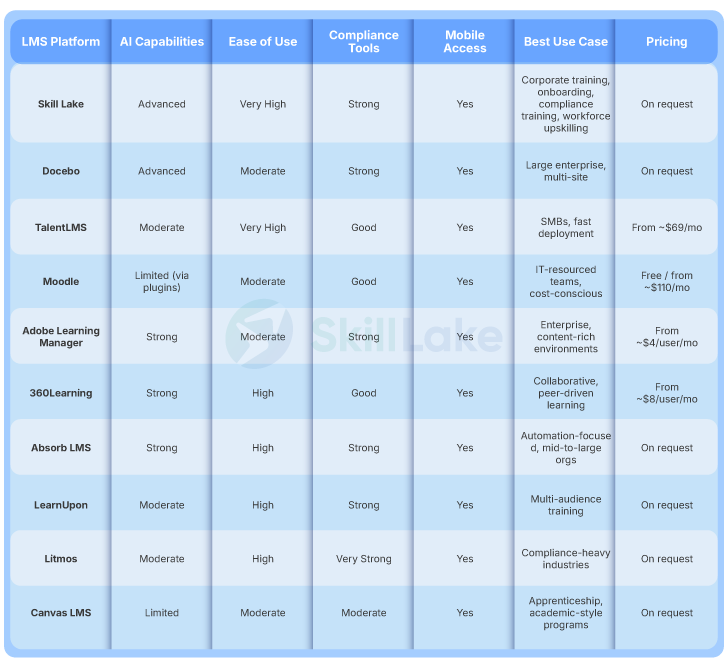
Comparison Table of Top LMS Platforms for Manufacturing

infographics 9 1

Why Manufacturing Industry Needs an LMS

Let’s be honest. Manufacturing training has a reputation problem. It’s often seen as a checkbox exercise. Fill out the form, pass the quiz, and forget everything by Monday. The industry deserves better than that.

Modern manufacturing facilities deal with a staggering training load. You have ISO compliance. Machine-specific SOPs. Hazardous materials handling. Multilingual workforces across multiple shifts. High employee turnover in frontline roles. It’s a lot to manage manually, and spreadsheets simply don’t cut it anymore.

An LMS for manufacturing industry centralizes all of this. It automates compliance tracking so nothing slips through the cracks. It delivers training to workers whether they’re on the floor, in the break room, or at a remote facility. It gives managers real-time visibility into who’s completed what and who hasn’t.

The numbers back this up too. Companies that invest in structured digital training see faster onboarding, lower error rates, better safety outcomes, and higher retention. In an industry where skilled labor shortages are already a major headache, that’s not a small thing.

Key Features of the Best LMS for Manufacturing Industry

Not every LMS is built for the realities of a factory floor. Here’s what to look for when you’re evaluating a manufacturing training platform:

Compliance and certification management

The platform should automate re-certification reminders, track expiry dates, and generate audit-ready reports on demand. No manual chasing.

Mobile-first access

Many manufacturing workers don’t sit at desks. The LMS needs to work on phones and tablets, even in areas with limited connectivity.

SCORM and xAPI support 

Ensures your existing content library plugs in without a rebuild.

Multi-location support 

If you run plants across different cities or countries, the platform needs to handle separate portals, localized content, and role-based access.

ERP and HRIS integration 

Manufacturing operations run on systems like SAP and Oracle. Your LMS should connect with them.

AI and personalization 

Adaptive learning paths that respond to individual skill gaps are becoming table stakes, not luxury features.

Robust analytics 

Not just completion rates. You want data on knowledge retention, performance trends, and training impact on production outcomes. 

Benefits of Using LMS in Manufacturing

The case for adopting an LMS for manufacturing companies isn’t complicated the benefits show up across multiple areas of the business.

Reduced training costs: Digital training eliminates the need for repeated in-person sessions, instructor travel, printed materials, and facility costs. Once a course is built, it scales to thousands of learners at no additional cost.

Consistent training delivery: Every worker across every shift and every location gets the same training. No variation based on which trainer is available that day.

Real-time compliance visibility: Managers can see exactly who holds current certifications and who’s overdue without chasing spreadsheets or emailing supervisors. Automated reminders handle the follow-up.

Faster onboarding: Structured digital onboarding paths get new hires productive faster. Role-specific learning sequences ensure workers learn what’s relevant to their job, not a one-size-fits-all generic orientation.

Better safety outcomes: Regular safety training delivered through an industrial training LMS correlates directly with lower incident rates. Consistent reinforcement builds habits that stick.

Data-driven L&D decisions: Analytics show which training programs are working, which learners are struggling, and where knowledge gaps exist so L&D teams can act on real data instead of gut feel.

How to Choose the Best LMS for Manufacturing Industry

There’s no single right answer here. The best LMS for one manufacturer might be completely wrong for another. Here’s a practical framework for narrowing it down:

Start with your primary training challenge: Is it compliance? Onboarding? Skills development? Safety? The platform you choose should excel at your number-one priority, not just be adequate across the board.

Consider your workforce size and structure: Small teams have different needs than 10,000-person operations. Platforms like TalentLMS excel at fast, lean deployments. Docebo and LearnUpon scale comfortably to enterprise complexity.

Assess your IT capacity: Open-source platforms like Moodle offer maximum flexibility but require internal technical resources. Cloud-based SaaS platforms reduce IT burden significantly.

Check integration requirements: If your HR, ERP, or payroll systems are non-negotiable, verify that the LMS connects with them before you commit to anything.

Think about content creation capacity: If you have an L&D team that creates custom content, you need strong authoring support. If you need ready-made courses, look for platforms with content libraries.

Pilot before you sign: Most platforms offer free trials or demos. Run a real training scenario don’t just click through the admin panel. Involve actual learners in the pilot and listen to their feedback.

Challenges in Manufacturing Training (and How LMS Solves Them)

Manufacturing training isn’t easy. Here are the most common pain points and how a good manufacturing LMS addresses them.

Challenge: High employee turnover means constant retraining. The frontline manufacturing workforce experiences some of the highest turnover rates in any industry. Onboarding new workers repeatedly eats up supervisor time and slows production.

LMS solution: Self-paced digital onboarding paths let new hires complete foundational training independently. Supervisors guide, but don’t babysit. Courses are reusable indefinitely.

Challenge: Compliance deadlines are easy to miss. With dozens of certifications expiring on different dates across a large workforce, manual tracking is practically impossible without errors.

LMS solution: Automated alerts and re-enrollment triggers mean the system handles the reminders. Managers get dashboards. Audit reports generate in minutes.

Challenge: Deskless workers are hard to train. Factory floor workers don’t have desks or computers. Traditional eLearning was built for office environments.

LMS solution: Mobile-first platforms deliver training on smartphones and tablets. Workers complete modules between shifts, during breaks, or at home. Offline access handles low-connectivity environments.

Challenge: Capturing institutional knowledge before experienced workers retire. Baby Boomer retirements continue to drain decades of expertise from manufacturing floors.

LMS solution: Platforms that support collaborative content creation (like 360Learning) let experienced workers record and share knowledge in structured formats before they leave.

Challenge: Multilingual workforces need localized content. Many manufacturing facilities employ workers who speak different languages, creating consistency challenges for training delivery.

LMS solution: Enterprise manufacturing LMS platforms support multilingual interfaces and content localization, ensuring every worker gets training in a language they understand.

Conclusion

The best LMS for manufacturing industry in 2026 isn’t just a course delivery tool it’s a strategic asset that keeps your workforce safe, compliant, skilled, and productive.

Whether you’re a small manufacturer looking for fast deployment with TalentLMS, a large multi-site enterprise exploring Docebo’s AI capabilities, or a compliance-focused operation considering Litmos, there’s a manufacturing LMS on this list that fits your reality.

The key is to match the platform to your actual challenges, not just your wishlist features. Think about what’s costing you the most time, money, or risk right now and choose the LMS that solves that problem first.

Ready to See What a Modern Manufacturing LMS Can Do?

If you’re looking for a manufacturing training platform that combines AI-powered course creation, real-time compliance tracking, and an experience your workers will actually use Skill Lake is worth a serious look.

Skill Lake brings together intelligent learning paths, automated compliance workflows, mobile-first delivery, and analytics that connect training to real performance outcomes. It’s built to scale from mid-sized manufacturers to complex multi-site enterprises without the enterprise price tag.

Request a Demo →

Frequently Asked Questions (FAQs)

Q: What is an LMS for manufacturing?

A: An LMS for manufacturing is a software platform designed to manage, deliver, and track employee training across manufacturing operations including safety compliance, machine operation training, onboarding, skills development, and certification management.

Q: Why do manufacturing companies need an LMS?

A: Manufacturing involves high compliance demands, complex safety requirements, and large frontline workforces that are difficult to train at scale manually. An LMS automates training delivery, tracks compliance, and ensures consistent learning outcomes across all locations and shifts.

Q: What features matter most in a manufacturing LMS?

A: Compliance and certification management, mobile access for frontline workers, SCORM/xAPI support, multi-location capabilities, ERP integration, and robust analytics are the most critical features for manufacturing use cases.

Q: What’s the difference between an LMS and a manufacturing training platform?

A: The terms are often used interchangeably. A manufacturing training platform typically refers to an LMS that’s configured or designed specifically for industrial workforce needs emphasizing compliance, safety, and skills tracking over general corporate learning.

Q: How much does an LMS for manufacturing cost?

A: Pricing varies widely. Entry-level platforms like iSpring Learn start at around $2.82/user/month. Mid-market platforms like TalentLMS start around $69/month flat. Enterprise platforms like Docebo, Absorb, and LearnUpon offer custom pricing based on organization size and features required.

Q: Can an LMS handle safety compliance training?

A: Yes. Most enterprise-grade LMS platforms include automated certification tracking, expiry reminders, audit-ready reports, and pre-built or customizable compliance content making them well-suited for OSHA, ISO, and other regulatory requirements.

Q: How long does it take to implement an LMS for manufacturing?

A: Implementation timelines range from a few days (for simpler platforms like TalentLMS) to several months (for large enterprise deployments like Docebo). The complexity of your content library, integrations, and workforce size all affect the timeline.


Anoop Kumar MS

Anoop Kumar MS, Product Manager of Fingent Global Solutions Pvt. Ltd., is an experienced product specialist with expertise in identifying customer needs and delivering innovative, data-driven solutions. Skilled in wireframing, UX, requirements analysis, risk assessment, team management, and root cause analysis, he excels in managing product lifecycles and fostering seamless collaboration to address real-world challenges.

Other Reads from Skill Lake

  • Top 10 Best LMS Software Systems for Modern Workforces

    Top 10 Best LMS Software Systems for Modern Workforces

    Scaling a business in 2026 requires scaling its workforce’s knowledge and performance readiness. Workplace dynamics have shifted and traditional employee training software doesn’t cut it anymore. Today’s market demands an AI-powered LMS that automates personalized learning journeys and delivers measurable ROI. In this LMS software comparison guide, we analyze the top 10 platforms designed to

    Read More
  • Top LMS Training Platforms for 2026: 10 Best Solutions for Corporate Learning

    Top LMS Training Platforms for 2026: 10 Best Solutions for Corporate Learning

    Legacy corporate training frameworks are failing to solve contemporary skill gaps. To build an agile, future-ready workforce, organizations need a modern corporate training LMS that drives active capability mastery. This post evaluates the top LMS training platforms for 2026 currently delivering measurable operational ROI. Top 10 LMS Training Platforms for 2026 Note: Pricing and features

    Read More

    Stay up to date on the latest in HR and L&D


    Highlights of Skill Lake

    • AI/ML Powered Course Recommendations
    • Courses with AR/VR Experiences
    • Competency & Course Management
    • Multiple Learning Modes
    • Mentoring & Feedback
    • Gamification
    • Learning Bytes
    • Mobile App
    • SCORM Compliance
    REQUEST A DEMO

    Highlights of Skill Lake

    • Sell-Paced & Instructor-Led Learning
    • Tracking & Reporting
    • Mentoring
    • Gamification
    • Learner Dashboard
    • Course Library
    • Enterprise IT Ready

      [recaptcha]

      Highlights of Skill Lake

      • AI/ML Powered Course Recommendations
      • Courses with AR/VR Experiences
      • Competency & Course Management
      • Multiple Learning Modes
      • Mentoring & Feedback
      • Gamification
      • Learning Bytes
      • Mobile App
      • SCORM Compliance
      • Multi-Cloud Hosting

        Watch Skill Lake in Action!

        REQUEST A DEMO

        AI Role Play for Soft Skills Assessment

        Soft skills are a major driver of corporate ROI, but measuring it at scale remains a persistent challenge for L&D leaders. For decades, organizations have relied on human-led evaluations to assess how their workforce actually perform in high-pressure situations. Today, AI role play for soft skills assessment is making the job a piece of cake for leaders. The deeply-immersive, simulation-based learning environment offered by AI role play replicates real-world stressors, simplifying the process of behavioral skill assessment in the modern workplace.

        By implementing AI role play for measuring soft skills, companies gain actionable insights into their employees’ communication, emotional intelligence, empathy, and leadership qualities. Besides, the technology also helps L&D leaders in ensuring that their employee skill development programs are always consistent and effective.

        The Critical Role of Soft Skills in Today’s Evolving Workplace

        With an increasing number of organizations relying on AI to handle their routine operations and data, the “human element” has become the ultimate competitive advantage today. For business leaders, corporate soft skills training is no longer a luxury—but a strategic necessity that drives:

        • Adaptability: Soft skills like critical thinking and ethical judgment allow employees to quickly navigate and adapt to the ongoing digital transformation.
        • Conflict Resolution: High-stakes problem-solving abilities and negotiation skills are crucial for maintaining high-performing, collaborative teams.
        • Retention and Culture: Strong communication fosters engagement, directly impacting long-term employee development and reducing turnover.
        • Customer Trust: Empathy and emotional intelligence remain the core of brand loyalty and customer retention, directly impacting the bottom line.

        What is AI Role Play for Soft Skills Assessment?

        AI role play in learning management system software is a modern, simulation-based learning technique that allows employees to practice and master high-stakes workplace interactions in a guided environment. Unlike traditional workshops, these AI training simulations use natural language processing to mimic real-world conversations—from handling an upset customer to conducting a performance review.

        For the C-suite and L&D leaders, AI-powered soft skills training provides a supervised, scalable way to evaluate empathy, leadership, and communication across a large, distributed workforce. AI transforms behavioral skill assessment from a subjective “guessing game” to an unbiased “data-driven tracking” mechanism.

        How AI Role Play for Soft Skills Assessment Works

        AI role play in LMS measures learners’ soft skills and engagement levels through a simple, iterative cycle:

        • Immersive Workplace Scenarios: Learners enter a guided digital environment where they interact with conversational AI personas that respond dynamically to the learner’s context, tone, word choice, and body language.
        • Real-Time Coaching: The system provides immediate, monitored feedback, highlighting strengths and identifying behavioral gaps as they happen. The instantaneous tips allow employees to constantly refine their soft skills.
        • Data-Backed Analytics: Every training session generates granular metrics, allowing for objective AI-driven workplace training that tracks progress over time.

        By integrating AI role play for corporate training, organizations move beyond theory into practical, repeatable mastery. This ensures that your team is not just “trained”, but truly prepared for the complexities of the modern workplace.

        Key Benefits

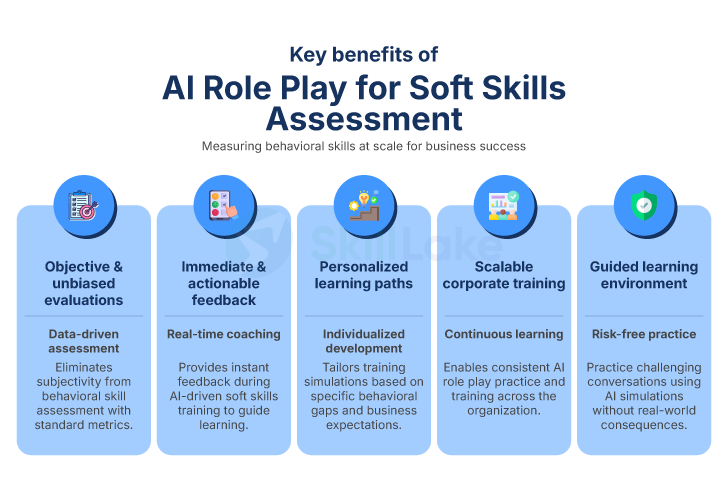
        AI-based learning platforms provide a standardized, data-driven framework for measuring your team’s behavioral skills and interpersonal nuances. This infographic highlights how AI role play training for employees transforms abstract traits into measurable performance metrics, allowing leaders to identify and close behavioral gaps with greater precision.

        infographics 7

        Traditional Role Play vs. AI Role Play for Soft Skills Assessment

        While manual role-playing has served as a training staple for decades, it fails to meet the modern demand for consistency, scalability, and precise data. Simulation-based soft skills evaluation is not just an alternative; it is a fundamental shift toward a fair, unbiased, and data-driven approach to professional growth.


        Assessment Feature Traditional (Manual Role Play) AI-Powered Role Play for Assessing Soft Skills
        Objectivity Subjective: Vulnerable to human bias and inconsistent grading. Objective: Standardized, consistent, algorithm-driven, and bias-free.
        Feedback Delayed: Insights depend on assessor availability and notes. Instant: Real-time, actionable feedback and coaching during the session.
        Scalability Limited: High cost; requires 1:1 human supervision. Unlimited: Scalable 24/7 across global teams instantly.
        Training Environment Variable: Performance often depends on the partner’s skill. Fully Guided: Consistent, risk-free, and repeatable AI training simulations.
        Performance Metrics (Data) Qualitative: Based on “gut feel” and narrative feedback. Quantitative: Granular, measurable KPIs and progress tracking.


        How AI Role Play for Soft Skills Assessment Works in the Real World

        One of the primary benefits of AI role play training is that it allows leaders to measure their team’s communication and negotiation readiness at scale. Here is how different business verticals are applying this technology in high-stakes scenarios:

        • Travel and Hospitality: Hotel chains use AI role play training for service recovery. For instance, staff can learn how to resolve booking errors in controlled simulations, turning hospitality training into a quantifiable, measurable asset.
        • Enterprise Sales (SaaS & Tech): Sales teams use AI role play simulation to master discovery calls. For example, reps can refine their objection-handling skills by facing “skeptical VP” personas. This gives L&D leaders a guided way to certify sales readiness.
        • Financial Services (Wealth Management): Leading banks use AI training simulations to prepare advisors for complex client negotiations. Advisors practice managing “tough” clients, allowing leaders to conduct a behavioral skill assessment on trust and compliance.
        • Healthcare (Patient Communication): Hospitals utilize simulation-based learning for bedside manner training. Staff practice de-escalation with AI patients in a monitored environment, ensuring empathy before real-world patient interactions.

        How Effective is AI Role Play for Soft Skills Assessment

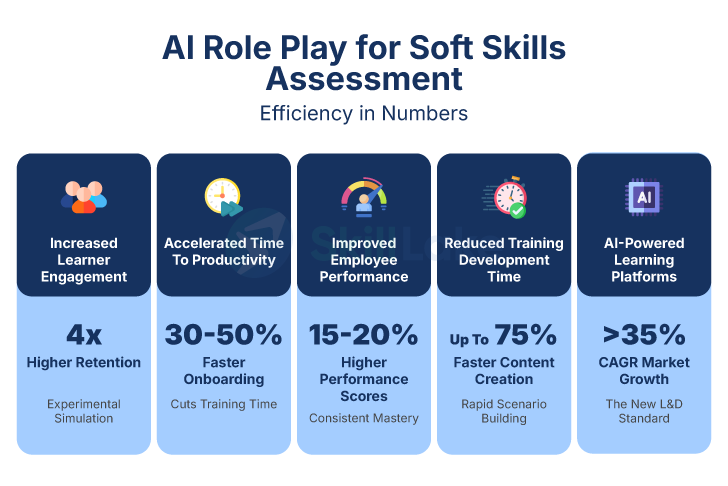
        AI role play drives measurable business outcomes and accelerates workforce readiness by offering the granular insights essential for analyzing employees’ behavioral skills. This statistical breakdown explores how AI role play acts as the new benchmark for building a resilient, future-proof workforce.

        infographics 8

        Future-Proof Your Workforce’s Soft Skills with AI Role Play Training

        The future of corporate growth belongs to organizations that treat interpersonal mastery as a measurable science rather than a subjective art. As technical roles evolve, the ability to communicate, lead, and negotiate remains your most valuable asset.

        By integrating AI role play in learning, Skill Lake LMS transforms passive content into an active, monitored environment for growth. Skill Lake’s AI role play feature effectively bridges the gap between theory and real-world performance, and enhances your L&D strategy through:

        • Realistic AI Training Simulations: Immersive scenarios that mirror high-stakes workplace challenges for guided practice.
        • Automated Behavioral Skill Assessment: Instant, objective scoring on empathy, tone, and persuasion to eliminate human bias.
        • Scalable Employee Skill Development: Deploy consistent, high-quality AI-powered soft skills training to thousands of employees simultaneously.
        • Data-Driven Insights: Comprehensive analytics that allow L&D leaders to track the ROI on behavioral growth.

        The next strategic step is clear: transition from traditional methods to a modern AI-based learning platform. Empower your team with Skill Lake and turn AI role play for soft skills assessment into your organization’s greatest strength.

        Frequently Asked Questions

        Q: How does AI role play for soft skills assessment improve traditional corporate training methods?

        A: Traditional methods are often subjective and slow. By transitioning to a modern LMS with AI role play, organizations get objective, data-driven insights into employee performance. AI-based training simulations eliminate human bias, offering a consistent and scalable way to measure interpersonal growth across the entire global workforce.

        Q: Can simulation-based learning actually replicate the complexity of real-world workplace interactions?

        A: Yes. Modern conversational AI training simulations use advanced natural language processing to mimic nuanced human conversations. This AI-driven workplace training allows employees to practice difficult scenarios—like conflict resolution or executive negotiations—in a monitored environment, ensuring they are fully prepared for real-world complexities.

        Q: What are the primary business benefits of AI role play training for employees?

        A: The benefits of AI role play training include faster time-to-productivity and reduced training costs. By prioritizing AI role play for corporate training, leaders ensure higher retention and engagement. It transforms employee skill development into a quantifiable asset, directly linking training performance to organizational ROI.

        Q: How does Skill Lake’s AI role play help scale global corporate soft skills training?

        A: As a leading learning management system software, Skill Lake allows enterprises to deploy consistent training modules worldwide instantly. The platform ensures every employee, regardless of location, receives the same high-quality, guided practice, making large-scale corporate soft skills training both efficient and affordable.

        Q: In what ways does Skill Lake use AI roleplay for learner engagement and mastery?

        A: Skill Lake provides interactive, dynamic scenarios that respond to user input. This active participation within the role play keeps employees motivated. Frequent, supervised sessions lead to rapid behavioral changes and a deeper mastery of critical communication and leadership competencies.

        Q: How does Skill Lake facilitate more accurate behavioral skill assessment?

        A: AI role play in Skill Lake LMS analyzes the learner’s tone, sentiment, and choice of words. This creates a highly accurate assessment of behavioral skills by generating granular performance metrics. Leaders can then use these insights to pinpoint specific gaps and tailor future development strategies precisely.


        Scale your team’s soft skills with Skill Lake’s AI role play. Discover how it works.

        Anoop Kumar MS

        Anoop Kumar MS, Product Manager of Fingent Global Solutions Pvt. Ltd., is an experienced product specialist with expertise in identifying customer needs and delivering innovative, data-driven solutions. Skilled in wireframing, UX, requirements analysis, risk assessment, team management, and root cause analysis, he excels in managing product lifecycles and fostering seamless collaboration to address real-world challenges.

        Other Reads from Skill Lake

        • Top 10 Best LMS Software Systems for Modern Workforces

          Top 10 Best LMS Software Systems for Modern Workforces

          Scaling a business in 2026 requires scaling its workforce’s knowledge and performance readiness. Workplace dynamics have shifted and traditional employee training software doesn’t cut it anymore. Today’s market demands an AI-powered LMS that automates personalized learning journeys and delivers measurable ROI. In this LMS software comparison guide, we analyze the top 10 platforms designed to

          Read More
        • Top LMS Training Platforms for 2026: 10 Best Solutions for Corporate Learning

          Top LMS Training Platforms for 2026: 10 Best Solutions for Corporate Learning

          Legacy corporate training frameworks are failing to solve contemporary skill gaps. To build an agile, future-ready workforce, organizations need a modern corporate training LMS that drives active capability mastery. This post evaluates the top LMS training platforms for 2026 currently delivering measurable operational ROI. Top 10 LMS Training Platforms for 2026 Note: Pricing and features

          Read More
        AI in Learning and Development

        Modern work requirements and training needs are changing quickly. Professionals are expected to learn new skills faster to adapt to the changing operational structure and customer demands. That’s why companies are turning to AI in learning and development. AI takes learning a step beyond traditional methods to make it more effective, interactive, and impactful.

        It’s true that traditional training methods can’t meet today’s training needs. They are time-consuming, feel mundane, and often don’t align with company goals or workflows. This is where AI-powered learning platforms come into play. These systems help teams learn faster, enhance personalization, and make learning more accountable.

        Here’s more on why modern businesses are choosing AI for learning and skill development.

        What is AI in Learning and Development?

        AI is reshaping how learning and development teams create, manage, and deliver training more efficiently through natural language processing (NLP) and machine learning (ML). It speeds up course creation, recommends content based on each learner’s journey, and identifies skill gaps through instant assessments. It also brings in AI role-play simulations to enable hands-on, practice-based learning.

        When these capabilities are embedded into modern LMS platforms, learning becomes more intuitive, scalable, and impactful. This is how it translates into real outcomes:

        • Build personalized learning paths for each employee
        • Support AI-powered course creation in minutes
        • Suggest what to learn next
        • Track progress with learning analytics
        • Run AI role-play training for real-world practice

        How Is AI Transforming Corporate Learning?

        AI in corporate training is taking learning from a one-size-fits-all approach to a more adaptive and continuous learning experience. It is ensuring that learning stays relevant, up to date, and aligned with each employee’s role and growth path.

        Instead of spending time on what they already know, employees focus only on skills that matter. This makes learning more efficient, practical, and impactful. AI-driven training can help:

        • Adjust content based on the learner’s needs
        • Update training as demand and skills evolve
        • Keep learners engaged with interactive formats
        • Support workforce reskilling without delay

        That’s why companies now depend on AI-based training to build stronger teams.

        Benefits of Using AI in Learning and Development

        The benefits of AI-driven learning platforms show up once teams start using it.

        Learning Feels Personal: Everyone learns differently, and AI understands that. So, it builds personalized learning paths based on skill level and goals.

        • Saves Time: No need to spend weeks building courses. With AI-based automated course creation, teams can launch training fast and save time.
        • Better Engagement: People stay interested when learning feels real. Here, AI roleplay training and interactive lessons help with that.
        • Clear Insights: Learning analytics show what works and what doesn’t. It helps managers to track employees’ progress and get real-time insights.
        • Lower Costs: AI-powered employee training cuts down manual work and outside training costs. Overall, workplace learning with AI helps companies train smarter, not harder.

        How Skill Lake AI Features Support Learning and Development?

        Workplace learning needs to stay relevant. Teams don’t just need content—they need to know what skills they have and what they’re missing. AI-based learning platforms like Skill Lake help make this clearer by supporting both learning and skill evaluation. Here’s how these features help in a simple way.

        AI Course Creation

        Creating courses takes time, especially when skill needs keep changing. Here, AI course generators in learning platforms help generate courses quickly on any topic, and it also helps focus on specific skills. If a team lacks a certain skill, courses can be created around that gap. This makes learning more targeted.

        AI Questionnaire Generation

        AI can create quizzes in seconds. These quizzes help check what learners actually understand. Also, these regular assessments make it easier to spot weak areas. If someone struggles with certain questions, it clearly shows a skill gap. This helps teams take action early instead of waiting.

        AI Copilot

        AI Copilot lets you refine courses and content to match them as per your needs. You can also summarize or rewrite text to align it closely to your training requirements. If learners find something difficult, it can be made easier. This keeps learning useful and supports better skill development over time.

        AI Course Recommendation

        Many learners lose interest when they don’t know what to learn next. AI course recommendations solve this by guiding them step by step.

        AI LMS offers course recommendations based on a learner’s profile, job role, past learning, and skill level. This means learners see content that actually fits their needs and keeps them engaged, as they don’t feel lost or overloaded. This improves employee skill development over time.

        AI Role Play Simulation

        AI role play gives learners a space to practice real situations. Instead of just reading, they respond and learn through experience. The system reacts based on their answers, which makes it feel real. After each session, learners get feedback on their performance. Also a reliable corporate training platform helps employees handle critical situations and build strong skills.

        Traditional LMS vs AI-Powered LMS

        Learning systems have changed a lot over time. A traditional LMS helps you share courses and track progress. An AI-powered LMS feels more smart and flexible. It learns how people learn and gives them content that fits their needs. It can guide users, suggest what to study next, and make learning more personal.

        The table below shows how both are different.

        Feature Traditional LMS AI-Powered LMS
        Learning Approach One-size-fits-all content Personalized learning paths based on user behavior
        Content Delivery Static modules and courses Dynamic, adaptive content recommendations
        Engagement Level Limited interactivity High engagement with AI-driven suggestions and gamification
        Skill Gap Analysis Manual or periodic Real-time identification of skill gaps
        Feedback Mechanism Delayed or generic Instant, data-driven feedback
        Scalability Limited flexibility Highly scalable and adaptive to business needs
        Decision Making Based on historical data Predictive insights and analytics
        Learning Experience Passive learning Interactive and continuous learning experience

        Statistics on AI-based Training (2025–2030)

        • AI can cut course creation time by up to 60%.
        • AI-powered learning platforms can boost engagement by 40–60%.
        • The AI in the corporate training market may grow by over 25% each year.
        • Companies see up to 30% better employee performance and revenue growth.
        • Around 70% of businesses may adopt AI learning platforms for enterprises by 2030.

         Statistics on AI in Learning and Development

        Use Cases of AI in Corporate Training

        AI is changing how people learn at work. It doesn’t just deliver training—it helps people learn the right things at the right time. Here are some simple ways it shows up in corporate training:

        Onboarding

        New hires don’t go through one fixed training anymore. They get learning based on their role and what they need to do. It helps them get comfortable faster and start contributing sooner.

        Sales Practice

        Sales teams can practice real conversations using AI role play simulation. They try different responses, handle tricky questions, and learn from feedback. It feels close to real customer situations, which builds confidence.

        Skill Gap Analysis

        One of the most useful parts is clarity. AI helps show what skills are missing in a team or individual. This makes it easier to plan training that actually matters.

        Personalized Learning Paths

        Every employee learns in a unique way or speed. AI maintains learning paths based on progress, so each person gets a more natural flow instead of a fixed plan.

        Continuous Learning Support

        We all know that learning is a continuous process and it doesn’t end after one course. AI keeps suggesting next steps, so people keep building skills over time instead of stopping after training sessions.

        Tech Skills Development

        Technology keeps changing, so teams need to keep learning. AI suggests useful topics based on current skills and job needs. This way, people don’t waste time on things they already know.

        Leadership Growth

        AI can pick up patterns in how people work and learn. This helps managers notice who is ready for bigger responsibilities. Those people can then be guided with the right learning steps.

        Top Trends of AI-Driven Learning Platforms

        AI is not only improving training but also transforming the process of learning. The following are some of the trends that will bring this transformation:

        Hyper-Personalized Learning

        AI interprets employees’ behavior and preferences, as well as their performance, and provides recommendations to enable a personalized learning journey.

        Intelligent Content Creation

        Rather than manually searching resources, AI automatically filters useful content, videos, articles, and courses, according to your purpose and progress.

        Real-Time Skill Gap Analysis

        AI-based LMS tracks performance and recognizes areas of skill deficiency in real time, enabling managers to implement initiatives for upskilling their employees.

        AI-Powered Learning Support

        Learning feels easier when you don’t have to figure everything out on your own. That’s where AI-powered learning support comes in role. It’s not a separate assistant. Instead, it works quietly in the background through features already built into the platform.

        Role plays, recommendations, and content suggestions all work collectively to support learners in real time. This kind of support also helps track progress and highlight skill gaps.

        AI-Driven Learning Insights

        Sometimes, you just need a clear view of what’s going on. AI-driven learning insights help with that. AI-based LMS show real insights about how people are learning, where they’re doing well, and where they need improvement. These insights also support better decisions around training, making it easier to adjust learning plans based on actual needs.

        Why Enterprises Are Integrating AI-Powered Learning Platforms?

        There are lots of reasons why businesses are integrating AI in corporate training. They don’t want traditional systems anymore that won’t give measurable results. Let’s check some of the top reasons:

        • Train faster
        • Improve employee skill development
        • Keep teams engaged
        • Scale learning across teams

        Conclusion

        Learning at work should feel useful, not forced. People don’t want long courses that they forget. They want quick help that solves real problems. That’s where AI in learning and development fits in.

        It helps teams learn faster, makes training simple, and gives clear results. For companies, it’s a simple way to build stronger, more capable teams for revenue growth and employee empowerment.

        FAQs

        Q: What is AI in corporate training?

        A: Use AI to help people learn better at work. It can build courses, guide users, and track how they do. It also adjusts learning based on each person. So, people get the right skills without wasting time.

        Q: How does AI help in corporate training?

        A: AI removes the need to do lots of hard work. It builds training fast and points people to what matters most. It also keeps things interesting with quizzes and real-life tasks. That way, learning sticks and people actually use them.

        Q: What are AI-powered learning platforms?

        A: These are tools that run training with AI. They don’t treat everyone the same and provide each learner with content based on their needs. They also show progress and give useful feedback, which makes learning feel simple and clear.

        Q: Why do companies use AI-driven workplace training?

        A: Companies use AI-driven workplace training to get better results in less time. AI helps them train teams faster and keep them engaged. It also supports skill growth across roles. Overall, with AI-driven workplace training, teams perform better and stay ready for change.

        Q: What is the future of AI in learning and development?

        A: The future of workplace learning with AI will focus on smarter, more personal learning. AI will guide people step by step and create content on the go. Companies will use it to keep teams skilled and adaptable.


        Anoop Kumar MS

        Anoop Kumar MS, Product Manager of Fingent Global Solutions Pvt. Ltd., is an experienced product specialist with expertise in identifying customer needs and delivering innovative, data-driven solutions. Skilled in wireframing, UX, requirements analysis, risk assessment, team management, and root cause analysis, he excels in managing product lifecycles and fostering seamless collaboration to address real-world challenges.

        Other Reads from Skill Lake

        • Top 10 Best LMS Software Systems for Modern Workforces

          Top 10 Best LMS Software Systems for Modern Workforces

          Scaling a business in 2026 requires scaling its workforce’s knowledge and performance readiness. Workplace dynamics have shifted and traditional employee training software doesn’t cut it anymore. Today’s market demands an AI-powered LMS that automates personalized learning journeys and delivers measurable ROI. In this LMS software comparison guide, we analyze the top 10 platforms designed to

          Read More
        • Top LMS Training Platforms for 2026: 10 Best Solutions for Corporate Learning

          Top LMS Training Platforms for 2026: 10 Best Solutions for Corporate Learning

          Legacy corporate training frameworks are failing to solve contemporary skill gaps. To build an agile, future-ready workforce, organizations need a modern corporate training LMS that drives active capability mastery. This post evaluates the top LMS training platforms for 2026 currently delivering measurable operational ROI. Top 10 LMS Training Platforms for 2026 Note: Pricing and features

          Read More
        AI-Powered Roleplay Learning

        Most organizational leaders find their current workforce development programs failing to bridge the gap between theory and execution. This massive disconnect exists because traditional training doesn’t provide the realistic and immersive practice environment essential for building true workplace competence today. Static and passive learning forces companies to deal with slow ramp-up times and a workforce that is unprepared for real-world challenges.

        A modern LMS with AI-powered roleplay learning prepares your employees for the actual workplace challenges through immersive simulations, repeated practice, and instant corrective tips. This post explores how AI role play training allows businesses to close the loop on employee performance and gain a decisive competitive edge.

        The Performance Gap: Traditional vs. AI-Powered Role Play Learning

        While traditional training focuses on information delivery, AI roleplay learning focuses on behavioral outcomes. Conversational AI simulations outperform legacy training methods, turning passive learners into high-performance assets—here is how the two methods compare in bridging the 2026 performance gap.


        Feature Traditional Learning (The Gap) AI Roleplay Learning (The Solution)
        Primary Method Passive (Reading manuals, watching slide decks). Active (Lifelike simulations, verbal interaction).
        Learning Speed Slow ramp-up; requires “on-the-job” mistakes. Quick mastery through repeated practice and correction.
        Feedback Loop Delayed (Periodic reviews, relies on manager availability). Instant (Objective, real-time AI scoring and feedback).
        Risk Factor High (Learning during high-stakes client calls). Zero (Safe-to-fail guided environment).
        Scalability Linear (Limited by human trainer hours). Exponential (Available 24/7 to large, distributed teams).
        Personalization Static (One-size-fits-all curriculum). Dynamic (AI adjusts to the learner’s needs and goals).
         

        AI-Powered Roleplay Learning: Fixing the Performance Gap

        Bridging the divide between theory and execution requires a drastic shift from static content to dynamic application. Here’s how AI role play in LMS transforms your workforce into a high-performance engine:

        Gamified Learning Experience

        AI transforms mundane training into an immersive game-like experience. By incorporating skill or role levels, instant feedback and scoring, and interactive narratives, AI role play for learner engagement triggers a dopamine response that keeps employees invested. It accelerates mastery and ensures consistent participation across global teams.

        Handling Difficult Workplace Scenarios with Confidence

        Employees can use AI role play for handling difficult workplace conversations—such as giving performance reviews or resolving conflicts—within a duly-guided, simulated environment. This boosts emotional intelligence, empathy, and true muscle memory, allowing teams to navigate high-stakes situations with confidence and precision.

        AI-Driven Personalized Learning Paths

        Traditional training has always been one-size-fits-all, while AI analyzes individual performance in real-time to adjust the complexity, purpose, and focus of each simulation. This ensures every employee receives a tailored learning path that addresses their specific skill gaps or professional development needs.

        Real-Time Feedback That Drives Performance

        Waiting for quarterly reviews and manager availability is too slow for modern business. AI-powered role play sessions provide immediate, objective reviews on tone, word choice, and strategy. This instant feedback loop allows employees to correct mistakes on the spot, significantly shortening the proficiency curve.

        Data-Driven Learning That Aligns With Business Outcomes

        A modern learning management system software with AI role play tracks behavioral shifts and competency gains beyond mere completion rates. This provides C-suite leaders with clear visibility into workforce readiness. It helps ensure every training hour directly contributes to hitting your strategic organizational KPIs.

        Shift from Passive Content to Active Skill Practice

        Reading a manual or slide deck isn’t the same as mastering a skill. By increasing your employees’ LMS engagement with AI role play, you help them advance from passive content consumption to active skills mastery. Realistic simulation-based learning facilitates the contextual application and deep retention of knowledge acquired.

        Read More: How AI Role Play for Learner Engagement Replaces Passive Training?

        The Business Impact of AI-Powered Role Play Learning

        Gartner’s report highlights that organizations investing in AI-driven employee upskilling are 2.5 times more likely to achieve positive business outcomes. This indicates the rise of AI roleplay simulations as a crucial bridge connecting employee learning and actual performance.

        5 Ways AI Role Play Training Impacts Your Business:

        • Efficiency: Shortens the proficiency curve significantly.
        • Agility: Employees correct errors in the moment.
        • Trust: Safeguards brand reputation and interpersonal relationships.
        • Growth: Delivers consistent training across the entire enterprise.
        • ROI: Ensures training time is spent only on specific skill gaps.

        How is AI-Powered Role Play Learning Used in the Real World?

        Realistic guided practice and bottom-line growth have a direct correlation. In fact, Forbes notes that companies investing in simulation-based learning experience a 42% rise in productivity. It proves why AI-based coaching is not just an L&D luxury but a financial imperative. Here are a few examples of how businesses are using AI role play training to fix their performance gaps and boost growth rates.

        Hospitality: Elevating Guest Experience

        Businesses in the hospitality and restaurant service sector are using AI-powered role play learning to standardize interactions. This approach accelerates ramp-up time for new hires and ensures premium service standards are met consistently, increasing brand loyalty without constant manual oversight.

        Compliance: Mitigating Regulatory Risk

        Organizations operating within regulated industries like Insurance, Banking, or Finance can use AI role play to simulate complex audits. This guided practice ensures professionals and executives navigate compliance mandates with precision, reducing human error and protecting the organization from costly legal or financial penalties.

        Infotech: Faster Technical Problem-Solving

        Immersive simulations allow IT support teams to practice high-pressure troubleshooting tickets and escalations in a regulated environment. This leads to faster issue resolution and higher training ROI as engineers quickly move from passive manuals to active skill mastery.

        Sales Departments: Increasing Conversion

        Using simulation-based coaching, sales reps can master scenarios like objection handling or answering client calls so they can close deals faster. This immersive practice shortens sales cycles and improves lead conversion by ensuring reps are prepared for every customer interaction.

        Healthcare: Optimizing Patient Communication

        Healthcare leaders use conversational AI simulations to automate empathy-based training for their staff. This scalable approach improves communication quality and reduces administrative burdens on contact centers, allowing for more efficient patient care and lower operational overhead.

        LMS Engagement with AI: Defining the Future of Training

        AI Role Play in LMS is now non-negotiable. It is no longer a nice-to-have feature but a strategic L&D necessity that transforms training from a passive “deliver and track” model to a “dynamic ecosystem” where employees build real muscle memory.Here are more reasons why traditional LMS training fails due to a lack of practice, whereas a modern LMS with AI role play can support:

        • Active skill development through immersive, lifelike practice
        • Real-time feedback boosts workforce performance
        • Simulation-based learning increases engagement and retention
        • Faster ramp-up and speed-to-productivity, higher ROI

        Skill Lake’s AI-powered roleplay learning is specifically engineered to bridge your company’s “learning-to-performance gap” by turning theoretical knowledge into field-ready expertise. Our platform provides a guided virtual environment for high-stakes practice, eliminating knowledge loss for businesses. It directly boosts your organization’s agility, bottom-line growth, and productivity.

        Get in touch with us to understand how Skill Lake can transform your corporate training into a high-performance engine.


        See how your teams can master real-world scenarios using AI-powered role play simulations.

        Frequently Asked Questions

        Q: How does AI-powered roleplay learning bridge my organization’s performance gap?

        A: AI-fueled role play sessions allow your team members to rehearse real-world conversations repeatedly in a guided environment. This boosts their communication skills and confidence, turning classroom knowledge into high-impact workplace performance.

        Q: What are the core benefits of using AI for roleplay learning?

        A: Key advantages include 24/7 scalability (for large and scattered teams), immediate personalized feedback, and a bias-free, guided space for repeated practice. Organizations see faster time-to-proficiency and significant cost savings by replacing expensive, manual role-playing sessions with consistent and adaptive AI simulations.

        Q: Can AI role play in LMS platforms improve long-term knowledge retention?

        A: Yes. AI role play in learning management system software uses active retrieval and spaced repetition. When learners communicate with AI personas, providing original, contextual responses, the knowledge retention rate improves manifold compared to passive reading or video consumption.

        Q: How does Skill Lake’s AI role play for learner engagement work?

        A: Skill Lake supports role-playing using different conversational personas—such as a frustrated customer or a demanding manager—to drive interaction and engagement. Learners engage in natural dialogues, and the AI adapts its tone and responses in real-time based on the user’s input. This ensures a highly authentic, personalized, and challenging experience.

        Q: Does Skill Lake’s AI role play provide data-driven coaching insights?

        A: Yes. Skill Lake analyzes the language, tone, sentiment, accuracy, and communication style of learners during every simulation, allowing L&D leaders to identify exactly where teams require personalized coaching/ human mentoring.

        Q: Is Skill Lake’s AI role play training customizable for specific industry needs?

        A: Absolutely. Our AI role play feature is fully customizable. You can define unique scenarios—from pharmaceutical compliance to hospitality service standards—ensuring that every training simulation is directly relevant to your organization’s specific business outcomes or challenges.


        Anoop Kumar MS

        Anoop Kumar MS, Product Manager of Fingent Global Solutions Pvt. Ltd., is an experienced product specialist with expertise in identifying customer needs and delivering innovative, data-driven solutions. Skilled in wireframing, UX, requirements analysis, risk assessment, team management, and root cause analysis, he excels in managing product lifecycles and fostering seamless collaboration to address real-world challenges.

        Other Reads from Skill Lake

        • Top 10 Best LMS Software Systems for Modern Workforces

          Top 10 Best LMS Software Systems for Modern Workforces

          Scaling a business in 2026 requires scaling its workforce’s knowledge and performance readiness. Workplace dynamics have shifted and traditional employee training software doesn’t cut it anymore. Today’s market demands an AI-powered LMS that automates personalized learning journeys and delivers measurable ROI. In this LMS software comparison guide, we analyze the top 10 platforms designed to

          Read More
        • Top LMS Training Platforms for 2026: 10 Best Solutions for Corporate Learning

          Top LMS Training Platforms for 2026: 10 Best Solutions for Corporate Learning

          Legacy corporate training frameworks are failing to solve contemporary skill gaps. To build an agile, future-ready workforce, organizations need a modern corporate training LMS that drives active capability mastery. This post evaluates the top LMS training platforms for 2026 currently delivering measurable operational ROI. Top 10 LMS Training Platforms for 2026 Note: Pricing and features

          Read More
        Insurance training platform

        The insurance industry operates in one of the most regulated, knowledge-intensive, and performance-driven sectors in the world. Every policy recommendation, underwriting decision, claims assessment, and customer interaction depends on how well employees understand compliance regulations, product structures, risk frameworks, and internal processes.

        Insurers operate under strict regulatory oversight. Certification requirements, product disclosures, audit mandates, and regulatory updates are continuous. Non-compliance can result in penalties, reputational damage, and operational setbacks.

        For Learning & Development (L&D) teams, this creates a strategic responsibility. Training is no longer just about knowledge sharing — it is about ensuring compliance, accelerating productivity, enabling sales performance, and demonstrating measurable ROI.

        A specialized Learning Management System Software, built specifically for insurance as a modern insurance training platform, transforms how organizations approach training. Modern Learning Management Systems (LMS) for the insurance industry centralize knowledge, automate compliance tracking, personalize learning journeys, and provide real-time analytics that connect training directly to business outcomes.

        Why Insurance Companies Need a Specialized LMS

        Insurance training is fundamentally different from general corporate training. It requires:

        • Mandatory certification lifecycle management
        • Ongoing regulatory training updates
        • Continuous product education
        • Structured insurance sales enablement
        • Multi-branch and distributed workforce training
        • Real-time compliance visibility

        A generic LMS may deliver digital courses, but it often lacks the certification automation, compliance dashboards, advanced reporting, and role-based intelligence essential for insurance operations.

        A purpose-built Insurance training platform aligns learning with regulatory compliance, operational excellence, and revenue performance.

        Key Training Challenges in the Insurance Industry

        Regulatory Compliance & Certification Management

        Insurance professionals must complete mandatory certifications and renew them periodically. Regulatory authorities require accurate documentation, timely renewals, and audit-ready reports.

        • Manual tracking through spreadsheets:
        • Increases administrative workload
        • Creates audit stress
        • Raises risk of certification lapses
        • Leads to compliance penalties

        A compliance-focused insurance training software automates certification lifecycle tracking, renewal alerts, mandatory assignments, and reporting — ensuring continuous readiness.

        Complex and Evolving Insurance Products

        Modern insurance portfolios include:

        • Customizable policies
        • Add-on riders
        • Digital insurance offerings
        • Micro-insurance plans
        • Usage-based insurance models

        Each product launch demands immediate knowledge transfer. Without a centralized insurance product training platform, delays in learning can result in mis-selling, customer dissatisfaction, and revenue loss.

        Distributed Workforce & Field Agents

        Insurance companies operate through:

        • Branch offices
        • Independent agents
        • Bancassurance partnerships
        • Remote support teams

        Delivering consistent training across geographies is difficult without a centralized digital learning ecosystem. A mobile-enabled LMS for insurance industry ensures field agents can access training anytime, anywhere.

        High Attrition & Continuous Onboarding

        Sales-heavy insurance firms experience frequent hiring cycles. L&D teams must repeatedly onboard new agents while maintaining compliance and product accuracy.

        A scalable insurance agent onboarding platform standardizes induction, accelerates readiness, and shortens time-to-productivity.

        Common Pain Points for Insurance L&D Teams

        L&D Challenge Business Impact
        Manual certification logs Increased compliance risk
        Classroom-heavy sessions High operational costs
        Fragmented knowledge systems Inconsistent information delivery
        No analytics visibility Limited ROI measurement
        Generic training modules Low engagement & retention
        Slow onboarding cycles Delayed revenue generation

        Modern L&D leaders are accountable not just for delivering training — but for proving measurable business impact.

        How Skill Lake Supports Insurance L&D Transformation

        Skill Lake is purpose-built to address compliance-intensive and distributed industry challenges. It strengthens every learning capability required in insurance.

        AI-Powered Course Creation & Personalization

        Skill Lake enables:

        • Rapid AI-assisted course creation
        • Personalized learning paths for agents, underwriters, brokers, and claims teams
        • Automated course recommendations
        • Skill gap identification through advanced analytics

        Using an AI-powered LMS for insurance, organizations can deliver intelligent, role-specific, and adaptive development journeys.

        AI-Driven Roleplay for Sales & Service Scenarios

        Skill Lake introduces AI-powered roleplay simulations for insurance-specific scenarios:

        • Simulate customer objections and sales interactions
        • Practice regulatory disclosure conversations
        • Improve empathy and communication through virtual roleplaying
        • Enable guided practice for new agents without risking customer experience

        This gamified, experiential learning enhances confidence, communication skills, and compliance readiness — especially valuable in high-stakes client-facing roles.

        Automated Compliance Training Workflow

        Skill Lake offers:

        • Certification lifecycle tracking
        • Expiry alerts and automated reminders
        • Mandatory compliance course assignment
        • Audit-ready documentation
        • Regulatory reporting dashboards

        With structured compliance training workflows and real-time reporting dashboards, compliance becomes more organized, visible, and easier to manage.

        Centralized & Structured Course Management

        For multi-branch insurance companies, Skill Lake supports:

        • Unified training delivery
        • Structured onboarding journeys
        • Version control for updated policies
        • Real-time tracking of learner progress across all branches

        This creates a single source of truth for insurance product training and compliance learning.

        Mobile LMS for Field Agents

        Skill Lake’s mobile-first approach offers:

        iOS and Android compatibility

        • Offline access
        • Instant product refreshers before client meetings
        • Push notifications for reminders and updates

        A mobile LMS for field agents ensures learning continues without operational interruptions.

        Training Performance & Analytics

        • Real-time course completion tracking
        • Assessment performance analysis
        • Learner engagement insights
        • Role-based learning progress visibility
        • Skill development tracking

        As a comprehensive insurance workforce development solution, it empowers L&D leaders to tie learning to revenue and regulatory outcomes.

        Case Study: 60% Rise in Training ROI with Skill Lake

        Client: Mana Insurance Solutions, Hawaii

        Challenges faced:

        • Inefficient manual training
        • Face-to-face onboarding delays
        • Poor compliance tracking
        • Inconsistent knowledge delivery
        • Low engagement from remote agents

        Solution Implemented:

        • Standardized digital onboarding
        • AI-personalized learning paths
        • Compliance automation
        • Roleplay simulations for customer scenarios
        • Mobile learning access
        • Centralized analytics

        Results Delivered:

        • 85%+ training completion rate
        • 70% faster compliance tracking
        • 40% faster onboarding
        • 5X higher learner engagement
        • 60% improvement in training ROI
        • Up to 70% reduction in training costs

        Traditional Insurance Training vs Skill Lake LMS

        Traditional Training Skill Lake LMS
        Classroom-dependent Digital & hybrid learning
        Manual certification logs Automated compliance dashboard
        Static content updates Instant content deployment
        Limited reporting Real-time analytics & ROI tracking
        Generic modules AI-personalized learning & roleplay
        High logistical cost Scalable digital training model

        Business Impact of Implementing Skill Lake in Insurance

        A specialized LMS for insurance companies delivers measurable impact:

        • Reduced compliance penalties
        • Accelerated onboarding
        • Improved product knowledge
        • Higher sales readiness
        • Lower operational training costs
        • Increased employee engagement
        • Stronger customer retention
        • Clear visibility into training ROI
        • Building a Future-Ready Insurance Workforce

        As insurance undergoes rapid digital transformation, staying compliant and competitive requires:

        • Always-on learning systems
        • Real-time compliance tracking
        • Product update dissemination
        • Distributed workforce enablement
        • Intelligent learning personalization

        With Skill Lake’s AI-powered LMS for insurance, L&D becomes a strategic business enabler — not just a support function.

        Conclusion

        In the insurance industry, knowledge is not optional. It is operational power.

        From regulatory compliance and evolving product portfolios to distributed agents and performance-driven sales teams, insurers operate in an environment where mistakes are costly and expertise builds trust.

        • Traditional training methods are no longer sufficient.
        • A modern AI-powered LMS enables insurance organizations to:
        • Deliver consistent, role-based training at scale
        • Accelerate onboarding for new agents
        • Strengthen sales and customer communication skills through AI roleplay simulation
        • Improve engagement and knowledge retention
        • Gain clear visibility into training performance
        • Align learning with business outcomes

        Skill Lake transforms learning from a reactive support function into a proactive growth engine.

        In a rapidly evolving and compliance-sensitive industry, investing in a specialized LMS is not just about digitizing courses. It is about building a smarter, more confident, and future-ready insurance workforce.

        Book a demo today and see how Skill Lake can elevate your insurance L&D strategy.

        Frequently Asked Questions (FAQ)

        Q: Why does the insurance industry need a specialized LMS?

        A: The insurance industry operates under strict regulatory requirements and complex product structures. A specialized LMS supports structured training, product education, onboarding, role-based learning paths, and performance tracking — all essential for maintaining compliance and improving sales readiness.

        Q: How does an LMS improve compliance training in insurance?

        A: An LMS helps by

        • Assigning mandatory training programs
        • Tracking course completion
        • Maintaining centralized documentation
        • Providing reporting visibility

        This ensures employees complete required compliance-related training and managers can monitor progress easily.

        Q: How does AI roleplay help insurance agents?

        A: AI-powered roleplay allows agents to practice

        • Customer objection handling
        • Policy explanation
        • Regulatory disclosures
        • Sales conversations

        It provides guided, text-based feedback so agents can improve communication skills and build confidence before interacting with real customers.

        Q: Can an LMS help with onboarding insurance agents?

        A: Yes. A structured digital onboarding program helps:

        • Standardize induction training
        • Deliver product education efficiently
        • Reduce time-to-productivity
        • Ensure consistent knowledge delivery

        This is especially important in high-attrition insurance environments.

        Q: How can insurance companies measure training performance?

        A: With training performance and analytics tools, organizations can track

        • Course completion rates
        • Assessment scores
        • Engagement levels
        • Skill development progress

        These insights help L&D teams understand training effectiveness and support business decisions.

        Q: Is Skill Lake suitable for distributed insurance teams?

        A: Yes. Skill Lake’s mobile-first platform allows agents, branch staff, and remote teams to access training anytime and anywhere, ensuring consistent learning across geographies.


        Anoop Kumar MS

        Anoop Kumar MS, Product Manager of Fingent Global Solutions Pvt. Ltd., is an experienced product specialist with expertise in identifying customer needs and delivering innovative, data-driven solutions. Skilled in wireframing, UX, requirements analysis, risk assessment, team management, and root cause analysis, he excels in managing product lifecycles and fostering seamless collaboration to address real-world challenges.

        Other Reads from Skill Lake

        • Top 10 Best LMS Software Systems for Modern Workforces

          Top 10 Best LMS Software Systems for Modern Workforces

          Scaling a business in 2026 requires scaling its workforce’s knowledge and performance readiness. Workplace dynamics have shifted and traditional employee training software doesn’t cut it anymore. Today’s market demands an AI-powered LMS that automates personalized learning journeys and delivers measurable ROI. In this LMS software comparison guide, we analyze the top 10 platforms designed to

          Read More
        • Top LMS Training Platforms for 2026: 10 Best Solutions for Corporate Learning

          Top LMS Training Platforms for 2026: 10 Best Solutions for Corporate Learning

          Legacy corporate training frameworks are failing to solve contemporary skill gaps. To build an agile, future-ready workforce, organizations need a modern corporate training LMS that drives active capability mastery. This post evaluates the top LMS training platforms for 2026 currently delivering measurable operational ROI. Top 10 LMS Training Platforms for 2026 Note: Pricing and features

          Read More
        How Skill Lake helps insurance companies

        Insurance companies operate in a highly regulated environment where employees must understand complex policies, compliance requirements, and customer needs. Delivering consistent training across distributed teams can be challenging when organizations rely on traditional learning methods.

        The AI-powered Learning Management System (LMS) helps insurance organizations modernize workforce training by enabling role-based learning, automated compliance tracking, and personalized learning paths. With intelligent learning tools, insurance companies can improve agent productivity, accelerate onboarding, and ensure employees stay updated with evolving regulations and product knowledge.

        Modern LMS platforms also allow organizations to track employee performance, identify skill gaps, and continuously improve training strategies using real-time learning analytics.

        How Mana Insurance Improved Training ROI by 60% With Skill Lake LMS

        Mana Insurance Solutions implemented Skill Lake’s AI-powered LMS to transform its workforce training approach. By adopting a modern learning platform with role-based training paths, mobile accessibility, and automated compliance tracking, the organization streamlined its training operations and improved learning engagement.

        As a result, Mana Insurance achieved significant improvements in training efficiency and workforce performance, including a 60% increase in training ROI, faster onboarding for agents, and better compliance management.

        Training Impact at Mana Insurance

        After implementing Skill Lake LMS, Mana Insurance achieved measurable improvements in workforce training and performance.

        Key Outcomes

        • 60% increase in training ROI
        • 85% improvement in course completion rates
        • 40% faster onboarding for insurance agents
        • 70% faster compliance tracking
        • 5× increase in learning engagement

        These results helped the organization build a scalable and efficient insurance employee training platform.

        infographics 3

        About Mana Insurance Solutions

        Mana Insurance Solutions is a Hawaii-based insurance provider offering affordable health insurance plans for individuals, families, and businesses.

        The organization focuses on delivering high-quality customer service through well-trained insurance agents and effective policy guidance.

        To maintain service standards, Mana Insurance invested in a corporate training automation system that supports continuous employee learning and compliance readiness.

        The Training Challenge

        Like many insurance organizations, Mana Insurance faced difficulties scaling training programs across distributed teams and branch offices.

        Their legacy learning model relied heavily on classroom sessions and offline training programs, which limited accessibility and slowed employee development.

        Without a modern insurance LMS platform, training lacked scalability, personalization, and performance insights.

        Major Workforce Training Problems

        Mana Insurance encountered several challenges affecting training efficiency.

        • Difficulty delivering personalized learning paths across departments
        • Slow agent onboarding system for new hires
        • Limited visibility into employee skill development
        • Manual compliance training tracking using spreadsheets
        • Limited accessibility for mobile learning users
        • High operational costs due to classroom training
        • Weak product knowledge affecting policy sales conversions

        Insurance professionals must continuously learn new policies, regulatory updates, and customer scenarios. Without continuous microlearning, knowledge retention becomes difficult.

        Why Skill Lake LMS Was the Right Solution

        Mana Insurance implemented Skill Lake LMS, an advanced AI-powered learning management system software designed for corporate training and workforce upskilling.

        The platform helped the organization transition from traditional training methods to a modern AI-driven employee training ecosystem.

        How Mana Insurance Implemented Skill Lake LMS

        Mana Insurance followed a structured implementation process to modernize their training system.

        Step 1: Centralizing Training Content

        All learning materials, compliance courses, and product training were migrated into the Skill Lake LMS platform.

        Step 2: Creating Role-Based Learning Paths

        Customized learning journeys were designed for different roles such as sales agents, underwriters, and claims teams.

        Step 3: Introducing AI Role Play Simulations

        Agents practiced real-world customer conversations using AI-powered role play simulations.

        Step 4: Enabling Mobile Learning

        Field agents gained access to training programs through the mobile LMS platform, allowing them to learn anytime and anywhere.

        Step 5: Tracking Performance with Analytics

        Training managers used dashboards to track course completion, skill gaps, compliance status, and engagement metrics.

        Key Features That Supported Training Transformation

        AI-Powered Course Creation

        Skill Lake enabled rapid development of training content using AI-assisted tools. This allowed training teams to quickly update learning programs whenever regulations or insurance products changed.

        Personalized Learning Paths

        Not every employee needs the same training. Skill Lake LMS allows organizations to create role-based learning paths, ensuring employees receive training that is relevant to their responsibilities.

        This helps organizations to:

        • Deliver role-specific training
        • Improve learning engagement
        • Build skills more effectively

        For example:

        • Sales agents focus on product communication and customer engagement.
        • Underwriters receive training on policy evaluation and risk assessment.
        • Claims teams learn through scenario-based case training.

        Mobile Learning Accessibility

        Skill Lake’s mobile learning platform enabled remote agents to access training materials anytime.

        This flexibility was particularly beneficial for distributed insurance teams.

        Interactive Training and Simulations

        Skill Lake introduced engaging training formats such as:

        • AI role play simulation
        • Scenario-based learning modules
        • Customer conversation practice

        These interactive methods helped agents gain real-world experience in a safe learning environment.

        Performance Analytics and Skill Tracking

        The platform provided advanced analytics dashboards that allowed managers to monitor training effectiveness.

        Managers could identify:

        • Employee skill gaps
        • Course completion rates
        • Engagement levels
        • Compliance training progress

        Workforce performance trends

        These insights helped the organization continuously improve its training strategy.

        Traditional Training vs AI-Powered LMS Training

        Training Aspect Traditional Training Skill Lake AI LMS
        Learning Delivery Classroom sessions Digital corporate training platform
        Accessibility Office-based Anytime, anywhere mobile learning
        Personalization Uniform training content Role-based learning paths
        Compliance Tracking Manual process Automated tracking dashboards
        Engagement Level Low participation Interactive simulations
        Performance Monitoring Limited insights Advanced learning analytics
        ROI Measurement Difficult to measure Data-driven reporting

        How Training Improved Sales and Customer Experience

        Better training directly improved sales performance and customer satisfaction.

        Insurance agents gained deeper product knowledge, enabling them to:

        • Handle customer objections confidently
        • Clearly explain policy coverage
        • Recommend suitable insurance plans
        • Reduce policy rejection errors
        • Improve customer trust and retention

        This transformation strengthened both employee productivity and customer experience.

        The Future of Insurance Workforce Training

        Insurance companies are increasingly adopting AI-powered learning platforms to support continuous workforce development. As the industry evolves with new regulations, digital tools, and changing customer expectations, employees need faster and more effective ways to learn and update their skills.

        Modern training systems help organizations deliver continuous, role-based learning while tracking employee progress and performance. This allows insurance teams to stay compliant, improve product knowledge, and respond more confidently to customer needs.

        Today’s learning platforms support:

        • AI-driven course creation
        • Real-time skill gap analysis
        • Automated compliance monitoring
        • Interactive role-play simulations

        Mobile-first workforce learning

        By adopting intelligent learning systems, insurance companies can build a more skilled, agile, and future-ready workforce while improving training efficiency and overall business performance.

        Key Takeaways

        • Insurance companies need scalable LMS platforms like Skill Lake to manage training and compliance efficiently.
        • AI role play simulations and personalized paths boost engagement 5x and ROI by 60%.
        • Mobile learning + analytics dashboards cut onboarding 40% and compliance tracking 70%.
        • Modern corporate learning platforms enable continuous skill development and better workforce performance.

        Ready to Transform Your Insurance Training Strategy?

        If your organization still relies on outdated training systems, you may be missing opportunities to improve employee productivity, compliance efficiency, and sales performance.

        With Skill Lake LMS, organizations can build an AI-powered training ecosystem that supports onboarding, workforce upskilling, and performance analytics.

        Improve learning engagement, accelerate onboarding, and increase ROI with intelligent learning technology.


        Discover How Leading Insurance Companies Are Transforming Workforce Learning

        Frequently Asked Questions

        Q: How Did Mana Insurance Improve Training ROI?

        A: Mana Insurance improved training ROI by 60% by implementing Skill Lake’s AI-powered Learning Management System. The platform introduced role-based learning paths, AI-powered course creation, mobile learning accessibility, and interactive training simulations such as AI role play. These features improved onboarding speed, increased training engagement, and enabled real-time workforce performance tracking.

        Q: How does AI improve insurance training?

        A: AI-powered LMS platforms support personalized learning, automated course creation, skill gap analysis, and interactive training simulations such as AI role play.

        Q: What is the role of mobile LMS in workforce learning?

        A: Mobile LMS platforms allow employees to access training programs anytime, supporting distributed and remote insurance teams.

        Q: How does training impact insurance sales performance?

        A: Effective training improves product knowledge, communication skills, and customer interactions, leading to higher sales conversions.

        Q: Why is personalized learning important?

        A: Personalized learning ensures employees receive training relevant to their role, improving engagement, retention, and job performance.

        Anoop Kumar MS

        Anoop Kumar MS, Product Manager of Fingent Global Solutions Pvt. Ltd., is an experienced product specialist with expertise in identifying customer needs and delivering innovative, data-driven solutions. Skilled in wireframing, UX, requirements analysis, risk assessment, team management, and root cause analysis, he excels in managing product lifecycles and fostering seamless collaboration to address real-world challenges.

        Other Reads from Skill Lake

        • Top 10 Best LMS Software Systems for Modern Workforces

          Top 10 Best LMS Software Systems for Modern Workforces

          Scaling a business in 2026 requires scaling its workforce’s knowledge and performance readiness. Workplace dynamics have shifted and traditional employee training software doesn’t cut it anymore. Today’s market demands an AI-powered LMS that automates personalized learning journeys and delivers measurable ROI. In this LMS software comparison guide, we analyze the top 10 platforms designed to

          Read More
        • Top LMS Training Platforms for 2026: 10 Best Solutions for Corporate Learning

          Top LMS Training Platforms for 2026: 10 Best Solutions for Corporate Learning

          Legacy corporate training frameworks are failing to solve contemporary skill gaps. To build an agile, future-ready workforce, organizations need a modern corporate training LMS that drives active capability mastery. This post evaluates the top LMS training platforms for 2026 currently delivering measurable operational ROI. Top 10 LMS Training Platforms for 2026 Note: Pricing and features

          Read More
        AI Role Play for Learner Engagement

        Employee training has long relied on videos, presentations, and reading materials that employees passively consume. While these methods help deliver information, they often fail to prepare learners for real-world situations where communication, decision-making, and problem-solving skills matter most. This gap between knowing what to do and actually doing it is one of the biggest challenges in modern workplace learning. AI roleplay in learning is emerging as a powerful approach to bridge this gap by allowing employees to practice real scenarios instead of just consuming content.

        As organizations adopt advanced Learning Management Systems, the focus is shifting from passive learning to more interactive and experience-driven training methods. The “anxiety gap”—the difference between finishing a training module and facing a real-world challenge is where most corporate ROI disappears. Passive training methods like reading slides or watching videos only tell your team how to do the job, whereas active learning, powered by AI role play, boosts engagement and allows employees to practice the job in a guided, monitored environment.

        Data from the National Training Laboratories suggests that active “learning by doing” can result in retention rates as high as 75%, compared to just 10% from passive reading. For modern enterprises, this is the ultimate power-up. When your employees can practice realistic scenarios before they meet a customer, their confidence scales. Here’s how you can start building true mastery by harnessing AI role play for learner engagement in corporate training.

        What is AI Role Play in LMS?

        AI role play in a Learning Management System (LMS) is an AI-powered training method where employees practice real workplace scenarios by interacting with virtual characters. Instead of passively watching videos or slides, learners engage in simulated conversations that help them build skills, improve performance, and prepare for real customer interactions with greater confidence.

        A learning management system software integrated with the AI role play feature replaces passive reading with active, scenario-based training. It offers your team immersive training by simulating real-world workplace interactions.

        Unlike static videos, AI-driven role play simulations allow your employees to have live, verbal or text-based dialogues with persona-driven virtual characters—such as an irate customer or a direct report. By rehearsing diverse scenarios with the help of AI, your employees can quickly apply the knowledge in real-world contexts.

        How AI Role Play Improves Learner Engagement?

        Moving from passive observation to active participation is essential for boosting learner engagement in training. Here is how AI role play transforms your corporate training platform into a performance powerhouse.

        • Guided Practice Environment: Employees can rehearse high-stakes interactions in a monitored setting, without the fear of judgement or practice anxiety.
        • Quick and Direct Feedback: AI provides real-time feedback on the learner’s performance and tone of communication, delivering the rapid skill development modern professionals expect.
        • Adapt Practice Simulations: As a learner’s skill grows, it’s possible to create more challenging AI role play simulations, reducing boredom and sustaining learner engagement in training.
        • Easy to Personalize and Scale Training: With AI role play in LMS, you can train thousands of employees simultaneously, while providing them with highly personalized, one-on-one coaching.
        • Real Professional Contexts: By simulating industry- and role-specific scenarios from the real-world, AI keeps the content highly relevant to the employee’s daily tasks and business expectations.
        • Emotional Immersion: Realistic and interactive simulations mirror typical human reactions, allowing learners to stay cognitively present.
        • Gamified Learning Experience: Learners earn scores and badges for successful milestone wins, making AI role play for employee development feel rewarding.
        • Unlimited Scope for Practice: Employees can practice “in the flow of work” whenever they need to, until they improve their competence and confidence for the real job.

        The Engagement Gap: Traditional Training vs. AI Role Play

        While traditional methods focus on delivering content, AI role play solutions for corporate training programs focus on applying it. This distinction is the difference between a check-the-box exercise and a high-performance workforce.

        Feature Legacy Training (Passive) AI Role Play in LMS (Active) Bottom-Line Impact
        User Interaction Watching videos / Reading PDFs. Real-time simulated conversations. 3x higher engagement rates.
        Feedback Speed Days or weeks (Manual review). Real-time feedback and guidance. 60% faster skill acquisition.
        Scalability & Availability Linear (1 coach to 20 people). 1-on-1 simulations with each learner. 24/7 on-demand practice, any number of learners.
        Practice Safety High-risk: Practice with clients. Zero-risk: Virtual simulation. Protects brand reputation.
        Knowledge Transfer Only recognition (Multiple choice). Better recall (Spoken conversation). 90% better information retention.


        The Verdict: By adopting AI-driven practice, you provide the interactive development top-tier talent demands, leading to a 25% reduction in turnover and a more confident, capable workforce.

        Benefits of AI Role Play in Learner Engagement and Retention

        According to SHRM, the average cost of replacing an employee accounts for up to 200% of their annual salary, in terms of lost productivity, hiring, and onboarding expenses. Lack of learner engagement in training is a significant reason behind this budget bleed. Integrating AI role play for employee development prevents the drain of both your talent and finances, as it minimizes staff turnover and boosts long-term ROI.

        • Accelerated Onboarding
          New hires reach full competency faster by practicing in a simulated LMS environment before their first live interaction.
        • Increased Knowledge Retention
          Moving from “watch” to “perform” ensures skills stick, maximizing the ROI in learning and the overall impact of your training investment.
        • Consistency Across Global Teams
          Ensure every employee delivers the same brand-level experience through standardized, simulation-based learning.
        • Elimination of Training Fatigue
          Conversational training, backed by AI, keeps learners excited, preventing the burnout associated with legacy, dry training modules.
        • Mitigation of Risks in Training
          Employees can practice difficult compliance and HR scenarios safely, protecting your company’s reputation and bottom line.
        • Reduced Cost of Error
          Scenario-based AI coaching allows teams to “fail and learn” from their mistakes in a guided space, preventing costly mistakes with real clients.
        • Future-Proofed Workforce
          Harness AI-driven conversational training to instantly deploy new talk tracks or compliance scenarios to keep your team agile and future-ready.

        Use Cases: How AI Role Play Drives Learner Engagement in Corporate Training

        By implementing an LMS with AI role play features, organizations can bridge the “skill gap” with 24/7, high-fidelity practice. Here are five areas in modern corporate training where AI role play delivers impactful results:

        • Handling Sales Objection: Sales reps can practice crucial tasks like countering competitor pushback or tough pricing with adaptive AI-driven buyer personas. It helps boost closing rates significantly.
        • Corporate PR and Communications: Public relation managers or corporate communication departments can rehearse handling sensitive media questioning or social media criticisms using customized AI simulations. It helps them respond with greater clarity and confidence during pressure.
        • Engaging Distributed Global Teams: Managers of globally scattered teams can use AI role play for mastering the nitty-gritties of virtual one-on-ones, enhancing tone and engagement in a remote work environment.
        • Customer Service Training: Support teams can use active simulation-based learning to master the art of calming frustrated customers, directly improving customer satisfaction scores and brand experience.
        • Contract Terms Negotiation: Accounting and procurement departments can rehearse communicating with tough negotiators to refine contract closing or ghostwriting strategies, directly protecting the company’s margins.

        Traditional LMS vs AI Role Play: The Shift to Active Learning

        Traditional LMS relies on passive learning, where employees mainly consume content. This often leads to low engagement (around 20% retention), slow skill development with long ramp-up periods, higher risk when employees practice skills with real customers, and limited performance insights.

        AI role play introduces active, AI-driven learning where employees practice real scenarios and receive feedback. This approach leads to higher engagement (around 75% retention), faster skill development, safe practice environments, and data-driven insights for coaching and improvement.

        By moving from passive learning to interactive AI practice, organizations can achieve 2× increased productivity, 30% reduced training time, and a 40% boost in learner confidence, improving overall business performance.

        THE URGENCY OF AI ROLE PLAY infographics 3

        How AI Role Play in Skill Lake LMS Boosts Learner Engagement?

        Skill Lake’s AI role play simulation transforms your training from a simple “to-do” list into a major competitive advantage. Eliminating the “anxiety gap,” our LMS enables your team to build true muscle memory through lifelike, conversational practice before the stakes get high.

        By moving beyond passive reading, Skill Lake drives active learner engagement in training through:
        Natural Conversations for Practice: Conversational AI personas adapt to the learner’s tone and intent for authentic practice.

        • Instant Loops of Feedback: Instant feedback and on-the-spot guidance provided by AI accelerate your team’s journey from novice to expert.
        • Focus on Engagement and Retention: Emotionally immersive practice, powered by tailored AI simulations, ensures your best people stay engaged and grow.
        • Rapid New Hire Onboarding: AI role play in Skill Lake LMS delivers hands-on practice for newly recruited employees, so they feel confident and prepared for their very first live interaction.
        • Custom Scenarios and Unique Personas: Learners can easily practice by choosing from a variety of AI personas including a challenging customer, a demanding manager, or a diverse teammate. You can also deploy training simulations specific to the industry, job role, or business challenge.

        The Future of L&D: Why AI Role Play is Inevitable for Every LMS

        High-performing teams stay when they feel competent. L&D managers can utilize AI role play to boost learner engagement and build confidence through realistic practice. By mastering complex workplace scenarios in a non-judgmental and duly-guided practice space, learners stay engaged with the content, resulting in improved knowledge retention and a more loyal workforce.

        Read More: Why AI Role Play in LMS Will Be a Core Feature in Learning Management?

        Why L&D Leaders Are Prioritizing AI Role Play

        By turning passive knowledge into active performance, AI role play has evolved to become the new standard for building elite soft skills at scale.

        • Scale: One-on-one coaching for everyone, 24/7.
        • Accuracy: Immediate feedback on pacing, tone, and confidence.
        • Relevance: Tailored scenarios that mirror your team’s daily hurdles.
        • Confidence: A guided space to fail, learn, and master difficult talks.
        • Impact: Immersive practice that delivers measurable business growth and ROI.
        Why LD Leaders Are Prioritizing AI Role Play infographics 2


        Frequently Asked Questions

        Q: How does AI role play drive active learner engagement?

        A: AI role play engages learners through interactive training simulations that require them to respond in real time. This “learning by doing” approach encourages participation, strengthens practical skills, and improves knowledge retention compared to passive methods like lectures or static training content.

        Q: Can AI role play scale personalized coaching for large teams?

        A: Yes. AI role play makes it possible to deliver personalized one-on-one coaching to thousands of learners. Each learner can practice scenarios individually while receiving a tailored learning experience, allowing organizations to scale coaching without increasing trainer workload.

        Q: Does the instant feedback in AI role play enable behavioral transformation?

        A: Yes, behavioral change is enabled through real-time “micro-corrections.” By receiving instant feedback on tone and empathy, learners can immediately refine their responses. This continuous loop of practice and correction rapidly transforms new skills into lasting habits, ensuring training translates directly into improved real-world performance.

        Q: How does Skill Lake’s AI role play boost learner engagement in training?

        A: Skill Lake employs various techniques such as dynamically responding virtual personas, realistic and tailored role play scenarios, instant feedback and guidance, gamified scores and badges, and a rapid loop of practice and refinement to keep learners cognitively present and emotionally invested.

        Q: Can non-technical L&D managers create AI personas in Skill Lake LMS?

        A: Yes. Skill Lake is designed for ease of use. You simply define the persona, such as a skeptical CTO or an agitated customer and the goal of the conversation. The platform handles the underlying AI complexity, allowing your L&D leaders to focus on creating high-impact simulations rather than complex coding.

        Discover how Skill Lake’s AI role play prepares your team for high-stakes interactions.

        Anoop Kumar MS

        Anoop Kumar MS, Product Manager of Fingent Global Solutions Pvt. Ltd., is an experienced product specialist with expertise in identifying customer needs and delivering innovative, data-driven solutions. Skilled in wireframing, UX, requirements analysis, risk assessment, team management, and root cause analysis, he excels in managing product lifecycles and fostering seamless collaboration to address real-world challenges.

        Other Reads from Skill Lake

        • Top 10 Best LMS Software Systems for Modern Workforces

          Top 10 Best LMS Software Systems for Modern Workforces

          Scaling a business in 2026 requires scaling its workforce’s knowledge and performance readiness. Workplace dynamics have shifted and traditional employee training software doesn’t cut it anymore. Today’s market demands an AI-powered LMS that automates personalized learning journeys and delivers measurable ROI. In this LMS software comparison guide, we analyze the top 10 platforms designed to

          Read More
        • Top LMS Training Platforms for 2026: 10 Best Solutions for Corporate Learning

          Top LMS Training Platforms for 2026: 10 Best Solutions for Corporate Learning

          Legacy corporate training frameworks are failing to solve contemporary skill gaps. To build an agile, future-ready workforce, organizations need a modern corporate training LMS that drives active capability mastery. This post evaluates the top LMS training platforms for 2026 currently delivering measurable operational ROI. Top 10 LMS Training Platforms for 2026 Note: Pricing and features

          Read More
        Microlearning & Mobile LMS

        Why is microlearning essential in 2026? Let’s start with a real scenario most businesses face today. Due to fast-changing roles, people don’t find a lot of time for long-form training or learning anymore. Learning often happens in small amounts of time, like between meetings, while traveling, or during work. But many corporate training programs are still long and hard to complete. Also, it makes learning feel like a burden.

        This shift has led to the rapid adoption of AI-driven microlearning & mobile LMS platforms across industries. Microlearning provides short and focused training programs that are easy to understand and quick to complete.

        At the same time, AI-based mobile LMS helps personalize learning by suggesting the right content based on an employee’s role, skills, and learning progress. Also, a mobile LMS allows employees to access content anytime, anywhere.

        It helps employees learn and apply their learning immediately to their work. Also, it makes learning more practical and productive.

        Indeed when microlearning is provided through a mobile LMS, learning literally transforms. Together, microlearning, mobile LMS, and AI create a modern learning system that fits easily into daily jobs.

        The Evolution of Employee Learning in the AI Era

        Employee learning is evolving as artificial intelligence reshapes how organizations develop skills and share knowledge. Rapidly changing roles and new technologies require learning systems that align with modern business needs. Long training sessions are no longer effective for today’s teams; instead, they require focused and flexible learning that supports continuous growth and productivity.

        In the AI era, learning teams can respond faster to changing skill demands. By analyzing performance data, job roles, and learning behavior, AI helps organizations identify skill gaps and recommend relevant learning content. This enables companies to deliver personalized, targeted learning experiences instead of generic training programs.

        Why Traditional LMS Fails in 2026?

        It’s 2026, and many teams still lean on traditional Learning Management Systems (LMS) that are not sufficient for today’s training needs. These traditional LMS tools were built mainly for uploading long courses and tracking completions — not for today’s busy, mobile learners.

        Also, people don’t learn like they used to, and long slideshows or desktop-only lessons don’t fit today’s busy, on-the-go schedules. Statistics show that about half of users are unhappy when an LMS lacks mobile capability, and many dislike bulky dashboards that don’t connect with their learning needs.

        That’s where microlearning and mobile-first LMS shine. Microlearning breaks training courses into small, easy-to-learn pieces that learners can access anytime.

        Also, learners today expect training on their phones. They want quick access, flexibility, and the ability to learn as per their convenience. Traditional LMSs fail because they’re not flexible and not suited for on-the-go learning.

        Traditional LMS and Microlearning + Mobile LMS

        Feature Traditional LMS Microlearning + Mobile LMS
        Learning format Structured, course-based, comprehensive Short, bit-sized lessons
        Learning Flow Scheduled sessions On-demand, anytime
        Engagement Often low Higher and consistent
        Content Delivery Web-based, desktop-heavy Mobile-first, designed for quick use
        Best For Long-term training programs, certifications On-the-go training, upskilling, reskilling
        Flexibility Limited Highly flexible

        What Is Microlearning? Why It Works Today

        Microlearning is a method of learning where the content is delivered in small and short close-focus modules that target a single goal or skill. Rather than spending hours and hours in training, employees can access bite-sized learning modules which can easily fit in their day-to-day work processes. Microlearning is effective in the current fast-paced workplace setting as it avoids cognitive overload and takes into consideration the small attention spans.

        Employees have the ability to acquire what they need to know, when they need to know, increasing retention and expediting knowledge use. Microlearning is needed as part of an ongoing process of upskilling so organizations can manage dynamic shifts in technology and processes.

        The Rise of Mobile-First LMS Platforms

        Mobile-first Learning Management Systems Software are designed to offer the entire learning process through mobile phones or tablets. Mobile accessibility has become a significant concern in the provision of training in areas where the remote, hybrid, and frontline workforce is increasing.

        Mobile-first LMS systems allow employees to learn at any location or time, it can be during a break, traveling to work or task switching. Mobile-first LMS systems allow employees to learn at any location or time, it can be during a break, traveling to work or task switching. The platforms are not limited to the current content delivery, push notification and real-time tracking of progress.

        Mobile LMS also improves learners’ engagement and ensures the sustainability of the training program. It also allows businesses to scale learning efficiently across diverse and geographically dispersed employees. When organizations apply microlearning & mobile LMS solutions together, they remove barriers to employee learning and increase participation across teams.

        How AI Enhances Microlearning?

        Artificial Intelligence can play an important role in improving microlearning by customizing the content depending on specific behavior of learning, performance, and skill gaps. Artificial intelligence-powered systems interpret the interaction of employees with learning modules and suggest appropriate content in real time. It helps learners receive the most effective and unique content, not repetitive ones.

        Gartner report shows that by 2026, 70% of enterprise learning platforms will include AI-driven personalization. This trend strengthens the impact of Microlearning & Mobile LMS systems by ensuring that employees receive relevant content at the right time.

        AI will also provide adaptive learning courses, smart assessments, and predictions to learning leaders in 2026. By facilitating the correspondence between microlearning and AI, organizations can receive more engagement, retention, and measurable learning results, and employee training will become a non-randomized and data-driven experience.

        Why AI + Microlearning + Mobile LMS Boost Employee Performance

        AI with microlearning and mobile LMS creates a powerful combination that improves employee performance through relevance, speed, and accessibility. We know that employees now want to learn what they need and when they need it.

        Here, AI-powered mobile LMS helps them by creating personalized learning paths. Microlearning keeps lessons focused. Mobile LMS platforms deliver content anywhere. Together, they support performance-driven employee learning.

        As per some studies, organizations that apply continuous learning models see 37% higher productivity and 34% better employee engagement. These outcomes link directly to modern learning platforms.

        Microlearning & Mobile LMS platforms also support managers by providing real-time insights into learning progress and skill upgrades.

        Real-World Use Case of Microlearning & Mobile LMS

        Sales Enablement at Fingent

        Use case: Faster product knowledge and deal readiness
        Challenge

        Fingent’s global sales force needed to stay current with complex product lines, pricing systems, and customer applications. Traditional classroom training slowed sales readiness and delayed the impact on deals, leaving representatives less confident and underprepared.

        Solution

        Fingent implemented a microlearning-based mobile LMS. Short, scenario-based lessons were delivered directly to sales representatives’ mobile devices, allowing pre-meeting preparation in minutes. AI-driven recommendations tailor learning based on region, product line, and deal stage, ensuring relevance and timely application.

        Result

        Sales professionals could quickly update their knowledge and immediately apply it during customer interactions. Fingent reported higher sales confidence, faster onboarding of new employees, and improved deal readiness across its global sales team.

        Why it worked: Microlearning delivered targeted knowledge. Mobile LMS ensured access anywhere. AI aligned learning with sales context.

        Business Benefits of Implementing AI-Powered Microlearning

        AI-powered microlearning delivers focused training that matches each employee’s role and skills. Short, personalized modules help employees learn faster, retain knowledge, and stay engaged. This approach allows organizations to scale training across remote and global teams. Tracking performance and updating content keeps learning aligned with business goals.

        Benefits of AI-based microlearning

        • Personalized learning paths
        • Relevant course recommendations
        • Active learner engagement
        • Faster skill acquisition and knowledge retention
        • Increased employees’ motivation
        • Easily accessible content for remote and global teams

        Conclusion

        The future of employee learning depends on speed, intelligence, and accessibility. And AI, microlearning, and mobile LMS platforms like Skill Lake deliver these elements together.

        Organizations that adopt microlearning and mobile LMS solutions create learning cultures that adapt to change. They help their employees to learn regularly and perform better.

        Platforms like Skill Lake boost this shift, providing a framework designed for flexible, bite-sized learning that meets with the growing needs of the modern workforce. By delivering targeted knowledge, such solutions help employees apply learning immediately, stay relevant, and respond effectively to business challenges.

        Undoubtedly, short-form, intelligent learning systems have become an essential tool today. They define a competitive necessity in 2026.

        Transform learning with AI-powered LMS—start now!

        FAQs

        Q: What is micro learning and how does it assist in training employees?

        A: One of the approaches is micro learning that provides brief and concise lessons with the perspective of simplifying and accelerating the learning process. Training to employees comes in bite-sized amounts which can be accomplished within a short period as compared to bulky courses. This helps them grab information positively, retains the interest, and fits into busy workdays without heavy schedules.

        Q: What is the effect of mobile LMS in transforming employee learning in the workplace?

        A: Mobile LMS helps employees to receive training programs at any place and hour on a smartphone or a tablet. The training process can be adaptable and can be easily completed at the comfort of the learners like during breaks and commuting to work thus maximizing the chances of successful completion. With quick accessibility to the platform, learning becomes easier and adaptable.

        Q: Is it possible to enhance knowledge retention with the use of microlearning?

        A: Yes. Microlearning breaks information into concepts that are full of knowledge. This will help the learners to focus on one particular idea at a particular time and limit overloading of information. The lessons are simplified and thus, the workers are bound to remember some of the information and use it in their work.

        Q: Can mobile microlearning be applied to other employees?

        A: Absolutely. Mobile microlearning can be used for desk based employees, remote workers, and frontline workers as it can be integrated in various work flows and schedules. Training is brought closer to different learning styles and positions with the employees determining when and how to learn.

        Q: What are the advantages of integrating microlearning and mobile LMS to companies?

        A: This combination facilitates quicker and less complicated training, as well as increases the engagement. Microlearning delivers quick lessons while the mobile LMS helps employees to access them instantly, even on the go. That improves everyday learning habits of learners and creates a more skilled workforce in the organization.

        Anoop Kumar MS

        Anoop Kumar MS, Product Manager of Fingent Global Solutions Pvt. Ltd., is an experienced product specialist with expertise in identifying customer needs and delivering innovative, data-driven solutions. Skilled in wireframing, UX, requirements analysis, risk assessment, team management, and root cause analysis, he excels in managing product lifecycles and fostering seamless collaboration to address real-world challenges.

        Other Reads from Skill Lake

        • Top 10 Best LMS Software Systems for Modern Workforces

          Top 10 Best LMS Software Systems for Modern Workforces

          Scaling a business in 2026 requires scaling its workforce’s knowledge and performance readiness. Workplace dynamics have shifted and traditional employee training software doesn’t cut it anymore. Today’s market demands an AI-powered LMS that automates personalized learning journeys and delivers measurable ROI. In this LMS software comparison guide, we analyze the top 10 platforms designed to

          Read More
        • Top LMS Training Platforms for 2026: 10 Best Solutions for Corporate Learning

          Top LMS Training Platforms for 2026: 10 Best Solutions for Corporate Learning

          Legacy corporate training frameworks are failing to solve contemporary skill gaps. To build an agile, future-ready workforce, organizations need a modern corporate training LMS that drives active capability mastery. This post evaluates the top LMS training platforms for 2026 currently delivering measurable operational ROI. Top 10 LMS Training Platforms for 2026 Note: Pricing and features

          Read More
        AI role play in LMS

        Think of the last time your team sat through a dry compliance module—did it actually change how they handle a high-stakes client call? Probably not. The future of upskilling isn’t just about what employees know; it’s about how they perform under pressure. This is why AI role play in LMS is rapidly becoming the core of modern corporate training platforms.

        When you choose an LMS with AI role play feature, you aren’t just buying another software; you’re investing in a powerful learning management system that delivers 3.5x more completed exercises than standard formats. Why is an AI role play LMS non-negotiable for your 2026 talent strategy? Let’s explore.

        How AI Role Play in LMS Fixes Broken Training Delivered by Legacy Platforms

        Traditional learning management systems act as a library, not a training ground. Here is how AI-powered role play learning solves the hurdles of traditional training methods:

        Theory Overload vs. Experiential Learning

        Legacy training offers “death by PowerPoint” but zero muscle memory. AI role play in learning shifts the focus to active doing, allowing teams to practice techniques with realistic AI personas rather than just reading about them.

        The “Feedback Desert” vs. Instant Guidance

        Standard systems leave learners waiting days for supervisor reviews. An AI role play LMS provides instant, personalized feedback, telling the learner exactly how to rephrase a response to win over a “customer” in the moment.

        One-Size-Fits-All vs. Hyper-Personalized Learning

        Legacy training platforms deliver static and less personalized content to everyone. Whereas AI role play features in your LMS allow you to dynamically tailor role play games and simulations based on your team’s unique training needs, specific workplace scenarios, employee skill levels, or job roles.

        Logistical Nightmares vs. Infinite Scalability

        Peer-to-peer role play sessions are highly subject to human bias and rely heavily on the availability of managers and other team members. AI-powered role play learning doesn’t demand a dedicated 1:1 time between you and your team, so your employees can learn at their own pace. AI role play in learning scales infinitely, offering all your employees a uniform, impartial coaching experience.

        The Confidence Gap vs. Safe Failure

        Written tests can’t simulate the pressure of a disgruntled client. AI role play creates a “guided practice” environment where learners build genuine confidence by navigating tough, real-life conversations multiple times before facing an actual customer.

        Data Blindspots vs. Performance Analytics

        Most platforms only track “completion,” not competency. Integrating AI role play in LMS allows you to analyze sentiment and empathy levels, providing a clear view of your ROI in learning and proving who is field-ready.

        Traditional LMS vs. AI Role Play LMS: Measuring the ROI in Learning
        Performance Metric Traditional LMS (The “Legacy” Way) AI Role Play LMS (The “Future” Way) Measurable Business Impact
        Time-to-Competency Slow: Weeks of theory before live practice. Rapid: Real-world practice from Day 1. 50% faster ramp time for new hires.
        Learner Engagement Low: Passive video watching/clicking. High: Immersive, conversational practice. 3.5x more practice exercises completed.
        Training Scalability Difficult: Limited by manager/peer availability. Infinite: On-demand simulations for everyone. Zero scheduling bottlenecks or travel costs.
        Feedback Quality Subjective: Delayed & varies by manager. Objective: Instant, supervised, and data-driven. 25% improvement in actual learning outcomes.
        ROI in Learning Opaque: Hard to link “completion” to revenue. Clear: Directly tracks skill proficiency. Avg. 250% ROI within the first 18 months.

        The Real-World Impact of AI Role Play in Learning

        Theory is good, but practice is better. Here is how leading organizations are employing learning management system software with AI role play features to drive measurable ROI in learning.
        Compliance Training: Modern corporate training platforms use AI to place employees in realistic ethical dilemmas. Instead of just clicking “Next,” learners must talk through data breaches or harassment scenarios. This approach improves knowledge retention by over 50%, ensuring genuine organizational protection.

        • Sales and Customer Support Training: Reps use AI-powered role play learning to practice with skeptical “gatekeepers” before hitting the field. Companies have seen up to 50% reduction in new hire ramp time. AI-driven role play games equip sales and support agents to master conflict-handling in a supervised trial environment, accelerating their contribution to the company’s revenue.
        • Leadership Development: Managers often struggle with performance reviews and conflicts. AI role play in LMS provides a guided space to master these high-stakes talks, using instant feedback to increase team output by up to 45%.
        • Handling Difficult Workplace Conversations: Every business leader knows the cost of a conversation gone wrong—whether it’s a mishandled client objection or a poorly managed internal conflict. By adopting an LMS with AI-powered role play learning, your team achieves more than 60% competency and confidence in handling high-stakes conversations.

        Why Skill Lake is the Ultimate LMS with AI Role Play Feature for Global Teams

        Whether you’re training a global sales force or local clinical staff, Skill Lake ensures your team masters the “how” of their roles before they ever face a real-world situation. Skill Lake AI Role Play simulation provides the foundation for closing your company’s skill gaps by offering:

        Immersive Personalization at Scale: Deliver custom, role-based and industry-based AI simulations across your entire organization without the logistical nightmare.
        Guided Practice Environment: A supervised, lifelike setting where teams practice until they reach peak performance readiness.
        Real-Time Feedback and Guidance: Real-time AI coaching that provides on-the-spot guidance to sharpen confidence and field-readiness.
        Gamified Learning Experience: Interactive and engaging simulations that transform dull training into a competitive, high-retention experience.
        Actionable Performance Intelligence: Genuine data to align individual growth with organizational ROI in learning.
        Deploy Scalable Training: Extend training to any number of learners (globally dispersed workforce) with consistent, role-specific coaching.

        The Verdict: AI Role Play is the Future of Every LMS

        In the next few years, the gap between market leaders and laggards will be defined by how fast their teams can adapt. Moving to an AI role play LMS isn’t just about upgrading your tech; it’s about ensuring your workforce can execute under pressure.

        With a 25% improvement in learning outcomes and a 50% faster ramp time for new hires, the ROI in learning is clear. Don’t let your team practice on your customers. Switch to a corporate training platform that builds real-world mastery through AI-powered role play learning and lead your industry into 2026.

        Frequently Asked Questions

        Q: What is an AI role play LMS?

        A: An LMS with AI role play features is a modern learning management system software that uses artificial intelligence to simulate real-life conversations. This allows employees to practice job-specific scenarios in a supervised, guided practice environment.

        Q: How does AI role play in learning improve employee performance?

        A: AI-driven role plays upgrade training from monotonous reading to realistic practice, strengthening your people’s actual muscle memory. This contributes to a steady rise in the learning ROI, ensuring your team is fast and field-ready.

        Q: Why is an LMS with AI role play feature better than traditional training?

        A: Traditional LMS platforms often result in “theory overload,” whereas AI-powered role play learning provides instant feedback. It eliminates the “feedback desert,” allowing learners to correct mistakes and build confidence on the spot.

        Q: How does Skill Lake AI role play personalize training for large teams?

        A: Whether you want to customize training scenarios or upskill global teams with uniform content, Skill Lake is the only platform you will ever need. You can tailor simulations by industry, role, skill level, or any other specific requirement.

        Q: How does Skill Lake help me use AI role play for learner engagement?

        A: Skill Lake helps gamify learning experience for your employees by converting dry modules into interactive, high-stakes simulations. This approach drives learner engagement and retention, making training both addictive and effective.

        Q: How do I track the effectiveness of Skill Lake AI role play?

        A: Skill Lake provides crucial data about your team’s performance data by analyzing their sentiment and competency levels. This gives leadership clear, data-driven insights into how training impacts your overall ROI in learning.


        See how Skill Lake works.

        Discover how Skill Lake’s AI role play prepares your team for high-stakes interactions.

        Anoop Kumar MS

        Anoop Kumar MS, Product Manager of Fingent Global Solutions Pvt. Ltd., is an experienced product specialist with expertise in identifying customer needs and delivering innovative, data-driven solutions. Skilled in wireframing, UX, requirements analysis, risk assessment, team management, and root cause analysis, he excels in managing product lifecycles and fostering seamless collaboration to address real-world challenges.

        Other Reads from Skill Lake

        • Top 10 Best LMS Software Systems for Modern Workforces

          Top 10 Best LMS Software Systems for Modern Workforces

          Scaling a business in 2026 requires scaling its workforce’s knowledge and performance readiness. Workplace dynamics have shifted and traditional employee training software doesn’t cut it anymore. Today’s market demands an AI-powered LMS that automates personalized learning journeys and delivers measurable ROI. In this LMS software comparison guide, we analyze the top 10 platforms designed to

          Read More
        • Top LMS Training Platforms for 2026: 10 Best Solutions for Corporate Learning

          Top LMS Training Platforms for 2026: 10 Best Solutions for Corporate Learning

          Legacy corporate training frameworks are failing to solve contemporary skill gaps. To build an agile, future-ready workforce, organizations need a modern corporate training LMS that drives active capability mastery. This post evaluates the top LMS training platforms for 2026 currently delivering measurable operational ROI. Top 10 LMS Training Platforms for 2026 Note: Pricing and features

          Read More
        Mandatory Courses for a Corporate Company LMS

        Corporate training has evolved from a basic HR function into a strategic compliance and risk management framework. Organizations operate in a highly regulated environment where employee misconduct, data breaches, workplace incidents, and non-compliance can lead to multi-million-dollar penalties and lasting reputational damage.

        Mandatory training is no longer optional or “good practice.” It is a legal and operational requirement.
        A modern Learning Management System (LMS) serves as the central infrastructure that ensures every employee completes required training, certifications are tracked, renewals are automated, and audit documentation is always accessible.

        This comprehensive guide explains:

        • What mandatory corporate training means
        • Why it is legally critical
        • The complete list of essential LMS courses
        • Industry-specific requirements
        • Global regulatory considerations
        • LMS features required for compliance
        • Implementation best practices
        • Renewal cycles and reporting strategies

        By the end of this guide, you will have a complete framework for designing a legally sound, scalable corporate training program.

        What Is Mandatory Corporate Training?

        Mandatory corporate training refers to legally required or risk-mitigating courses that employees must complete as a condition of employment. These courses ensure compliance with labor laws, workplace regulations, industry standards, and international governance frameworks.

        Mandatory training generally falls into three core categories:

        First, legal compliance training required by government authorities. Second, safety and risk prevention training that protects employees and infrastructure. Third, corporate governance and ethical conduct training that ensures responsible business operations.

        Unlike optional professional development programs, mandatory courses are enforceable. Organizations must track completion and maintain documentation in case of audits, legal disputes, or regulatory inspections.

        Why Mandatory Training Is Critical in 2026

        Corporate compliance risks have increased significantly due to:

        • Globalized operations
        • Remote and hybrid work environments
        • Expanding data privacy regulations
        • Rising cybersecurity threats
        • Stronger employee protection laws
        • Increased whistleblower protections

        Regulatory bodies worldwide now impose severe penalties for non-compliance. Fines under the General Data Protection Regulation (GDPR) can reach millions of euros. Violations of workplace safety standards regulated by the Occupational Safety and Health Administration (OSHA) can result in heavy penalties and legal consequences.

        Beyond fines, organizations face:

        • Lawsuits
        • Operational shutdowns
        • Brand damage
        • Loss of investor confidence

        Mandatory LMS training reduces these risks by creating documented evidence that employees were informed, trained, and certified.

        Core Mandatory Courses Every Corporate LMS Must Include

        While requirements differ by geography and industry, the following courses form the foundational compliance framework for most corporate organizations.

        Workplace Health and Safety Training

        Workplace safety training ensures employees understand how to identify hazards, prevent accidents, and follow emergency procedures.

        In the United States, OSHA regulations require employers to provide safe working conditions. In the UK, oversight is provided by the Health and Safety Executive (HSE).

        Health and safety training typically includes:

        • Fire safety awareness
        • Emergency evacuation procedures
        • First aid basics
        • Ergonomic safety
        • Hazard identification
        • Incident reporting processes

        In industrial sectors, it may extend to machine operation safety, chemical handling, confined space protocols, and personal protective equipment (PPE) usage.
        Annual refresher training is commonly required.

        Anti-Harassment and Workplace Conduct Training

        Anti-harassment training protects employees from discrimination and inappropriate conduct while protecting organizations from lawsuits.

        In the United States, guidance comes from the Equal Employment Opportunity Commission (EEOC). In India, organizations comply with regulations guided by the Ministry of Women and Child Development under POSH legislation.

        Training covers:

        • Sexual harassment prevention
        • Anti-discrimination policies
        • Respectful workplace behavior
        • Reporting procedures
        • Investigation protocols
        • Whistleblower protection

        Many jurisdictions require periodic recertification.

        Data Protection and Privacy Compliance Training

        Data privacy has become one of the most significant corporate compliance concerns.
        Organizations operating in the EU must comply with GDPR. Businesses operating in California follow the California Consumer Privacy Act (CCPA).

        Privacy training teaches employees:

        • Lawful data collection practices
        • Data minimization principles
        • Secure data storage
        • Breach reporting procedures
        • Consumer rights handling

        Failure to train employees in privacy compliance can lead to regulatory investigations and substantial fines.

        Cybersecurity Awareness Training

        Cyberattacks increasingly target human vulnerabilities rather than technical systems.

        Cybersecurity awareness courses typically cover:

        • Phishing detection
        • Social engineering tactics
        • Secure password practices
        • Multi-factor authentication
        • Remote work security
        • Safe use of public Wi-Fi
        • Ransomware response procedures

        Organizations with international operations often align cybersecurity policies with standards like ISO/IEC 27001.
        Annual cybersecurity refresher training is strongly recommended.

        Code of Conduct and Business Ethics Training

        A corporate code of conduct outlines acceptable behavior and ethical decision-making standards.

        This course usually includes:

        • Conflict of interest policies
        • Anti-bribery regulations
        • Vendor relationship ethics
        • Confidential information handling
        • Insider trading awareness

        Multinational corporations frequently align ethics training with the Foreign Corrupt Practices Act (FCPA).
        Ethics training protects organizations from corruption scandals and compliance violations.

        Diversity, Equity, and Inclusion (DEI) Training

        DEI training promotes inclusive workplace environments and reduces discrimination risks.

        This course covers:

        • Cultural competency
        • Unconscious bias
        • Inclusive leadership practices
        • Equal opportunity policies

        Although not universally mandated by law, many organizations make DEI training compulsory to strengthen corporate culture and reduce legal exposure.

        IT Acceptable Use and Information Security Policy Training

        This training ensures employees understand acceptable usage of corporate technology resources.

        It includes:

        • Acceptable device usage
        • Cloud storage policies
        • Confidential document handling
        • Remote work security compliance
        • Email and communication protocols

        For technology-driven companies, this training is essential to maintain system integrity.

        Anti-Money Laundering (AML) Training (Industry-Specific)

        Financial institutions must implement AML programs aligned with global standards from the Financial Action Task Force (FATF).

        AML training covers:

        • Suspicious activity identification
        • Know Your Customer (KYC) requirements
        • Transaction monitoring basics
        • Regulatory reporting obligations

        This training is mandatory for banks, fintech firms, insurance providers, and investment companies.

        Environmental Compliance Training

        Companies in manufacturing, logistics, construction, and energy sectors must comply with environmental standards.

        Environmental compliance training may align with ISO 14001.

        Topics include:

        • Waste management procedures
        • Hazardous material handling
        • Environmental reporting standards
        • Sustainability compliance

        Workplace Violence Prevention Training

        This course educates employees on identifying warning signs, reporting threats, and responding during emergency situations.

        It strengthens employee safety and reduces liability risks.

        Industry-Specific Mandatory LMS Training

        Different sectors require specialized compliance programs.

        • Healthcare organizations must comply with the Health Insurance Portability and Accountability Act (HIPAA), which mandates patient data privacy training.
        • Construction companies require OSHA-certified site safety training.
        • Manufacturing organizations require equipment operation certification.
        • IT companies require secure coding and advanced cybersecurity compliance training.
        • Financial services firms require AML, fraud prevention, and regulatory compliance certifications.

        Global Regulatory Considerations

        Multinational companies must consider regional compliance variations.

        • The European Union enforces GDPR.
        • The United States has federal and state-level regulations.
        • India enforces POSH compliance through national frameworks.
        • The UK follows regulations guided by the Health and Safety Executive.

        Organizations operating internationally must localize mandatory training content to align with regional laws.

        Key LMS Features Required for Mandatory Training

        An LMS must provide robust compliance tracking capabilities.

        Essential features include:

        • Automated course assignment based on role or department.
        • Deadline tracking with automated reminders.
        • Digital certification issuance.
        • Centralized audit reporting dashboards.
        • Version control for policy updates.
        • Multi-language support for global teams.
        • Mobile accessibility for remote employees.
        • Integration with HR systems for onboarding workflows.

        Without automated tracking, compliance programs become fragmented and unreliable.

        Check out our guide to the 10 Best Learning Management Systems (LMS) for 2026 and find a platform that truly supports compliance, automation, and scalable workforce training.

        Implementation Best Practices

        To build an effective mandatory training framework:

        • Assign mandatory courses during employee onboarding.
        • Require annual recertification for high-risk compliance topics.
        • Use role-based learning paths to customize training requirements.
        • Incorporate scenario-based simulations for higher engagement.
        • Track completion rates and generate compliance dashboards.
        • Maintain digital records for at least five years (or per local regulations).
        • Update training content immediately after regulatory changes.
        • Engage legal advisors to validate compliance alignment.

        How Often Should Mandatory Courses Be Renewed?

        Common renewal cycles include:

        • Annual renewal for harassment, safety, and ethics training.
        • Bi-annual cybersecurity awareness updates.
        • Role-based recertification for safety-sensitive positions.
        • Immediate retraining after policy updates or regulatory changes.
        • Always verify renewal requirements with legal counsel.

        Benefits of Centralizing Mandatory Training in an LMS

        Centralizing mandatory training provides measurable advantages:

        • Reduced legal risk
        • Standardized compliance documentation
        • Improved audit readiness
        • Increased employee awareness
        • Enhanced corporate governance
        • Improved workplace culture
        • Lower incident rates
        • Better regulatory transparency

        An LMS transforms compliance from reactive to proactive.

        The Future of Mandatory Corporate Training

        Compliance training is evolving through:

        • AI-driven adaptive learning
        • Microlearning modules
        • Gamified compliance education
        • Real-time regulatory updates
        • Advanced analytics dashboards
        • Predictive compliance risk monitoring

        Organizations investing in scalable LMS infrastructure will be better prepared for regulatory expansion.

        Conclusion

        Mandatory corporate training is the backbone of compliance, risk mitigation, and responsible business operations.

        By implementing structured courses covering workplace safety, anti-harassment, data privacy, cybersecurity, ethics, environmental standards, AML compliance, and industry-specific certifications, organizations protect both employees and the business itself.

        A robust LMS ensures consistent training delivery, automated tracking, certification management, and audit-ready reporting.

        In an increasingly regulated global economy, companies that invest in structured, centralized mandatory training programs gain more than compliance — they gain operational stability, employee trust, and long-term resilience.


        Anoop Kumar MS

        Anoop Kumar MS, Product Manager of Fingent Global Solutions Pvt. Ltd., is an experienced product specialist with expertise in identifying customer needs and delivering innovative, data-driven solutions. Skilled in wireframing, UX, requirements analysis, risk assessment, team management, and root cause analysis, he excels in managing product lifecycles and fostering seamless collaboration to address real-world challenges.

        Other Reads from Skill Lake

        • Top 10 Best LMS Software Systems for Modern Workforces

          Top 10 Best LMS Software Systems for Modern Workforces

          Scaling a business in 2026 requires scaling its workforce’s knowledge and performance readiness. Workplace dynamics have shifted and traditional employee training software doesn’t cut it anymore. Today’s market demands an AI-powered LMS that automates personalized learning journeys and delivers measurable ROI. In this LMS software comparison guide, we analyze the top 10 platforms designed to

          Read More
        • Top LMS Training Platforms for 2026: 10 Best Solutions for Corporate Learning

          Top LMS Training Platforms for 2026: 10 Best Solutions for Corporate Learning

          Legacy corporate training frameworks are failing to solve contemporary skill gaps. To build an agile, future-ready workforce, organizations need a modern corporate training LMS that drives active capability mastery. This post evaluates the top LMS training platforms for 2026 currently delivering measurable operational ROI. Top 10 LMS Training Platforms for 2026 Note: Pricing and features

          Read More

        Posts navigation

        Older posts
        Newer posts

        Solutions

        • Learning Management System
        • LMS Mobile App
        • Learning & Development Platform
        • People Development Platform
        • Corporate Training Platform
        • Training Management System
        • Content Creation
        • Learning Experience Platform
        • Performance Review System

        Industries

        • Info Tech
        • Manufacturing
        • Hospitality
        • Insurance
        • Automotive
        • Telecom
        • Restaurant


        • Construction
        • Non-Profit
        • Energy
        • Retail
        • Franchise
        • Healthcare

        Resources

        • What is an LMS?
        • Case Studies
        • Blogs
        • Help
        • Use Cases
        • Videos
        • Downloads
        • Release Notes

        Company

        • About Us
        • Partners
        • Contact Us
        • Terms of Use
        • Privacy Policy
        alternet text alternet text alternet text alternet text

        © 2026 Skill Lake | All rights reserved. Skill Lake is developed and supported by Fingent.