Powering Learning With AI and Gamification for Employee Engagement
Enterprises often struggle with employee engagement. They invest large amounts on training programs, webinars, and workshops, but very rarely see the expected results. Employees, more than getting involved or engaged, feel burdened in traditional training. Repetitive training patterns and mundane course formats fade a learner’s motivation quickly. It gradually starts with lower participation, lesser accountability, and finally leads to low employee retention rates.
Here’s where AI and Gamification for employee engagement in modern LMSs come into play. Artificial intelligence personalizes learning, shapes custom paths, and uses data to guide progress. Gamification then adds motivation through rewards and visible growth. Together, they make learning a rewarding and relevant experience. AI + Gamification in learning boosts engagement by up to three times compared to traditional training methods.
That is why forward-looking organizations now invest in gamified learning platforms and AI-based LMS platforms for boosting workplace engagement. This approach helps them drive lasting learning outcomes and consistent performance improvement.
Here’s more on why businesses must consider it if they want to enhance employee engagement.
Why Engagement Matters in Learning
Engagement in learning is more than participation. It directly shapes performance, skill application, and overall return on investment. When employees feel engaged, they learn with intent. When they feel disconnected, training loses impact.
Engaged learners complete courses easily and apply new skills faster at work. This strong combination between learning and performance makes engagement business-centric and result-oriented.
Low engagement creates a ripple effect across learning outcomes. Indeed, applying AI and gamification for boosting workplace engagement is a smart choice for businesses.
Key reasons engagement matters include:
- Engaged learners complete courses at higher rates.
- Motivation improves skill application on the job.
- Strong engagement links learning outcomes to business goals.
A study shows that companies with highly motivated employees can bring up to 23% more profits than their competitors. This clearly links engagement to business success. Yet global engagement levels remain low.
Many employees complete learning only to meet compliance needs. They often do not focus on building real skills. Gamified learning management system software in an LMS makes learning meaningful, relevant, and motivating.
How AI Impacts Learning & Employee Engagement
AI is transforming the way people understand and learn. Instead of static training, learners now prefer dynamic training that matches with their behavior, skills, and goals. This system makes learning more personal and more effective.
AI helps in creating personalized learning paths. It looks at learners’ data and behaviour, then suggests the best and relevant training course to them.
Features of AI in workplace learning and development include:
AI Course Generation
AI Course generator creates structured courses based on roles and skill needs. It delivers relevant content faster, reduces manual effort, and ensures consistent learning experiences aligned with real workplace requirements.
AI Questionnaire Generation
AI builds targeted analytics linked to learning goals. These questionnaires measure understanding, identify skill gaps. It also provides clear insights to improve training effectiveness.
AI Role Play
AI role play in learning provides interactive, scenario-based learning experiences where employees can practice in a real-world environment. It helps employees create decision-making, communication and problem-solving skills in a safe, interactive learning environment. With AI role play simulation, learners can experience realistic workplace scenarios and respond dynamically, making training more practical and impactful.
Together these features make the learning experience more engaging and interactive. They improve active participation, reinforce skills through practice, and keep employees motivated.
Research shows AI-based LMS platform-driven training can increase engagement by up to 72%, when personalization takes place. AI in Corporate learning platforms like Skill Lake helps in providing real-time feedback. This personalized approach keeps employees engaged, focused, and confident.
What Gamification Brings to Learning
Gamification makes learning an engaging experience. Gamified elements of a learning management software like scoreboards and badges awarded to learners on completion of each course keep them motivated to stay hooked on learning. These elements develop a sense of healthy competition among peers, keep learning engaging, and reduce the mundane in learning. It speeds skill development in employees, ultimately benefiting the growth of the company.
The core gamification techniques for employee motivation include:
- Points and badges that reward progress
- Leaderboards that encourage friendly competition
- Challenges and quests tied to real skills
- Progress tracking and visible milestones
Gamification techniques for employee motivation make efforts visible. It clearly displays a learner’s journey and progress. This not only encourages them to keep learning but also inspires others to do the same. Clear visibility of employee learning patterns and progress also helps mentors quickly identify skill gaps and implement more goal-oriented training models.
Organizations that use gamification in LMS platforms get strong results. Engagement increases by up to 48%, and course completion rates can reach 90%.
This explains why gamification in learning management system software is not about entertainment. It is a performance strategy that keeps learners returning and progressing.
Take a look at how an international Christian non-profit organization improved volunteer retention by 50% with a Modern LMS like Skill Lake that uses AI and Gamification for employee engagement.
The Power Duo: AI + Gamification
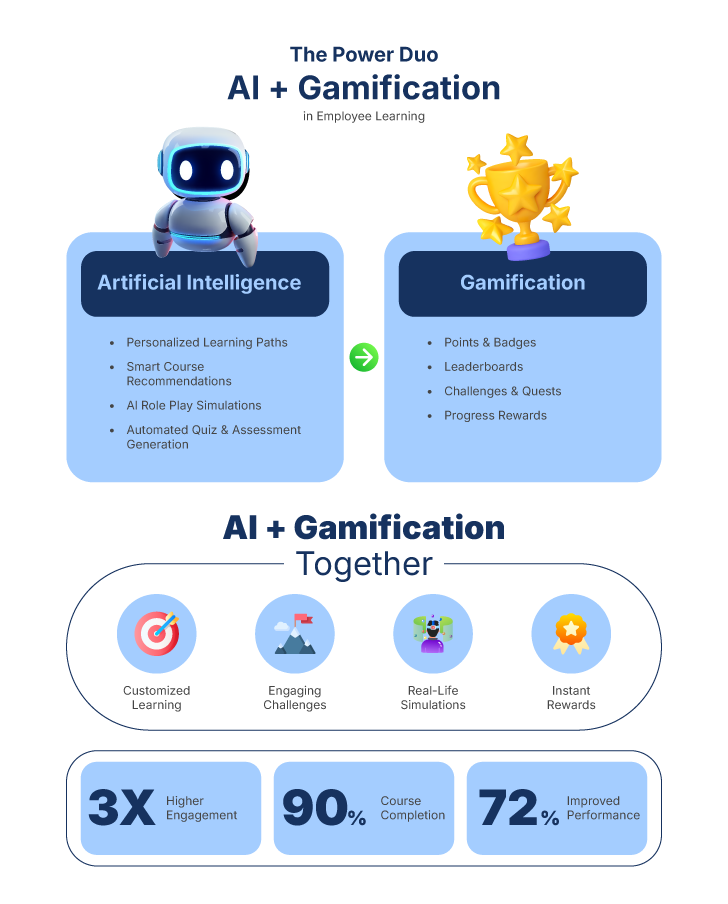
AI and gamification deliver results independently. When combined, their impact multiplies. AI simplifies what learners need. At the same time, gamification motivates them to perform accordingly. AI personalizes the experience. Gamification rewards effort. Feedback reinforces progress, and motivation builds naturally.
How the two complement each other:
- AI simplifies creating unique personalized courses.
- Gamification encourages action
- AI takes theory to practice with real-life simulations
- Real-time rewards maintain long-term interest
For example, AI may detect a skill gap and suggest a targeted quiz. Gamification then turns that quiz into a challenge with points and recognition. Learners feel motivated to complete it, not obligated.
AI analytics also improve gamification itself. Organizations can adjust reward systems based on engagement data. Challenges evolve as learners progress. This dynamic design keeps experiences fresh and relevant.
This explains why AI and gamification for employee engagement can boost participation by up to 3x.
Real-World Examples and Impact
Several organizations reported that they achieved strong results after combining AI and gamification. Engagement improvements appear quickly. AI-driven LMS platforms also show longer session durations and higher satisfaction levels. According to a survey, up to 75% of organizations report increased employee engagement after applying AI-powered learning tools.
AI further supports learners who struggle. By identifying disengagement early, AI triggers personalized nudges and content adjustments. This intervention improves completion rates and learning success.
Business Benefits of Combining AI + Gamification
The value of this combination extends beyond engagement. It delivers measurable business benefits that align learning with organizational goals.
Key business advantages include:
- Improved ROI in learning through higher completion and application rates
- Faster skill development via personalized learning paths
- Higher productivity driven by motivated learners
- Better talent retention
- Data-driven insights
AI in workplace learning and development allows leaders to analyze impact easily as learning data connects directly to performance metrics. Also, Gamification in the training management software ensures employees stay engaged long enough for learning to translate into results.
Together, AI and gamification for employee engagement support both individual growth and business performance. They move learning from a cost center to a strategic investment. These outcomes show that AI and gamification for boosting workplace engagement are long-term solutions that boost talent and performance cultures.
Conclusion
Employee engagement in learning is no longer an option as it has become essential for your business success. Traditional training models are no longer effective for modern learners. Employees now want more relevant, dedicated, and engaging learning.
AI and gamification for employee engagement work together to meet these expectations. AI personalizes learning, whereas gamification motivates consistent participation.
Organizations using AI and gamification see higher employee engagement. They also achieve stronger retention and improved productivity. AI-driven performance improvement supports growth for both employees and organizations.
Undoubtedly, AI and gamification are now essential, not optional.
FAQs
Q: How do AI and gamification boost employee engagement?
A: AI and Gamification play a vital role in boosting employee engagement. AI tackles the most tedious challenges of training, like course creation and the generation of tests and assessments. It also enhances learning experiences with features like AI Role Play, which allows users to create real-life simulations to practice what they learn. Gamification, on the other hand, improves participation and keeps learners motivated with badges, scores, and leaderboards. They help develop a connected and engaging learning culture. When combined, AI + Gamification boosts employee engagement by 3x.
Q: Can gamified learning improve learner completion outcomes?
A: Yes, gamification raises the rate of completion and can get it as high as 90. Badges, leaderboards, points, and levels enhance the interest of the learners. Challenges and rewards keep the interest, enhance development, and assist the learners to cover the courses through to the end.
Q: How does AI help in personalized learning paths?
A: AI analyzes skills, interests, progress and behavior patterns of learners to have their own learning paths. It also customizes content challenges and aligns it to personal needs. It also assists the learners to be more relevant in terms of being able to concentrate on the skills and therefore attain higher learning results.
Q: Can AI-driven learning help in measuring ROI?
A: Yes, AI-based learning assists companies to estimate ROI in an unambiguous manner. It provides visibility of engagement, skills acquisition, course completion, and workplace performance which allows teams to relate learning outcomes to quantifiable business outcomes.
Build a culture of continuous learning with Skill Lake’s state-of-the-art people development platform. Give your employees professional training to help them excel in their job roles and propel your business to greater efficiency and success.
Start Today

Other Reads from Skill Lake
-

Top 10 Best LMS for Restaurant Training in 2026
Read MoreRestaurant training is a daily challenge, especially with high staff turnover and evolving safety standards. Traditional methods rarely keep up with today’s fast-paced teams and rising industry demands. Having an enterprise-grade AI learning platform makes it easier to train everyone in your organization, from employees and franchise owners to customer-facing teams – all in one
-
Top 10 Best LMS for Insurance Industry in 2026
Read MoreTraditional insurance training methods can no longer keep up with complex policies and strict state regulations. Relying on static training manuals leaves agents unequipped for real-world client interactions, leading to compliance bottlenecks. Modern insurance learning management systems solve these challenges through automated certification tracking and scenario-based practice. This guide explores the 10 best LMS for


Anoop Kumar MS
Anoop Kumar MS, Product Manager of Fingent Global Solutions Pvt. Ltd., is an experienced product specialist with expertise in identifying customer needs and delivering innovative, data-driven solutions. Skilled in wireframing, UX, requirements analysis, risk assessment, team management, and root cause analysis, he excels in managing product lifecycles and fostering seamless collaboration to address real-world challenges.