How LMS Data Drives Continuous Learning Culture in 2026

Organizations are facing quick shifts in skills and employee expectations in 2026. Companies that fail to learn fast lose their reliability. Also, a strong learning mindset no longer supports growth alone; it defines survival. This shift has made data-driven learning essential for every enterprise.
Here, LMS data plays a central role in this transformation. By using data from your learning management system, learners can track their progress, behavior, skills, and results. These insights help teams improve performance, close skill gaps, and meet their learning goals. Also, LMS data helps organizations make their learning systems that evolve with people and strategy.
Deloitte’s Global Human Capital Trends reports that 89% of executives rank continuous learning as critical to long-term success. Yet many firms struggle to measure learning impact. This challenge explains more clearly why data from your learning management systems matters.
A strong, continuous learning culture in 2026 enables employees to adapt, innovate, and perform. This culture depends on visibility, measurement, and feedback. But your learning initiatives fail when leaders cannot see progress or impact.
What is LMS Data and Continuous Learning Culture?
LMS data is the data gathered using a Learning Management System, which measures the activity, progress, performance, level of engagement, assessment and course completion of the learner. This data helps organizations understand how their employees learn and evaluate the effectiveness of training programs. Also, it enables them to make well-informed decisions to improve learning processes and overall business performance.
A continuous learning culture motivates employees to learn and grow their careers. It is learning that is beyond onboarding or compliance training in an organization.
In 2026, employees own their skill growth and trainers guide them as coaches, not controllers. Teams learn from structured programs, teamwork, and real-world application. So, organizations should provide access to learning tools, data, and time for growth.
This culture thrives when learning aligns with career goals and business priorities. Data makes that alignment possible. Without insightful data, learning teams rely on assumptions. With data, they act with clarity.
How LMS Data Boosts Continuous Learning
Personalizing Learning Through AI-Based LMS
Learners expect relevance. Static content can’t meet workforce needs. AI-powered LMS analyzes behavior and role requirements to personalize learning experiences.
Data from your corporate training platform can help track employees’ engagement, their test scores, and content preferences. An AI LMS uses this data to suggest required modules and skill-based paths. It enhances personalization and makes better alignment with performance and learning.
Knowing Skill Gaps and Development Needs
Indeed, skill gaps result in lower productivity and growth. Organizations need precise insight into existing capabilities. Data from LMS platforms provides this visibility through assessments, certifications, and competency frameworks.
A modern learning management system software maps skills to job roles and business objectives. Leaders view gaps at individual, team, and enterprise levels.
Data-driven skill analysis supports smarter workforce planning. With accurate insights, HR teams design targeted reskilling programs. It helps managers guide their employees with confidence. It also helps employees get clarity about next steps in their careers.
Driving Engagement and Learning Adoption
Engagement determines learning success. Do you know when employees withdraw from training programs? Employees withdraw when they feel disconnected from their job role. Data from the learning management system shows participation rates, session duration, and drop-off points.
Learning teams use this data to improve course content and delivery. Also, features like gamification in an LMS platform increase motivation through rewards and progress tracking.
According to a study, gamified learning boosts learner engagement by up to 48%. It shows that high engagement leads to a constant learning environment. This creates a long-term learning culture instead of one-time participation.
Measuring Impact and Training ROI
Executives demand proof. So, learning teams must show value beyond completion rates. Here, LMS data helps you. It connects learning activity with performance metrics, productivity, and business outcomes.
A modern corporate training platform integrates learning analytics with HR and performance systems. It helps leaders in tracking skill growth, promotion readiness, and project success.
Organizations that measure learning outcomes see higher productivity. It shows that clear metrics improve ROI in learning and justify future investment.
Moreover, such insightful data helps eliminate ineffective programs. It helps learners to focus on methods that bring results.
Supporting Leadership and Organizational Development
Leadership development shapes culture and strategy. Whereas data from the LMS platforms supports leadership pipelines through competency tracking and feedback loops.
Some research notes that companies with strong leadership development programs achieve 2.3 times higher revenue growth. Learning data ensures leaders develop skills that match business direction.
So, adopting a scalable corporate learning platform enables cohort analysis, mentoring insights, and readiness assessments. Its data highlights high-potential employees and development needs.
Enabling Flexible and Mobile Learning
Workforces now operate across locations and time zones. Learning must adapt to this reality. Learning management system data tracks how employees access learning across devices and schedules. Insights into mobile learning trends show rising demand for short, flexible modules.
Flexible access to data through LMS increases participation and supports learning continuity. Also, mobile learning also supports frontline and remote employees who lack access to traditional training formats.
Real-World Use Cases of LMS Data in 2026
LMS data isn’t just about checking off courses anymore—it’s changing how organizations plan and run learning. By keeping an eye on participation, skills, and performance, companies can see where help is required. They can then make training better and connect it directly to their goals. LMS insights help organizations do many things—from keeping brand messages consistent to following rules.
Let’s check the real-world use cases of LMS data in 2026
Unified Brand Training
LMS data makes sure that every employee understands and represents the brand consistently. By tracking how employees engage with brand training, companies can spot gaps in knowledge. This also helps strengthen key messages and keep everyone on the same path. It creates stronger customer experiences and boosts brand credibility.
Sales Training
Sales teams benefit from LMS insights by tracking which training methods lead to better conversion rates. Data highlights which areas need reinforcement. Organizations can use these insights to train employees, minimize skill gaps, and increase growth.
Compliance Training
LMS data helps compliance programs see who has completed training and how they scored. Leaders can find employees who need extra support. This helps reduce risk and shows stakeholders that the organization is responsible.
Employee Training
LMS data lets employees follow learning paths that fit them, so they can upskill at their own pace. By tracking progress and engagement, companies can spot gaps and recognize achievements. This makes training more effective and helps employees feel supported and valued.
Industry Associations Training
Industry associations use LMS data to shape certifications and continuing training programs. It shows which courses are popular, where skill gaps are growing, and how members engage. This helps associations make their programs more useful, keeping members skilled, active, and satisfied.
What Happens Without LMS Data?
Without LMS data, learning and development decisions often rely on assumptions instead of measurable insights. Also, without LMS data organizations may continue to invest in the programs that do not support performance, productivity and employee capability.
The absence of LMS data also makes the procedure of identifying the gaps in the skills, measuring the learners’ involvement, or the learning initiatives more complicated. As a result, learning becomes an individual activity rather than helping the business grow and improve.
The main issues that organizations cannot solve without LMS data are:
- Lack of visibility into employee learning progress and completion rates.
- Inability to measure ROI of training initiatives.
- Poor alignment between learning programs and business objectives.
- Difficulty identifying high-performing or underperforming teams.
- Delayed decision-making due to absence of actionable insights.
- Reduced employee engagement because learning paths remain generic.
Indeed, without LMS data, workforce planning suffers and learning cannot support long-term success.
Challenges and Limitations of LMS Data
Many organizations depend heavily on LMS reports when making decisions, yet these reports don’t always show the complete picture. When learning is viewed only through data, it can sometimes lead to misunderstandings about how effective training really is and how well employees are actually growing.
LMS has made training much easier to track and manage. They give organizations helpful insights into who is learning, which courses are being completed, and how learners are engaged.
But measuring the training is not always possible by numbers. Someone may complete training and clear all assessments, still feel hesitant in using those skills in real scenarios.
To get a clearer understanding, it’s worth exploring the main challenges that keep LMS data from showing real learning.
Limited Insight into Practical Skills
LMS data tracks course completion rates, test scores, and participation. But, it usually fails to measure how well learners apply knowledge in real workplace situations, making it difficult to analyze skill improvement areas and performance outcomes.
Data Accuracy and Reliability
Not every learner moves through training with full attention. Some rush just to complete modules. Others may guess quiz answers or multitask while learning. On top of that, technical glitches or outdated course material can also affect results. All of this can make LMS data look better — or worse — than reality.
Lack of Personalization
LMS data often focuses on learning metrics and may not reflect individual learning needs, preferences, or challenges. It can stop organizations from creating truly personalized and effective learning strategies.
Integration and Data Silos
Many LMS platforms do not easily integrate with other business systems, such as performance management or HR tools. This creates data silos, making it harder for organizations to gain a complete view of employee development and organizational growth.
Why Consider LMS Data for a Continuous Learning Culture in 2026
A continuous learning culture in 2026 grows from clear insights and measurable outcomes. Organizations need proof of skill growth, engagement, and impact, and data from LMS platforms provides that proof.
Data transforms learning from an event into a system. It aligns employee development with strategy. Also, it empowers leaders to make informed decisions and gives learners control over growth. Without data, learning remains reactive. With data, learning becomes strategic.
Want to discover which platforms are shaping the future of workplace learning?
Explore the 10 Best Learning Management Systems (LMS) for 2026 and find solutions designed to help organizations build skills, improve performance, and create a truly data-driven learning culture
How Skill Lake Builds a Data-Driven Learning Culture
Indeed, skills demand is changing faster than ever. AI, automation, and digital platforms are reshaping the teams’ work and their roles. In this environment, organizations can no longer depend on periodic training programs because learning has become a consistent approach.
Using Skill Lake offers a modern LMS designed for future-ready organizations. The platform uses LMS data to power skill-based learning, analytics, and personalization.
Skill Lake delivers AI-driven recommendations, advanced dashboards, and competency tracking. It also helps leaders gain visibility into engagement, performance, and readiness. Also, learning teams measure impact and improve programs with confidence.
Skill Lake isn’t just about tracking who completed a course—it’s about showing real, measurable impact. Take TROTB, for example. After adopting Skill Lake’s LMS, volunteer attrition dropped by 50%, training efficiency improved by 30%, and operating costs fell by 60%. These numbers show how a well-designed digital learning platform can bring the required results.
With Skill Lake, leaders can track key KPIs like retention rates, cost savings, employee readiness, and skill growth. It helps organizations to measure how learning can make the actual difference in engagement, performance, and overall business outcomes.
Ready to build a future-ready learning culture?
Book a demo with Skill Lake and see how data-driven learning can transform your workforce!
FAQs
Q: How does LMS data help build a continuous learning culture in organizations?
A: LMS data are used to figure out how employees learn, what they learn and the skill gaps. LMS data assists organizations in knowing the learning process of employees, the course effectiveness, and areas where learning improvements are required. With this information, learning teams can easily enhance training programs, promote regular learning, and develop a culture that makes learning an ongoing and measurable aspect of daily jobs.
Q: What types of data does an LMS collect for learning analysis?
A: Data commonly gathered by an LMS includes the course completion rates, the time spent by the learner, their results in assessments, learning style, skill development, and trends in participation. Behavioral analytics, collaboration activity and content effectiveness are also tracked via advanced systems.
Companies rely on this information to detect the training needs, enhance the quality of the course, and also to see that employees get the relevant learning experience that is aligned with their career development and the business purposes.
Q: Why is LMS analytics important for employee development in 2026?
A: Data-driven decision-making is at the heart of employee growth in 2026. LMS analytics assists companies in shaping their training from normal training to a growth engine.
Managers have the opportunity to define specific areas of learning, evaluate progress over time, and current job needs. This will ensure that employees continue enhancing their skills, adapting to change, and sustaining themselves in the long term learning processes within the organization.
Q: How can organizations use LMS data to improve training effectiveness?
A: Organizations may examine LMS data to know which courses provide real learning results and which require enhancement. The data on drop-off rates, quiz scores, and feedback scores indicate whether the content is engaging and relevant. By optimizing content through actual learner behavior, businesses can minimize training expenditure; enhance knowledge acquisition, and learn programs that contribute directly to the performance and the organization objectives.
Q: Can LMS data support personalized learning experiences for employees?
A: Yes, LMS data significantly contributes to personalized learning experiences. Organizations can suggest applicable courses and adaptive learning paths, by analyzing the performance, preferences, and the progress of the learners.
Personalized learning eliminates the problem of training fatigue and boosts motivation since employees get content that is aligned with their job and their level of skills. The approach reinforces continuous learning culture by making the learning process more meaningful, efficient, and focused on personal growth requirements.
Build a culture of continuous learning with Skill Lake’s state-of-the-art people development platform. Give your employees professional training to help them excel in their job roles and propel your business to greater efficiency and success.
Start Today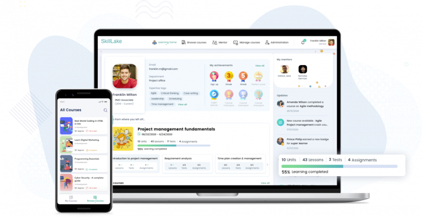

Other Reads from Skill Lake
-

Learning and Development Management Software: Key Features to Look for in 2026
Read MoreToday’s businesses need a capable L&D platform that acts beyond delivering courses or tracking completions. Choosing a modern learning and development software allows organizations to speed up content creation, simplify training management, facilitate skill development, and measure the true impact of training. If you are evaluating new L&D management software this year, here are the
-
When to Replace an Employee Learning Management System: 10 Signs to Look For
Read MoreIs your employee learning management system helping you build real skills, or is it just frustrating your team? Outdated software wastes your budget and turns training into a tedious chore. If your current LMS platform feels hard to use, lacks modern features, or takes too much manual work to run, it’s time for a change.


Anoop Kumar MS
Anoop Kumar MS, Product Manager of Fingent Global Solutions Pvt. Ltd., is an experienced product specialist with expertise in identifying customer needs and delivering innovative, data-driven solutions. Skilled in wireframing, UX, requirements analysis, risk assessment, team management, and root cause analysis, he excels in managing product lifecycles and fostering seamless collaboration to address real-world challenges.