Best LMS for Customer Training in 2026: Top 10 Platforms Compared

Customer expectations are evolving rapidly, and businesses are under increasing pressure to deliver value from the very first interaction. Today’s customers expect clear onboarding, continuous guidance, and the ability to quickly understand and use products without friction.
Without a structured training approach, many organizations face common challenges such as low product adoption, increased support requests, and higher customer churn.
This is where a Learning Management System (LMS) for customer training becomes essential.
An LMS enables organizations to deliver consistent, scalable, and engaging learning experiences that help customers understand products, apply knowledge, and achieve results faster.
A modern LMS helps businesses:
- Simplify and standardize customer onboarding
- Deliver consistent product education across all users
- Improve adoption and engagement
- Reduce dependency on support teams
- Increase retention and customer lifetime value
Organizations that invest in structured customer training often see faster onboarding, fewer support queries, and stronger long-term customer relationships, making LMS a critical component of sustainable growth.
Top 10 Best LMS for Customer Training in 2026
Note: Pricing and features based on data as on May 2026.
1. Skill Lake LMS
Skill Lake is an AI-powered LMS designed to make customer training practical, personalized, and outcome-driven. It focuses on enabling customers to apply knowledge in real-world scenarios rather than just consuming content.
Key Features
AI Course Generator
Transforms product documents, workflows, and knowledge bases into structured training modules automatically. This significantly reduces manual effort and accelerates onboarding. It helps organizations create customer training content faster without depending heavily on manual course development.
AI Co-Pilot
Assists in course design, content optimization, and training management, improving efficiency and quality. It helps administrators simplify training processes and maintain more consistent learning experiences across teams.
AI Role Play Simulation (Real-World Practice)
Simulates real customer scenarios, allowing users to practice and build confidence in using the product. This hands-on learning approach improves knowledge retention and prepares customers for real-world usage.
AI Quiz and Question Generator
Automatically creates assessments to reinforce learning without additional manual work. It helps businesses quickly validate learner understanding and keep training more interactive and engaging.
Role-Based Learning Paths
Delivers personalized training experiences tailored to user roles, industries, and use cases. Customers receive more relevant content based on their responsibilities and learning requirements.
Skill Tracking and Performance Analytics
Provides visibility into learner progress, identifies skill gaps, and measures training effectiveness. Businesses can use these insights to improve learning outcomes and customer engagement.
Automated Customer Onboarding Journeys
Guides customers from initial onboarding to advanced product usage with minimal manual intervention. This creates a more structured, scalable, and consistent onboarding experience.
Interactive Learning Experience
Combines videos, simulations, quizzes, and assessments to improve engagement and retention. Interactive formats help customers stay involved and understand concepts more effectively.
Prebuilt Course Library
Provides ready-to-use courses, templates, videos, and learning materials that help organizations launch training programs faster. It reduces content creation time and ensures consistent learning experiences across customers and teams.
Best Use Case
Organizations aiming to improve customer onboarding, product adoption, and engagement through AI-powered and interactive learning experiences. It is especially suitable for businesses looking to scale customer education while reducing manual training effort and support dependency.
Why It Stands Out
Skill Lake combines AI-powered learning, course creation, gamification, role play simulation, and interactive learning experiences with real-world training scenarios that help customers learn by doing, not just reading. It supports personalized learning experiences, adaptive learning paths, and skill-based learning journeys through flexible, mobile-first, AI-driven platforms that adjust to different users, roles, teams, and business needs. It also enables continuous learning, real-time feedback, and performance tracking to improve engagement, retention, and learning outcomes.
2. Docebo
Docebo is widely used by large enterprises that require advanced scalability and AI-driven learning recommendations. It is designed for complex organizational structures where customer, partner, and employee training need to be managed in one system. The platform is strong in automation, multilingual training delivery, and integration with enterprise systems like CRM and HR tools. However, its setup and customization often require technical expertise, making it more suitable for enterprise-level teams.
- Key Features
- AI-driven content recommendations
- Social and collaborative learning
- Multi-language support
- Enterprise integrations
Best Use Case
Large organizations managing global customer education programs.
Why It Stands Out
Strong scalability and enterprise-level capabilities.
Pricing: Custom pricing for Elevate and Enterprise plans based on business needs and user scale.
3. TalentLMS
TalentLMS is a lightweight and easy-to-use LMS popular among small and mid-sized businesses. It allows quick course creation with minimal technical skills, making it ideal for teams that need to launch training programs rapidly. The platform includes gamification, quizzes, and mobile-friendly learning features. While it is simple and cost-effective, it may lack advanced AI-driven personalization and deep analytics needed for large-scale customer education programs.
- Key Features
- Drag-and-drop course creation
- Gamification features
- Mobile accessibility
- Ready-to-use templates
- Best Use Case
- Small and mid-sized businesses.
Why It Stands Out
Fast setup and minimal learning curve.
Pricing: Free plan available. Paid plans start from $119/month, with custom enterprise pricing options.
4. LearnWorlds
LearnWorlds focuses on creating interactive and engaging learning experiences, especially through video-based training. It is often used by organizations that want to build branded learning portals or sell online courses. The platform provides strong customization options and interactive video tools that improve learner engagement. However, it is more focused on content experience than deep automation or AI-driven customer onboarding workflows.
- Key Features
- Interactive video learning
- Custom branding
- Built-in course website
Best Use Case
Businesses delivering structured customer education.
Why It Stands Out
High engagement through interactive content.
Pricing: ~$24 to $249/month depending on features
5. Thinkific Plus
Thinkific Plus is designed for businesses that want to monetize training content or build scalable online education programs. It provides strong branding, customization, and integration capabilities, making it suitable for customer education and partner training. The platform is widely used by organizations looking to turn training into a revenue stream. However, its focus is more on course delivery and monetization rather than advanced AI-powered learning automation.
- Key Features
- Customization and integrations
- Scalable infrastructure
- Monetization tools
Best Use Case
Organizations monetizing training programs.
Why It Stands Out
Flexible and business-oriented.
Pricing: Plans start from $74/month (Start), $149/month (Grow), and $374/month (Expand), with custom pricing
6. Absorb LMS
Absorb LMS is an enterprise-focused platform known for its strong reporting, automation, and analytics capabilities. It helps organizations manage large-scale training programs with detailed tracking of learner progress and performance. The system is highly reliable for structured training environments and compliance-heavy industries. However, its interface and setup complexity can be challenging for smaller teams or non-technical users.
- Key Features
- Advanced analytics
- Automation tools
- E-commerce support
Best Use Case
Enterprises requiring detailed reporting and automation.
Why It Stands Out
Strong analytics capabilities.
Pricing: Available on request.
7. Litmos
Litmos is a cloud-based LMS designed for fast deployment and compliance-driven training. It is commonly used in industries where regulatory training and certifications are important. The platform includes pre-built content libraries, mobile learning, and reporting features that make it easy to manage training at scale. While it is efficient for structured training programs, its customization and modern learning experience capabilities are somewhat limited compared to newer AI-driven platforms.
- Key Features
- Compliance tracking
- Pre-built course content
- Mobile learning support
- Reporting and analytics
- Automation and integrations
Best Use Case
Regulated industries and organizations requiring compliance-focused training.
Why It Stands Out
Reliable and compliance-focused with strong mobile accessibility and ready-to-use training content.
Pricing: Available on request
8. LearnUpon
LearnUpon is designed for organizations that need to manage training across multiple audiences such as customers, partners, and employees. It offers strong segmentation features, allowing businesses to deliver targeted learning experiences to different user groups. The platform is known for its ease of use and multi-portal structure. However, it may not offer advanced AI-driven learning automation or simulation-based training experiences.
- Key Features
- Multi-portal training
- Segmentation tools
- Reporting dashboards
Best Use Case
Businesses with diverse customer groups.
Why It Stands Out
Efficient audience management.
Pricing: Custom pricing based on users and business requirements.
9. iSpring Learn
iSpring Learn is a simple and fast LMS that integrates closely with PowerPoint, making it easy for teams to convert presentations into training courses. It is widely used for corporate training, onboarding, and internal learning programs. The platform offers strong reporting, certification tracking, and mobile learning support. However, it is more traditional in structure and lacks advanced interactive or AI-powered learning features.
- Key Features
- PowerPoint-based course creation
- Mobile learning support
- Progress tracking and reporting
- Certification management
Best Use Case
Corporate training and onboarding
Why It Stands Out
Easy course creation with strong reporting capabilities.
Pricing: Business plans start at approximately $6.91/user/month for 100 users, $4.46/user/month for 300 users, and $3.97/user/month for 500 users (billed annually).
10. Moodle
Moodle is an open-source LMS known for its flexibility and customization capabilities. It allows organizations to build highly tailored learning environments through plugins and custom development. It is widely used by educational institutions and organizations with strong technical teams. While it is cost-effective and highly flexible, it requires significant technical effort to set up, maintain, and scale compared to modern SaaS-based LMS platforms.
- Key Features
- Plugin ecosystem
- Custom configurations
- Cost-effective
Best Use Case
Organizations with technical expertise.
Why It Stands Out
Highly customizable.
Pricing: Available on request
Comparison Table of Top LMS for Customer Training
| Platform | Best Use Case |
|---|---|
| Skill Lake | Customer onboarding, product adoption, and customer support enablement |
| Docebo | Enterprise learning and global training programs |
| TalentLMS | Quick training setup for SMBs |
| LearnWorlds | Interactive course delivery and online learning |
| Thinkific Plus | Monetizing training and building learning businesses |
| Absorb LMS | Large-scale enterprise training and reporting |
| Litmos | Compliance training and fast deployment |
| LearnUpon | Training customers, partners, and employees |
| iSpring Learn | Corporate training and onboarding |
| Moodle | Highly customized learning environments |
Why Businesses Need an LMS for Customer Training
Without structured training, customers often struggle to fully understand product capabilities, leading to lower adoption and increased reliance on support teams.
An LMS enables organizations to deliver consistent, scalable, and self-service learning experiences. This reduces operational overhead while improving customer satisfaction and long-term success.
It also allows businesses to transition from reactive support models to proactive customer education strategies.
If you want to explore how LMS platforms are used in other industries, you can also read our blog on best LMS for the manufacturing industry.
Key Features of the Best LMS for Customer Training
The most effective LMS platforms go beyond basic course delivery and focus on creating engaging, scalable, and result-driven learning experiences for customers.
They typically include AI-powered personalization, which helps tailor learning paths based on user behavior, role, and progress. This ensures every customer gets relevant training instead of a one-size-fits-all experience.
Interactive learning formats such as videos, quizzes, simulations, and guided walkthroughs make learning more engaging and easier to retain. These formats help customers understand how to actually use the product in real scenarios.
Automated training workflows reduce manual effort by handling onboarding, course assignments, reminders, and certifications automatically, making training scalable and consistent.
With advanced analytics and reporting, businesses can track learner progress, engagement levels, and product adoption, helping them continuously improve training effectiveness.
Mobile accessibility ensures customers can learn anytime, anywhere, which increases completion rates and flexibility.
Modern LMS platforms also support AI-generated content, which helps quickly convert product documentation into structured training materials, saving significant time.
Features like real-world simulations and automated assessments allow customers to practice and validate their understanding, making learning more practical.
Finally, adaptive learning paths adjust content based on individual progress, ensuring customers move at the right pace and focus only on what they need.
Together, these features make customer training more personalized, efficient, and outcome-driven, helping businesses improve adoption and customer success.
Benefits of Using LMS for Customer Training
- Faster onboarding and time-to-value
Helps customers quickly understand the product through structured learning paths, so they can start using it without confusion or delay. This ensures they reach value faster and reduce early-stage drop-offs. - Improved product adoption
Guides users to explore and use more features effectively, leading to deeper product usage and better overall value. It also helps customers discover hidden or advanced capabilities they might otherwise miss. - Reduced support costs
Customers can solve common issues through training content and self-learning, reducing dependency on support teams. This allows support teams to focus on more complex and high-priority customer issues. - Higher engagement levels
Continuous and interactive learning keeps customers more involved with the product instead of one-time usage. This creates a habit of learning and strengthens their connection with the platform. - Increased customer retention
When customers understand and succeed with the product, they are more likely to stay longer and remain loyal. It also reduces churn by preventing frustration caused by lack of knowledge or support. - Better overall customer experience
Structured training makes the journey smoother, more confident, and more satisfying for users. As a result, customers feel more supported and valued throughout their lifecycle.
How to Choose the Best LMS for Customer Training
When selecting an LMS, consider:
- Ease of use for both administrators and learners
- Scalability to support business growth
- AI capabilities for automation and personalization
- Customization options for branding and workflows
- Reporting and analytics for performance tracking
The right platform should enable customers to actively engage with and apply what they learn.
If you want a more detailed breakdown, you can read our blog on How Do You Choose The Right LMS For Customer Training.
Challenges in Customer Training (and How LMS Solves Them)
| Challenge | LMS Solution |
|---|---|
| Low engagement | Interactive learning experiences |
| Lack of practice | Simulations and applied learning |
| Scaling challenges | Automation and structured paths |
| Limited visibility | Analytics and reporting |
Real-World Example
A SaaS company faced challenges with low product adoption and high support ticket volume. Many customers struggled to understand the product during onboarding, which led to frequent support requests and limited usage of key features.
To address this, the company implemented a structured customer training program using an LMS. They introduced guided onboarding modules, role-based learning paths, and interactive training content to help users learn at their own pace.
After implementing the LMS:
- Onboarding became faster and more consistent
- Support requests reduced as customers became more self-sufficient
- Engagement improved with more users actively using the platform
- Feature adoption increased as customers gained better understanding
The shift from support-led guidance to structured learning enabled customers to explore and use the product with confidence, while also helping the business scale training more efficiently.
Conclusion
Customer training has become a critical driver of business growth. Organizations that invest in structured and scalable learning experiences are better positioned to improve adoption, reduce churn, and build long-term customer relationships.
The right LMS enables businesses to deliver consistent onboarding, provide personalized learning experiences, and ensure customers can effectively use their products.
As training needs expand across different business functions, organizations should also consider how LMS platforms support broader workforce development.
Turn Customer Training into Measurable Business Impact
- Customer training should lead to clear outcomes, including improved product adoption, higher engagement, and stronger customer retention.
- An effective LMS helps organizations:
- Deliver structured onboarding experiences
- Provide personalized and relevant training
- Enable customers to apply knowledge in real scenarios
- Reduce dependency on support teams
- Build long-term customer relationships
Organizations evaluating LMS platforms should focus on solutions that align with their business goals and support measurable outcomes.
You can also explore our customer training use case to understand how structured learning programs improve adoption and reduce support dependency.
Request a demo to explore how the right LMS can support your customer training strategy and drive long-term growth.
FAQs
Q: What is a customer training LMS?
A: A customer training LMS is a platform used to educate customers on how to use a product or service effectively through structured learning programs.
Q: How does an LMS improve customer onboarding?
A: It provides step-by-step guidance, structured learning paths, and self-paced training, reducing confusion and accelerating product adoption.
Q: What features should a customer training LMS include?
A: Key features include AI-powered personalization, automation, analytics, interactive content, and mobile accessibility.
Q: Can an LMS reduce support costs?
A: Yes, by enabling self-service learning and addressing common queries through training, an LMS reduces the volume of support requests.
Q: Is LMS suitable for small businesses?
A: Yes, many LMS platforms offer scalable solutions that work for small businesses as well as large enterprises.
Q: How does AI improve customer training?
A: AI helps automate content creation, personalize learning experiences, provide real-time feedback, and simulate real-world scenarios.
Q: What is the difference between customer training and employee training LMS?
A: Customer training focuses on product education and adoption, while employee training focuses on internal skill development and compliance.
Q: Can LMS platforms support global customers?
A: Yes, most modern LMS platforms support multi-language content, localization, and scalable delivery for global audiences.
Q: How do you measure the success of customer training?
A: Success can be measured through metrics such as course completion rates, product adoption, reduction in support tickets, and customer retention.
Q: Is it possible to integrate LMS with other tools?
A: Yes, most LMS platforms integrate with CRM systems, support tools, and analytics platforms to provide a seamless experience.
Build a culture of continuous learning with Skill Lake’s state-of-the-art people development platform. Give your employees professional training to help them excel in their job roles and propel your business to greater efficiency and success.
Start Today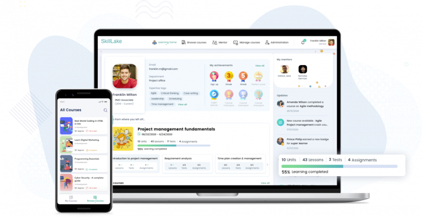

Other Reads from Skill Lake
-

When to Replace an Employee Learning Management System: 10 Signs to Look For
Read MoreIs your employee learning management system helping you build real skills, or is it just frustrating your team? Outdated software wastes your budget and turns training into a tedious chore. If your current LMS platform feels hard to use, lacks modern features, or takes too much manual work to run, it’s time for a change.
-
Top 10 Best LMS for Restaurant Training in 2026
Read MoreRestaurant training is a daily challenge, especially with high staff turnover and evolving safety standards. Traditional methods rarely keep up with today’s fast-paced teams and rising industry demands. Having an enterprise-grade AI learning platform makes it easier to train everyone in your organization, from employees and franchise owners to customer-facing teams – all in one


Anoop Kumar MS
Anoop Kumar MS, Product Manager of Fingent Global Solutions Pvt. Ltd., is an experienced product specialist with expertise in identifying customer needs and delivering innovative, data-driven solutions. Skilled in wireframing, UX, requirements analysis, risk assessment, team management, and root cause analysis, he excels in managing product lifecycles and fostering seamless collaboration to address real-world challenges.