AI in Learning and Development: The Future of Workplace Training

Modern work requirements and training needs are changing quickly. Professionals are expected to learn new skills faster to adapt to the changing operational structure and customer demands. That’s why companies are turning to AI in learning and development. AI takes learning a step beyond traditional methods to make it more effective, interactive, and impactful.
It’s true that traditional training methods can’t meet today’s training needs. They are time-consuming, feel mundane, and often don’t align with company goals or workflows. This is where AI-powered learning platforms come into play. These systems help teams learn faster, enhance personalization, and make learning more accountable.
Here’s more on why modern businesses are choosing AI for learning and skill development.
What is AI in Learning and Development?
AI is reshaping how learning and development teams create, manage, and deliver training more efficiently through natural language processing (NLP) and machine learning (ML). It speeds up course creation, recommends content based on each learner’s journey, and identifies skill gaps through instant assessments. It also brings in AI role-play simulations to enable hands-on, practice-based learning.
When these capabilities are embedded into modern LMS platforms, learning becomes more intuitive, scalable, and impactful. This is how it translates into real outcomes:
- Build personalized learning paths for each employee
- Support AI-powered course creation in minutes
- Suggest what to learn next
- Track progress with learning analytics
- Run AI role-play training for real-world practice
How Is AI Transforming Corporate Learning?
AI in corporate training is taking learning from a one-size-fits-all approach to a more adaptive and continuous learning experience. It is ensuring that learning stays relevant, up to date, and aligned with each employee’s role and growth path.
Instead of spending time on what they already know, employees focus only on skills that matter. This makes learning more efficient, practical, and impactful. AI-driven training can help:
- Adjust content based on the learner’s needs
- Update training as demand and skills evolve
- Keep learners engaged with interactive formats
- Support workforce reskilling without delay
That’s why companies now depend on AI-based training to build stronger teams.
Benefits of Using AI in Learning and Development
The benefits of AI-driven learning platforms show up once teams start using it.
Learning Feels Personal: Everyone learns differently, and AI understands that. So, it builds personalized learning paths based on skill level and goals.
- Saves Time: No need to spend weeks building courses. With AI-based automated course creation, teams can launch training fast and save time.
- Better Engagement: People stay interested when learning feels real. Here, AI roleplay training and interactive lessons help with that.
- Clear Insights: Learning analytics show what works and what doesn’t. It helps managers to track employees’ progress and get real-time insights.
- Lower Costs: AI-powered employee training cuts down manual work and outside training costs. Overall, workplace learning with AI helps companies train smarter, not harder.
How Skill Lake AI Features Support Learning and Development?
Workplace learning needs to stay relevant. Teams don’t just need content—they need to know what skills they have and what they’re missing. AI-based learning platforms like Skill Lake help make this clearer by supporting both learning and skill evaluation. Here’s how these features help in a simple way.
AI Course Creation
Creating courses takes time, especially when skill needs keep changing. Here, AI course generators in learning platforms help generate courses quickly on any topic, and it also helps focus on specific skills. If a team lacks a certain skill, courses can be created around that gap. This makes learning more targeted.
AI Questionnaire Generation
AI can create quizzes in seconds. These quizzes help check what learners actually understand. Also, these regular assessments make it easier to spot weak areas. If someone struggles with certain questions, it clearly shows a skill gap. This helps teams take action early instead of waiting.
AI Copilot
AI Copilot lets you refine courses and content to match them as per your needs. You can also summarize or rewrite text to align it closely to your training requirements. If learners find something difficult, it can be made easier. This keeps learning useful and supports better skill development over time.
AI Course Recommendation
Many learners lose interest when they don’t know what to learn next. AI course recommendations solve this by guiding them step by step.
AI LMS offers course recommendations based on a learner’s profile, job role, past learning, and skill level. This means learners see content that actually fits their needs and keeps them engaged, as they don’t feel lost or overloaded. This improves employee skill development over time.
AI Role Play Simulation
AI role play gives learners a space to practice real situations. Instead of just reading, they respond and learn through experience. The system reacts based on their answers, which makes it feel real. After each session, learners get feedback on their performance. Also a reliable corporate training platform helps employees handle critical situations and build strong skills.
Traditional LMS vs AI-Powered LMS
Learning systems have changed a lot over time. A traditional LMS helps you share courses and track progress. An AI-powered LMS feels more smart and flexible. It learns how people learn and gives them content that fits their needs. It can guide users, suggest what to study next, and make learning more personal.
The table below shows how both are different.
| Feature | Traditional LMS | AI-Powered LMS |
|---|---|---|
| Learning Approach | One-size-fits-all content | Personalized learning paths based on user behavior |
| Content Delivery | Static modules and courses | Dynamic, adaptive content recommendations |
| Engagement Level | Limited interactivity | High engagement with AI-driven suggestions and gamification |
| Skill Gap Analysis | Manual or periodic | Real-time identification of skill gaps |
| Feedback Mechanism | Delayed or generic | Instant, data-driven feedback |
| Scalability | Limited flexibility | Highly scalable and adaptive to business needs |
| Decision Making | Based on historical data | Predictive insights and analytics |
| Learning Experience | Passive learning | Interactive and continuous learning experience |
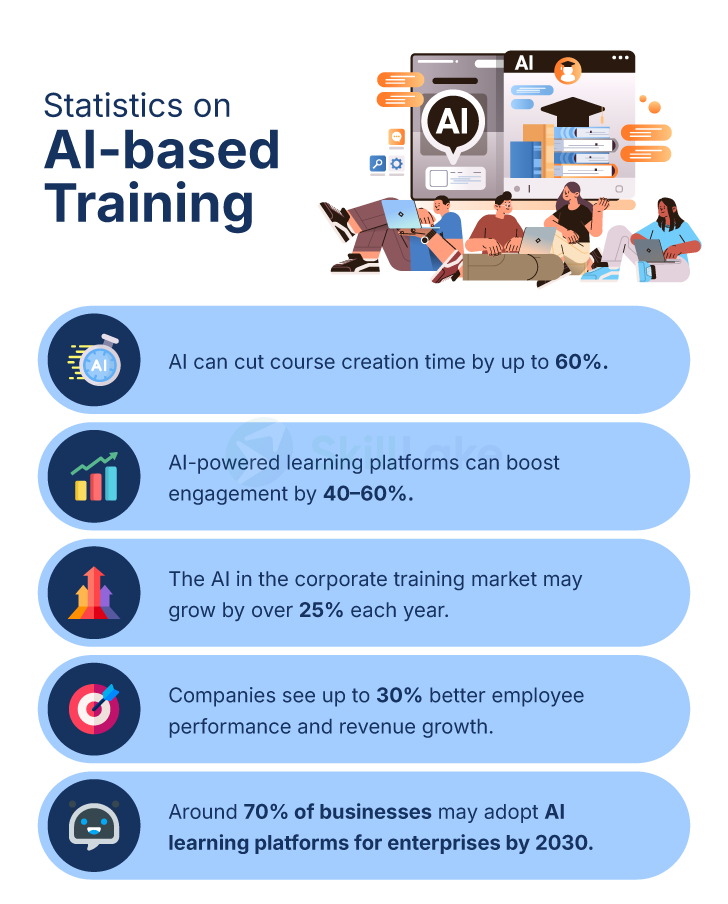
Statistics on AI-based Training (2025–2030)
- AI can cut course creation time by up to 60%.
- AI-powered learning platforms can boost engagement by 40–60%.
- The AI in the corporate training market may grow by over 25% each year.
- Companies see up to 30% better employee performance and revenue growth.
- Around 70% of businesses may adopt AI learning platforms for enterprises by 2030.
Use Cases of AI in Corporate Training
AI is changing how people learn at work. It doesn’t just deliver training—it helps people learn the right things at the right time. Here are some simple ways it shows up in corporate training:
Onboarding
New hires don’t go through one fixed training anymore. They get learning based on their role and what they need to do. It helps them get comfortable faster and start contributing sooner.
Sales Practice
Sales teams can practice real conversations using AI role play simulation. They try different responses, handle tricky questions, and learn from feedback. It feels close to real customer situations, which builds confidence.
Skill Gap Analysis
One of the most useful parts is clarity. AI helps show what skills are missing in a team or individual. This makes it easier to plan training that actually matters.
Personalized Learning Paths
Every employee learns in a unique way or speed. AI maintains learning paths based on progress, so each person gets a more natural flow instead of a fixed plan.
Continuous Learning Support
We all know that learning is a continuous process and it doesn’t end after one course. AI keeps suggesting next steps, so people keep building skills over time instead of stopping after training sessions.
Tech Skills Development
Technology keeps changing, so teams need to keep learning. AI suggests useful topics based on current skills and job needs. This way, people don’t waste time on things they already know.
Leadership Growth
AI can pick up patterns in how people work and learn. This helps managers notice who is ready for bigger responsibilities. Those people can then be guided with the right learning steps.
Top Trends of AI-Driven Learning Platforms
AI is not only improving training but also transforming the process of learning. The following are some of the trends that will bring this transformation:
Hyper-Personalized Learning
AI interprets employees’ behavior and preferences, as well as their performance, and provides recommendations to enable a personalized learning journey.
Intelligent Content Creation
Rather than manually searching resources, AI automatically filters useful content, videos, articles, and courses, according to your purpose and progress.
Real-Time Skill Gap Analysis
AI-based LMS tracks performance and recognizes areas of skill deficiency in real time, enabling managers to implement initiatives for upskilling their employees.
AI-Powered Learning Support
Learning feels easier when you don’t have to figure everything out on your own. That’s where AI-powered learning support comes in role. It’s not a separate assistant. Instead, it works quietly in the background through features already built into the platform.
Role plays, recommendations, and content suggestions all work collectively to support learners in real time. This kind of support also helps track progress and highlight skill gaps.
AI-Driven Learning Insights
Sometimes, you just need a clear view of what’s going on. AI-driven learning insights help with that. AI-based LMS show real insights about how people are learning, where they’re doing well, and where they need improvement. These insights also support better decisions around training, making it easier to adjust learning plans based on actual needs.
Why Enterprises Are Integrating AI-Powered Learning Platforms?
There are lots of reasons why businesses are integrating AI in corporate training. They don’t want traditional systems anymore that won’t give measurable results. Let’s check some of the top reasons:
- Train faster
- Improve employee skill development
- Keep teams engaged
- Scale learning across teams
Conclusion
Learning at work should feel useful, not forced. People don’t want long courses that they forget. They want quick help that solves real problems. That’s where AI in learning and development fits in.
It helps teams learn faster, makes training simple, and gives clear results. For companies, it’s a simple way to build stronger, more capable teams for revenue growth and employee empowerment.
FAQs
Q: What is AI in corporate training?
A: Use AI to help people learn better at work. It can build courses, guide users, and track how they do. It also adjusts learning based on each person. So, people get the right skills without wasting time.
Q: How does AI help in corporate training?
A: AI removes the need to do lots of hard work. It builds training fast and points people to what matters most. It also keeps things interesting with quizzes and real-life tasks. That way, learning sticks and people actually use them.
Q: What are AI-powered learning platforms?
A: These are tools that run training with AI. They don’t treat everyone the same and provide each learner with content based on their needs. They also show progress and give useful feedback, which makes learning feel simple and clear.
Q: Why do companies use AI-driven workplace training?
A: Companies use AI-driven workplace training to get better results in less time. AI helps them train teams faster and keep them engaged. It also supports skill growth across roles. Overall, with AI-driven workplace training, teams perform better and stay ready for change.
Q: What is the future of AI in learning and development?
A: The future of workplace learning with AI will focus on smarter, more personal learning. AI will guide people step by step and create content on the go. Companies will use it to keep teams skilled and adaptable.
Build a culture of continuous learning with Skill Lake’s state-of-the-art people development platform. Give your employees professional training to help them excel in their job roles and propel your business to greater efficiency and success.
Start Today

Other Reads from Skill Lake
-

Learning and Development Management Software: Key Features to Look for in 2026
Read MoreToday’s businesses need a capable L&D platform that acts beyond delivering courses or tracking completions. Choosing a modern learning and development software allows organizations to speed up content creation, simplify training management, facilitate skill development, and measure the true impact of training. If you are evaluating new L&D management software this year, here are the
-
When to Replace an Employee Learning Management System: 10 Signs to Look For
Read MoreIs your employee learning management system helping you build real skills, or is it just frustrating your team? Outdated software wastes your budget and turns training into a tedious chore. If your current LMS platform feels hard to use, lacks modern features, or takes too much manual work to run, it’s time for a change.


Anoop Kumar MS
Anoop Kumar MS, Product Manager of Fingent Global Solutions Pvt. Ltd., is an experienced product specialist with expertise in identifying customer needs and delivering innovative, data-driven solutions. Skilled in wireframing, UX, requirements analysis, risk assessment, team management, and root cause analysis, he excels in managing product lifecycles and fostering seamless collaboration to address real-world challenges.