10 Best Learning Management Systems (LMS) for 2026: A Buyer’s Guide for Modern Organizations
Corporate learning was once confined to classrooms, printed manuals, and periodic workshops. Training happened in batches, progress was difficult to measure, and learning often stopped once onboarding was complete. That model no longer works in a world where roles evolve faster than job descriptions and skills expire within years, not decades.
Today, learning has become a continuous, data-driven business function. Organizations are expected to onboard faster, upskill continuously, maintain compliance, and prove the business impact of training initiatives. As a result, learning management systems have evolved from simple course repositories into intelligent platforms powering workforce transformation at scale. With more than 70 million active learners worldwide and the LMS market set to more than double by 2032, modern LMS platforms are now central to productivity, retention, and long-term organizational growth.
Modern organizations no longer ask whether they need an LMS – they ask which LMS aligns with their business strategy, workforce model, and growth plans.
In this guide, we evaluate the 10 best learning management systems (LMS) for 2026, based on real-world use cases, enterprise readiness, scalability, AI maturity, integrations, and learning impact.
How We Evaluated the Best LMS Platforms for 2026
- To ensure trust, and practical value, each LMS included in this list was evaluated against the following criteria:
- Target audience fit (SMB, enterprise, franchises, customer education)
- Learning experience & engagement (UX, gamification, personalization)
- AI & automation maturity
- Scalability & performance
- Integrations with HR, CRM, and business systems
- Analytics, reporting, and ROI measurement
- Security, compliance, and governance
- Total cost of ownership
What Is a Learning Management System (LMS)?
What is an LMS? A learning management system (LMS) is a software platform-typically delivered as a cloud-based SaaS solution-used to plan, deliver, manage, and measure learning and development initiatives across an organization.
At its core, an LMS acts as the central engine of your eLearning strategy. It enables organizations to design structured learning journeys, deliver training at scale, track learner progress, and continuously improve outcomes based on data. Whether the objective is to increase learner engagement, improve employee retention, ensure regulatory compliance, or build future-ready skills, an LMS provides the foundation to make learning measurable and repeatable.
Modern LMS platforms go far beyond hosting courses. They empower L&D teams to create impactful training programs more efficiently, personalize learning experiences, and make training easily accessible to learners-anytime, anywhere, and on any device. For learners, this means frictionless access to knowledge. For organizations, it means consistency, visibility, and control over learning outcomes.
When you choose the right learning platform, the impact is reflected across your entire learning ecosystem. Organizations typically see a more consolidated approach to training management software, faster and more effective onboarding, and clear, tangible return on investment (ROI) through improved productivity, reduced training costs, and higher engagement levels.
Choosing an LMS is not just a technology decision-it is a strategic investment in how your people learn, perform, and grow.
Why Use an LMS Platform?
The way organizations implement an LMS varies depending on industry, workforce size, geography, and business goals. However, the underlying value of an LMS learning remains consistent: it enables organizations to deliver the right learning to the right people at the right time, at scale.
Below are some of the most common and high-impact use cases for an LMS platform:
- Employee Onboarding
In a corporate training platform an LMS streamlines and automates the onboarding process by delivering role-specific training in structured, engaging formats. Through a combination of self-paced learning, guided paths, and blended experiences, new hires can ramp up faster, gain clarity on expectations, and become productive sooner-while HR and L&D teams maintain consistency across locations and teams. The employee training management software helps maintain the easiness and consistency in onboarding. - Compliance Training LMS
With an LMS, organizations can automate mandatory compliance training, create and update programs quickly, and track completion with accuracy. Internal subject-matter experts can collaborate on content creation, certifications can be managed centrally, and audit-ready reports can be generated in minutes-helping organizations reduce risk while improving completion rates in LMS for compliance training - Sales Enablement
An LMS plays a critical role in sales enablement by accelerating onboarding, standardizing product and process knowledge, and continuously upskilling sales teams within their workflow. With targeted learning paths and performance insights, organizations can shorten time-to-productivity and drive consistent revenue performance across regions. - Customer Training
Customer education is a powerful driver of adoption, retention, and long-term value. An LMS allows organizations to deliver customer training at scale, reduce repetitive one-on-one sessions, and provide customers with on-demand resources that help them get the most out of products or services-improving satisfaction while lowering support costs.
Quick Comparison: Top LMS Platforms by Use Case
| LMS | Best For | Standout Strength |
| Skill Lake LMS | Enterprises & franchises | AI LMS + Scalability & integrations + affordability |
| 360Learning | Collaborative internal training | Social & AI-powered content creation |
| TalentLMS | Fast deployment | Ease of use & flexibility |
| Learn Upon LMS | Multi-audience training | Scalability & integrations |
| Litmos | Compliance-heavy orgs | Ready-made content & mobile learning |
| Docebo | Large enterprises | Advanced AI & multi-portal architecture |
| Moodle LMS | Custom & open-source | Full control & extensibility |
| iSpring Learn | Rapid content creation | Authoring + LMS combo |
| Rippling LMS | HR-led organizations | HR & IT integration |
| WorkRamp | Revenue & enablement teams | Sales & partner training focus |
1. Skill Lake LMS
Skill Lake LMS stands out as one of the most balanced and future-ready learning management systems for organizations seeking enterprise-grade capability without enterprise-only pricing.
Designed for employee training, customer education, and franchise learning models, Skill Lake combines AI-powered personalization, scalable architecture, and transparent affordability into a single platform.
What sets Skill Lake apart is its AI-driven course creation, recommendation, AI Question generation and AI role-play capabilities, allowing organizations to move beyond static learning into adaptive, skill-focused development.
Key strengths
- AI-powered course creation and recommendations
- Built-in AI role-play for real-world skill practice
- Gamification to improve engagement and completion
- Mobile-first learning with offline access
- Franchise-ready multi-tenant architecture
- Strong analytics tied to learning outcomes
- One of the most affordable LMS platforms in the industry
Best suited for: Growing enterprises, franchises, and organizations prioritizing ROI-driven learning.
What users say (G2 & peer reviews)
Users consistently highlight:
- Ease of use for both admins and learners
- Affordable AI LMS
- Strong value for money compared to enterprise LMSs
- AI features that feel practical, not experimental
- New engagement features
- Easy Scalability & Integration possibilities
Common feedback themes:
“Affordable without feeling basic”
“Easy to launch and scale”
“AI actually helps, not just a buzzword”
Pricing
- Transparent, one of the most affordable LMS platforms in the market
- Pricing scales by users, not features
- No forced upgrades for core functionality
- (Exact plans typically shared on request to match organization size)
2. 360Learning
360Learning combines LMS, LXP, and academy functionality into a collaborative learning platform focused on peer-driven knowledge sharing.
Its AI-powered authoring tools enable subject-matter experts to contribute content quickly, reducing dependency on instructional designers.
Key strengths
- Collaborative course creation
- AI-assisted authoring and learning paths
- Automated compliance workflows
- Strong analytics and certification engine
- Limitations: Pricing scales quickly for large user bases.
What users say
Users frequently praise the platform for its collaborative authoring capabilities, modern and intuitive user interface, and strong analytics and certification tools that help teams make data-driven learning decisions.
At the same time, some users note that pricing can increase quickly as the number of users grows and that the platform may feel like overkill for simple or small-scale training needs. Overall sentiment often reflects that it is an excellent solution for collaborative learning, but one that can become expensive at scale.
Pricing
- Starts at ~$8 per registered user/month
- Costs increase with advanced features and scale
- Best suited for mid-sized to enterprise organizations
3. TalentLMS
TalentLMS is known for its intuitive interface and quick setup, making it ideal for organizations that need to launch training programs rapidly without heavy technical involvement.
Key strengths
- SCORM/xAPI support
- Built-in gamification and certifications
- Multi-tenant branching
- Real-time reporting dashboards
Limitations: Limited advanced customization for complex enterprises.
What users say
Users commonly mention quick onboarding, simple navigation, and reliable SCORM support, while some note limitations such as limited deep customization and that it may not be ideal for highly complex enterprise workflows.
4. LearnUpon LMS
LearnUpon is designed for organizations managing employee, customer, and partner training under one platform.
Key strengths
- Multi-portal architecture
- AI-assisted automation
- Strong reporting and analytics
- Enterprise-grade security and integrations
Limitations: Pricing requires demos and scales with usage.
What users say
Users frequently highlight the platform’s stability and scalability, clean user interface, and strong customer support. Criticisms? Some users point out pricing transparency as an area for improvement and mention a learning curve when setting up advanced configurations.
Pricing
- Custom pricing via demo
- Generally positioned in the mid-to-upper enterprise tier
5. Litmos
Litmos excels in compliance-heavy industries that require standardized training, certifications, and mobile access.
Key strengths
- AI-enabled content tools
- Extensive ready-made content libraries
- Offline and mobile learning
- Global scalability
Limitations: Less flexibility in deep customization.
What users say
Positive feedback includes:
- Mobile learning experience
- Content availability
- Global scalability
Negative feedback often includes:
- UI flexibility limitations
- Customization constraints
Pricing
Foundation & Platinum AI plans
Pricing available on request
Typically mid-market to enterprise pricing
6. Docebo
Docebo offers advanced AI-driven personalization and multi-audience capabilities, making it suitable for global enterprises with diverse learning needs.
Key strengths
- Generative AI and automation
- Multi-portal environments
- Strong integrations
- Advanced analytics
Limitations: High cost and longer implementation cycles.
7. Moodle LMS
Moodle remains the leading open-source LMS for organizations that want maximum control and customization.
Key strengths
- Open-source flexibility
- Extensive plugin ecosystem
- Strong assessment tools
- Mobile access
Limitations: Requires technical resources for setup and maintenance.
8. iSpring Learn
iSpring Learn pairs seamlessly with iSpring Suite, allowing teams to convert presentations into interactive learning quickly.
Key strengths
- SCORM compliance
- Simple UI
- Strong reporting
- Blended learning support
Limitations: Less advanced AI-driven personalization.
9. Rippling LMS
Rippling LMS integrates deeply with HR and IT workflows, automating training based on employee data.
Key strengths
- HR-driven automation
- Compliance catalogs
- Mobile access
- Real-time reporting
Limitations: Best value only if already using Rippling HR.
10. WorkRamp
WorkRamp focuses on employee, partner, and customer enablement tied to business performance.
Key strengths
- AI-assisted course creation
- Salesforce and Slack integrations
- Coaching and feedback loops
- Analytics tied to revenue outcomes
Limitations: Less suitable for academic-style learning.
How to Choose the Right LMS for Your Organization
The right LMS depends on:
- Organization size and growth plans
- Internal vs external training needs
- Compliance requirements
- AI and personalization expectations
- Budget and long-term ROI goals
Case Study: How Proper Use of an LMS Transformed Our Compliance and Onboarding Operations
Background
When our organization first implemented a learning management system software , the goal was simple: centralize training. However, like many teams, we initially underutilized the platform. Compliance training was still largely manual, onboarding involved repetitive sessions, and maintaining Standard Operating Procedures (SOPs) across teams was time-consuming and error-prone.
The real transformation began when we shifted from using an LMS as a content repository to using it as a structured learning and compliance engine.
The Challenge
Before optimizing our LMS usage, we faced several operational challenges:
- High recurring costs associated with compliance training
- Inconsistent delivery of compliance courses across teams and locations
- Manual tracking of SOP updates and employee acknowledgements
- Significant human effort spent onboarding new employees
- Delays and inefficiencies in compliance-related tasks
These issues not only increased costs but also introduced compliance risks.
The Approach: Using the LMS the Right Way
We redesigned our learning strategy around the LMS by:
- Automating compliance workflows and certification tracking
- Structuring SOPs into modular, easily updatable learning units
- Creating role-based onboarding paths instead of one-size-fits-all training
- Using reporting dashboards to monitor completion, gaps, and bottlenecks
- Replacing manual follow-ups with automated reminders and assessments
This shift allowed the LMS to support the entire compliance and onboarding lifecycle, not just course delivery.
The Results
- 63% Reduction in Compliance Costs
- Improved Compliance Course Delivery & SOP Maintenance
- Significant Reduction in Manual Onboarding Effort
- 72% Improvement in Compliance Task Efficiency
Frequently Asked Questions (FAQs)
Q: How is LMS technology evolving in 2026?
A: AI, automation, skills-based learning, and personalized learning paths are becoming standard expectations.
Q: What’s the difference between LMS and LXP?
A: An LMS manages learning, while an LXP enhances experience and discovery – modern platforms often combine both.
Q: How does AI improve LMS effectiveness?
A: AI enables adaptive learning paths, automated content creation, and skill-based recommendations.
Q: How do organizations measure LMS ROI?
A: Through completion rates, performance improvements, compliance adherence, and business impact metrics.
Take Home
The best learning management suite is not the one with the most features – it’s the one that aligns learning with business outcomes.
Each platform listed here excels in specific scenarios. The key is choosing the LMS that fits your strategy today and your scale tomorrow.
Build a culture of continuous learning with Skill Lake’s state-of-the-art people development platform. Give your employees professional training to help them excel in their job roles and propel your business to greater efficiency and success.
Start Today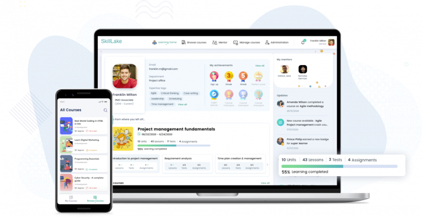

Other Reads from Skill Lake
-

Learning and Development Management Software: Key Features to Look for in 2026
Read MoreToday’s businesses need a capable L&D platform that acts beyond delivering courses or tracking completions. Choosing a modern learning and development software allows organizations to speed up content creation, simplify training management, facilitate skill development, and measure the true impact of training. If you are evaluating new L&D management software this year, here are the
-
When to Replace an Employee Learning Management System: 10 Signs to Look For
Read MoreIs your employee learning management system helping you build real skills, or is it just frustrating your team? Outdated software wastes your budget and turns training into a tedious chore. If your current LMS platform feels hard to use, lacks modern features, or takes too much manual work to run, it’s time for a change.


Anoop Kumar MS
Anoop Kumar MS, Product Manager of Fingent Global Solutions Pvt. Ltd., is an experienced product specialist with expertise in identifying customer needs and delivering innovative, data-driven solutions. Skilled in wireframing, UX, requirements analysis, risk assessment, team management, and root cause analysis, he excels in managing product lifecycles and fostering seamless collaboration to address real-world challenges.