Learning and Development Trends in 2026: AI and Beyond

The new normal has presented organizations with several issues, such as the need to manage a remote and hybrid workforce. The corporate learning and development (L&D) team got struck harder than any other department. Corporate training teams are a crucial component of organizational development, and their programs are designed to upskill personnel and fill the market’s perceived knowledge and skills gap. Managing change in the face of a pandemic and new health hazards has necessitated the development of unique techniques for setting and achieving milestones.
The learning and development landscape has changed significantly over the past few years. While trends such as microlearning, mobile learning, and blended learning continue to shape workplace training, organizations are now embracing artificial intelligence, skills-based development, and data-driven learning strategies to prepare employees for the future.
Modern learning platforms do much more than deliver online courses. They help organizations create training faster, personalize learning experiences, analyze learner progress, and continuously update content as business needs evolve. As AI becomes part of everyday work, L&D teams are also exploring new ways to create engaging learning content and support employees with relevant, on-demand learning.
The following trends continue to influence corporate learning while highlighting the latest innovations shaping workplace learning in 2026 and beyond.
Here are the top 12 trends in learning and development to look out for in 2026 and beyond.
Emerging Trends in Learning and Development
1. Reskilling & Upskilling
Your current workforce requires retraining to use new digital tools and processes due to digital transformation. A new emphasis on the ongoing upskilling programs got added to organization-wide reskilling. Since many businesses prefer to promote their employee skills from within, upskilling may take the shape of leadership training. With the introduction of online eLearning courses through modern learning platforms, upskilling has become simpler for the corporate sector. With flexible learning, providing time off, and rewards for passing these courses, L&D teams can also encourage internal workforces to acquire new skills.
2. Personlaized & Adaptive Learning
Adaptive learning is the most sought-after corporate training method companies adopt. It uses AI and machine learning techniques to deliver employees personalized training and learning experiences that can address their unique needs. In the coming years, it is predicted that personalized learning will be in great demand. Thus, this AI-powered, data-driven approach to training supports the L&D teams to guarantee fruitful and efficient employee training.
3. Microlearning
Breaking up L&D course material into brief, digestible learning units—usually no longer than five minutes—is known as microlearning. Microlearning helps L&D teams to get creative with their learning materials. It can take the shape of daily assignments, films, in-app tooltips or walkthroughs, and much more. Additionally, L&D teams can encourage microlearning content by gamification of employee education and training assignments. This form of content is also simpler to repurpose and refresh. And it helps in easy knowledge retention.
Read more: A Guide To Understanding Microlearning And How It Improves Learner Engagement!
4. Mobile Knowledge Delivery
Mobile devices are an integral part of life today. Learning from anywhere, anytime, and from any device is the new way of training and learning. The modern L&D platforms are compatible with smartphones, tablets, or other devices to make learning convenient and easy. In today’s busy work schedules, the best feature that eLearning solutions can provide is the flexibility to learn anytime, anywhere, at the learners’ convenience.
5. Blended Learning Programs
The blended learning approach provides self-paced learning, instructor-led sessions, or a combination of both to improve learning outcomes. Learners have the flexibility to learn at their own pace without any restrictions on time and place. Furthermore, it helps in better comprehension and improving the engagement level of employees.
6. Greater Emphasis on Soft Skills
Soft skills are in huge demand today, irrespective of whether the employee directly interacts with the client. Communication, leadership, and collaboration skills rank above empathy compared to how solid technical skills an employee has mastered. Cultivating soft skills always leads to improving performance and productivity and opens up better opportunities for them to advance in their career.
7. Assessment Tools
Organizations are willing to adopt assessment tools to analyze skill gaps and bridge those gaps. Identifying the gaps helps them better plan and provide relevant training programs to close the skill gaps. These tools also allow them to measure the effectiveness of their L&D initiatives, track the learners’ progress, and understand the current and future skill requirements.
8. Niche Platforms
Unlike multi-purpose HR and L&D technologies, specialty platforms serve a single goal in depth. A modern learning management system is an example of a niche specialist platform. Although multi-purpose platforms provide the ease of having all activities and information in one location, they will occasionally fail to satisfy your needs. Navigating the scale and complexity of the HR and L&D space necessitates specialized tools. Combining and integrating these into a single-employee environment is critical to meeting your learning objectives in the future.
Read more: How an L&D Platform Simplifies The Onboarding and Employee Experience Journey?
9. Collaboration and Social Learning
The latest trend in eLearning solutions like LMS or LXP stimulates collaborations and social learning. Social and collaborative tools like games and forums boost employee engagement and make learning enjoyable. Social learning makes learning more engaging and productive as counterparts, or skillful experts collaborate to share and discuss informative knowledge that helps each other to grow together and achieve learning goals.
10. Real-time Employee Feedback
Another exciting technology trend in learning and development to look out for is that L&D teams seek to improve feedback channels between trainers and employees. Modern eLearning platforms provide real-time employee feedback through surveys, discussions, and questionnaires, among other forums.
11. Knowledge-Sharing Ecosystem
Knowledge management is creating, curating, organizing, and disseminating vital organizational knowledge so that employees can access and locate it. Most eLearning solutions provide a centralized repository to store their learning materials that help ease employees’ access when needed. In a nutshell, it connects employees to the appropriate resources for any inquiries they may have.
12. Gamification
Gamification is a happening trend that is adopted by most eLearning platforms. Gamifying elements like badges, virtual rewards, and point-system makes learning fun and motivates learners to attend courses. It also supports peer-to-peer learning and virtually collaborating with each other. Gamified learning promotes a positive workplace culture and helps employees and organizations grow together.
13. AI Course Generators
Creating corporate training content manually can take days or even weeks. Today, AI course generators are transforming how learning teams build training programs by generating structured course outlines, learning objectives, lesson content, assessments, and quizzes within minutes.
By automating much of the course creation process, AI course generators enable instructional designers and L&D professionals to spend more time enhancing learning experiences rather than developing content from scratch. They also make it easier to keep training materials accurate and up to date as business processes, products, and compliance requirements evolve.
As organizations continue to scale employee learning, AI course generators are becoming an essential tool for creating high-quality, consistent, and engaging training content faster than ever before.
14. AI-Powered Video Learning
Video continues to be one of the most engaging ways to deliver workplace learning. Instead of creating training videos manually, organizations are increasingly using AI to convert documents, presentations, SOPs, product guides, and training materials into professional learning videos.
With AI avatars, natural voiceovers, subtitles, and multilingual narration, businesses can deliver consistent learning experiences across global teams while significantly reducing content development time.
15. AI Role Play
Traditional training often relies on theoretical learning, which may not fully prepare employees for real-world workplace situations. AI role play simulation is changing this by providing learners with interactive, scenario-based practice in a guided environment.
Using AI-powered simulations, employees can engage in realistic conversations for customer service, sales, leadership, negotiations, compliance, and difficult workplace interactions. The AI responds dynamically based on the learner’s input, creating an experience that closely mirrors real-life situations while providing instant feedback and personalized coaching.
AI role play helps employees build confidence, improve communication and decision-making skills, and apply what they’ve learned before facing real workplace scenarios. As organizations continue to prioritize experiential learning, AI role play is becoming an important part of modern learning and development strategies, making training more engaging, practical, and effective.
15. Skills-Based Learning
Organizations are increasingly shifting from role-based training to skills-based learning. Rather than assigning the same learning content to everyone, training is now aligned with the specific skills employees need to succeed in their current and future roles.
By identifying skill gaps and providing targeted learning opportunities, organizations can build a more agile workforce while supporting employee growth and career development.
16. Learning Analytics and Training ROI
Measuring the impact of learning has become just as important as delivering it. Modern learning platforms provide detailed analytics that help organizations track learner engagement, course completion, assessment scores, certifications, and overall training effectiveness.
These insights enable L&D teams to continuously improve learning programs and demonstrate how training contributes to business performance and employee development.
17. AI-Powered Learning Recommendations
Employees today expect learning experiences that are relevant to their roles and career goals. AI-powered recommendation engines analyze learning history, interests, and job responsibilities to recommend suitable courses automatically.
Providing learners with relevant recommendations encourages continuous learning, improves engagement, and helps employees discover new skills more effectively.
18. Multi-Format Learning Experiences
Different learners absorb information in different ways. Modern learning platforms support multiple content formats, including videos, presentations, documents, assessments, SCORM packages, instructor-led sessions, and self-paced courses.
Offering a variety of learning formats helps organizations accommodate different learning preferences while improving accessibility and learner engagement.
How Organizations Can Prepare for the Future of Learning
As workplace learning continues to evolve, organizations should focus on building learning strategies that are flexible, technology-enabled, and aligned with business goals. Investing in continuous learning, regularly updating training content, encouraging skill development, and using AI to improve learning experiences can help organizations remain competitive in a rapidly changing business environment.
Learning is no longer a one-time activity. It has become an ongoing process that supports employee growth, business innovation, and long-term organizational success.
Summing Up!
L&D teams are at the forefront of digital change in these uncertain times. They are in charge of upskilling and reskilling people and adopting emerging technology and processes. Although some of these learning and development trends have existed for some time, they have grown significantly and have become more popular since the pandemic. You must now assess which trends apply to you and adjust your corporate training strategies accordingly. The emerging trends in learning and development show us that learning will be more personalized, mobile, and goal-oriented with online learning management systems.
Sign Up with Skill Lake today and seamlessly employ the latest trends of L&D!
Frequently Asked Questions
Q: What are the latest learning and development trends?
A: Some of the latest trends include AI-powered course creation, AI-generated video learning, skills-based learning, personalized learning, learning analytics, microlearning, mobile learning, and blended learning.
Q: Why is AI becoming important in corporate learning?
A: AI helps organizations create learning content faster, personalize employee training, automate repetitive tasks, and provide valuable insights that improve learning effectiveness.
Q: How does AI video learning improve employee training?
A: AI can transform documents, presentations, and training materials into engaging learning videos with AI avatars, voiceovers, subtitles, and multilingual narration, making training more engaging and scalable.
Q: Why is skills-based learning important?
A: Skills-based learning helps organizations identify workforce skill gaps, prepare employees for future roles, and support continuous professional development.
Q: What features should a modern Learning Management System offer?
A: A modern LMS should support AI-powered course creation, video learning, assessments, learning analytics, personalized recommendations, mobile learning, blended learning, integrations, and content management to meet evolving workforce needs.
Build a culture of continuous learning with Skill Lake’s state-of-the-art people development platform. Give your employees professional training to help them excel in their job roles and propel your business to greater efficiency and success.
Start Today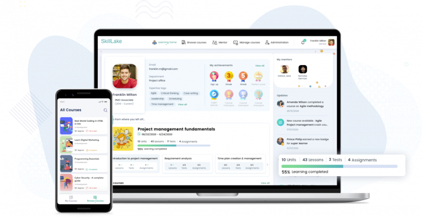

Other Reads from Skill Lake
-

When to Replace an Employee Learning Management System: 10 Signs to Look For
Read MoreIs your employee learning management system helping you build real skills, or is it just frustrating your team? Outdated software wastes your budget and turns training into a tedious chore. If your current LMS platform feels hard to use, lacks modern features, or takes too much manual work to run, it’s time for a change.
-
Top 10 Best LMS for Restaurant Training in 2026
Read MoreRestaurant training is a daily challenge, especially with high staff turnover and evolving safety standards. Traditional methods rarely keep up with today’s fast-paced teams and rising industry demands. Having an enterprise-grade AI learning platform makes it easier to train everyone in your organization, from employees and franchise owners to customer-facing teams – all in one


Ashmitha Chatterjee
Ashmitha is a learning and development enthusiast who shares her insights on e-learning. She loves to create engaging and informative content and is dedicated to helping people learn and grow through her deep expertise in the field.