Why Enterprises Are Moving to AI-Based Learning Platforms in 2026

Many companies still use old training methods that do not fit today’s work needs. Employees get bored with long training sessions, and companies find it hard to check if people are learning anything useful. This leads to skill gaps, low interest, and poor work performance.
To fix this, businesses now focus more on better and faster employee learning. That’s why many companies are moving to AI-based learning platforms. These platforms give training based on each employee’s needs. They also help teams learn new skills, stay engaged, and work better in a fast-changing business world.
What is an AI-based Learning Platform?
AI-driven corporate training platforms are emerging training models that use artificial intelligence to bring personalized and adaptive training. They help incorporate AI into modern learning management systems to recommend courses better, create personalized courses and skill assessments, and drive AI-simulated training. These platforms promote engaging and interactive learning experiences, allowing organizations smarter ways to foster a continuous learning culture.
Why Enterprises Are Adopting AI-Based Learning Platforms?
Companies today don’t want slow or rigid training. They want something smart that adjusts as people learn. That’s why many are moving to AI-Based Learning Platforms.
These platforms take training to a new level. For learners, AI-based learning makes grasping concepts faster. Features like AI course recommendation and AI Role Play improve experience and learning engagement.
For mentors, AI LMS platforms speed up course creation and skill evaluation abilities. This allows them to easily enable equal training quality for all learners, including remote teams sitting across cities and countries.
AI is paving the way for smarter, more convenient, and consistent training opportunities. Sticking to traditional training methods can curb a company’s workforce quality and growth.
Here’s more on why organizations must move beyond traditional corporate training methods.
Challenges with Traditional Corporate Training
Let’s be honest. Traditional training often feels dull due to its complexity, redundancy, and lack of engagement. Most traditional corporate training lacks real-time competency mapping and options to promote knowledge retention. That’s why the traditional system fails to work, and the skills are forgotten in the shortest possible time.
A McKinsey survey showed that just one-quarter of employees believe training improves their performance. They believe that these programs are normally costly, time-consuming, and one-size-fits-all, and therefore, they are ill-suited to specific learning requirements and high-speed business requirements.
Key limitations of traditional corporate training include:
- Low engagement: Long sessions decrease people’s interest, so they stop paying attention.
Lack of personalization: Training materials and approaches often do not match job profiles, skill levels, or learning preferences. - High cost, low ROI: Traditional training is often tedious and time-consuming. It involves high costs, but low engagement reduces participation rates and returns.
- Traditional content: Traditional training materials are often tedious to update with the changing learning requirements.
- No real practice: People hear the theory but don’t get to try it out. No real practices reduce learning accountability and impact.
All these factors lead to employees dropping interest in learning, ultimately affecting their performance and service quality.
Here’s how switching to a modern AI-powered LMS can make a difference.
Role of AI-Powered Enterprise LMS In Corporate Training Success
Companies need a smarter enterprise learning platform. They don’t need the tools that only deliver content, but tools that understand people. That’s where an intelligent LMS platform comes into play. It learns from user behavior and improves continuously.
The global AI-based learning management system (LMS) market was worth USD 24.09 billion in 2025 and is expected to reach USD 104.04 billion by 2034, growing at a CAGR of 16.10%. It shows that AI can bring a big shift in how companies train people.
With AI-Based Learning Platforms, companies can:
- Spot skill gaps quickly
- Recommend the right courses
- Improve learning step by step
- Enable personalized and adaptive learning
- Speed up course creation and customization
- Enhanced engagement
- Improved efficiency and ROI
Using AI-powered enterprise learning solutions, teams stay ready for change. And in today’s world, that matters a lot.
Read more:-AI in Learning and Development: The Future of Workplace Training
Benefits of AI-based LMS Over Traditional LMS
An AI-driven learning management system software for large enterprises is a game-changer for corporate training. It analyzes how employees learn and suggests training that fits each person. These LMS help trainers find skill gaps fast and focus on what matters most. Here’s a better view of the comparison between traditional LMS and AI LMS.
| AI-BASED LEARNING PLATFORMS VS TRADITIONAL LMS | ||
|---|---|---|
| Feature | Traditional LMS | AI-Based LMS |
| Learning Materials | Increases dependency on existing course materials | Allows generating content instantly based on learning requirements |
| Personalization | Limited or no personalization | Recommends courses based on the learner’s job role and learning path |
| Skill Evaluation | Limited to existing test assessments | Helps quickly generate tests, quizzes, and questionnaires to identify skill gaps |
| Engagement | Relies on static modules and quizzes | Allows interaction and AI-powered role-play-based learning, keeping learners involved |
| Scalability | Scaling may require excessive manual efforts | Simplifies training large or remote teams with e-learning convenience |
How AI-Based Learning Platforms Enhance Corporate Training
After switching to an AI-powered LMS, companies can see a big change in employees’ learning and grow. Training becomes more personal, simple, and easy to follow. Employees get content based on their skills and learning speed, which keeps them more engaged.
Managers can also track progress and spot skill gaps faster. It helps teams learn better and improve their performance at work. Of course, AI LMS platforms save time by reducing manual tasks and making training more organized for both employees and businesses.
- Training matches each employee’s needs
- Employees stay more engaged
- Learning becomes faster and easier
- Managers can track progress in real time
- Skill gaps become easier to find
- Teams improve productivity and performance
Why Enterprises Must Adopt AI-Based Learning Platforms
1. Personalized Learning
Everyone learns differently, and AI helps consider that. AI in LMS allows functionalities that ease creating and recommending courses apt for each learner’s journey. This promotes an engaging and personalized learning journey, amplifying individual growth as well as company performance.
2. Better Engagement
With AI, learning goes beyond theory-based training. Users get to interact with AI-powered simulations of real-life workplace scenarios to develop communication skills and quick thinking capabilities. Real-time feedback promotes continuous improvement. Such AI-based training helps keep learners on the hook, eliminating boredom and enabling accountable learning.
Read more:- How AI Simulation Training in LMS Prepares Teams for Real-World Scenarios
3. Saves Time
Corporate training often sees delays due to the time-consuming content creation process. With an AI-powered LMS, companies can instantly create full-fledged, unique courses apt for their audience. Mentors can also repurpose existing courses by refining them using AI Copilots. Questionnaires, quizzes, and test assessments can also be quickly generated to speed up evaluation processes. This helps cut down manual work, allowing teams to focus more on training strategies.
Read more:- The Complete Guide to AI Course Generators in Learning Platforms
4. Role-Based Training
AI-powered LMS promotes role-based learning. AI helps create, deliver, and recommend content that matches job roles rather than burdening learners with courses that don’t boost skill development.
5. Continuous Learning
AI makes learning more interactive. AI even recommends courses that exactly match learning needs. Learning is kept simple, hassle-free, relevant, and easy to grasp. This removes the mundanity of learning and pushes learners to complete courses faster and continue learning.
The shift is clear. More companies now prefer AI-Based Learning Platforms for better results.
How Skill Lake Supports Enterprise Learning?
Skill Lake helps companies build smarter AI-driven corporate training, enabling them to adapt quickly to changing business and workforce learning needs. As an enterprise learning platform, it helps organizations upskill employees through personalized, scalable, and engaging learning experiences.
With personalized training programs, learning becomes more relevant for every employee. Skill Lake’s AI-driven learning management system enables organizations to train teams at scale while maintaining consistent learning experiences across departments and locations. From onboarding and compliance training to leadership development and continuous upskilling, the platform supports every stage of the employee learning journey.
Here’s what Skill Lake offers:
- AI-powered course creation
- Smart course recommendations
- AI role-play simulations
- Interactive assessments and quizzes
- Competency and skill tracking
- Real-time analytics and reporting
- Gamification for higher learner engagement
- Mobile learning with anytime, anywhere access
- Instructor-led and self-paced learning
- SCORM-compliant content support
- Learning paths and certification management
- Seamless integrations with Zoom, Microsoft Azure AD, Google SSO, Google chat, Microsoft Teams
Slack, Leadde and Open APIs.
These capabilities help enterprises streamline training management, identify skill gaps, improve learner engagement, measure training effectiveness, and build a culture of continuous learning across the organization.
Conclusion
Corporate learning is quickly moving away from standardized training programs to individualized, skills-oriented development. This is where the AI-based learning platforms transform into a revolutionary aspect. Corporate learning platforms use AI, data analytics, and repeated evaluations to provide an organization with training that can be adjusted to the needs of every employee.
The adaptive learning platforms do not compel employees to undertake the same learning process, but instead concentrate on personal skills gaps and performance enrichment. This renders corporate learning more effective, participative, and directed towards business performance.
With the increased investment of companies into upskilling and reskilling, AI adaptive learning will become one of the primary resources to develop agile and future-adaptable workforces and scalable corporate learning spaces.
AI-powered learning helps businesses improve training results, build skills faster, and keep employees more engaged. It also helps teams perform better by giving the right learning support at the right time.
Ready to transform your corporate training? Explore how Skill Lake can help you build smarter, faster, and more effective learning experiences.
Frequently Asked Questions
Q: How do AI-Based Learning Platforms improve employee training?
A: These platforms enhance training by delivering related content according to the skills and progress of specific employees. They also provide insights and feedback in real-time, a factor that keeps the learners on track.
Data can help managers to keep track of performance and make more effective decisions. This consequently makes training more effective and business-oriented.
Q: Are AI-Based Learning Platforms suitable for large enterprises?
A: Yes, they are aimed at supporting large organizations that have different teams and learning requirements. They are easy to scale without any impact on performance or user experience.
The individual level of learning is also achieved in these platforms, as it offers centralized control at the personal level. This qualifies them as most suitable in global and growing enterprises.
Q: How do they differ from traditional LMS?
A: In contrast to the classical LMS, AI-based learning platforms prioritize customization and flexibility. They make use of data to prescribe content and enhance learning in a continuous manner. Conventional systems are usually based on fixed content and light analytics. On the other hand, AI platforms are more engaging and informative.
Q: Can AI platforms support role-based training?
A: Yes, AI platforms are very useful in providing role-specific training programs. Role-based training and upskilling using AI help them to align content with job requirements. This will make sure the employees acquire the skills that are most related to their work. This leads to more practical and effective training.
Build a culture of continuous learning with Skill Lake’s state-of-the-art people development platform. Give your employees professional training to help them excel in their job roles and propel your business to greater efficiency and success.
Start Today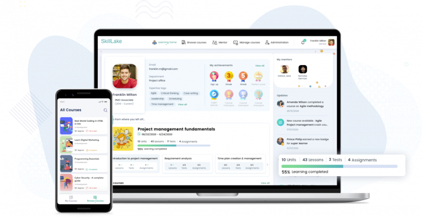

Other Reads from Skill Lake
-

Skill Lake LMS Partners With Udemy Business to Elevate Learning Experiences
Read MoreLearning is evolving, and so are learner expectations. Today’s workforce is moving beyond rigid, traditional training models to adopt more flexible, accessible, and personalized learning experiences. To meet this shift, Skill Lake LMS has partnered with Udemy Business to create a more unified and impactful learning journey. For modern businesses, this collaboration promises more efficiency
-

Learning and Development Management Software: Key Features to Look for in 2026
Read MoreToday’s businesses need a capable L&D platform that acts beyond delivering courses or tracking completions. Choosing a modern learning and development software allows organizations to speed up content creation, simplify training management, facilitate skill development, and measure the true impact of training. If you are evaluating new L&D management software this year, here are the

Anoop Kumar MS
Anoop Kumar MS, Product Manager of Fingent Global Solutions Pvt. Ltd., is an experienced product specialist with expertise in identifying customer needs and delivering innovative, data-driven solutions. Skilled in wireframing, UX, requirements analysis, risk assessment, team management, and root cause analysis, he excels in managing product lifecycles and fostering seamless collaboration to address real-world challenges.