AI Role Play for New Hires: How One Sales Rep Went From Nervous to Confident on His First Client Call
Every new sales hire remembers the first client call. The product knowledge is there, the onboarding is done, and the calendar invite is sitting in the inbox. What is missing is the confidence that only comes from having done it before.
Every new sales hire remembers the first client call. The product knowledge is there, the onboarding is done, and the calendar invite is sitting in the inbox. What is missing is the confidence that only comes from having done it before.
Sales success depends on how well someone handles a live conversation, so practice matters more here than in most roles. AI role play lets reps rehearse those conversations before they happen. The AI plays the prospect and responds to what the rep says, so each session feels like a real call. Here is where it is making the biggest difference:
- Preparing new hires for first calls. New reps can rehearse introductions, discovery calls, and product conversations until they feel natural, which helps them become confident faster.
- Handling objections. Pricing pushback, competitor comparisons, and “we need to think about it” are hard to master by reading about them. Reps can practice answering them out loud, as often as they need.
- Asking better discovery questions. Reps can build the habit of asking about the client’s goals before pitching, a common gap among new hires.
- Closing with a clear next step. Reps can practice ending every call with a proposed follow-up instead of letting the conversation fade.
- Freeing up manager coaching time. Managers cannot role-play with every rep every day. AI role play handles the repetitive rehearsal, so manager time goes to feedback and coaching.
Sales is a skill learned through conversation, and conversations are hard to learn from slides and courses alone. That is why more sales teams are adding AI role play to their training.
This is the case study of one new hire, a thoughtful manager, and how AI role play for new hires turned a nervous first call into a confident one.
Let’s see how this played out for one new hire.
The Day Before the First Call
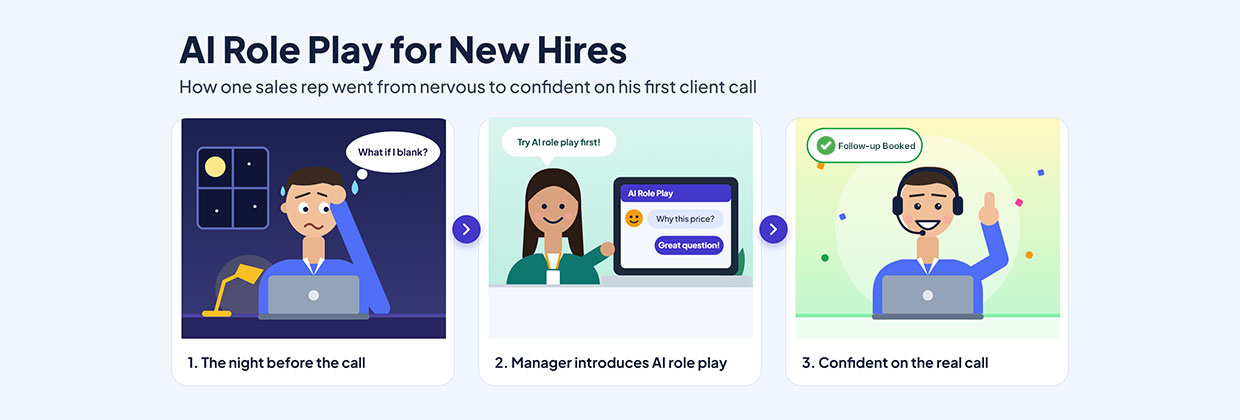
Rahul had joined the sales team three weeks earlier. He had completed his onboarding courses, shadowed two senior colleagues on calls, and learned the product inside out. On Monday afternoon, his manager, Meera, shared the news: his first solo call with a prospective client was on Tuesday at 11 a.m.
Rahul smiled and said, “Sure, I’m ready.” Inside, his stomach dropped.
The Fear He Could Not Say Out Loud
That evening, Rahul replayed the call in his head again and again. What if the client asked about pricing and he blanked? What if they compared the product with a competitor he barely knew? What if there was an awkward silence and he had nothing to say?
He wanted to ask Meera for help. But every time he opened a chat window, he deleted the message. He worried that admitting he was nervous would make him look unprepared. He had only been on the team for three weeks, and he did not want his manager to think she had made the wrong hiring decision.
So he did what many new hires do: he kept it to himself and read his notes for the tenth time.
A Manager Who Noticed
Meera had seen the signs. Rahul had been quieter than usual in the team stand-up. He had asked fewer questions, and he had been rereading the same product sheet all afternoon. She remembered feeling exactly the same way before her own first client call.
Instead of asking, “Are you nervous?”, she pulled up a chair and said, “Before tomorrow, I want to show you something we have in our LMS. It’s called AI role play.”
She explained it simply: “It lets you practice real conversations with an AI that plays the client. There is no audience and no judgment, and you can try as many times as you like. Think of it as a rehearsal room that’s open whenever you need it.”
Rahul felt his shoulders relax for the first time that day.
How AI Role Play Works, Step by Step
Meera walked Rahul through the feature on Skill Lake, the team’s AI-powered LMS.
- Step 1: Choose a scenario. Rahul picked a first client call, the exact situation he was dreading. Practicing a situation that matches the real one is what makes role play useful.
- Step 2: Set the scene. The AI takes the role of the client, and Rahul plays himself. There is no script to memorize. He simply starts the conversation the way he would on the real call.
- Step 3: Have the conversation. The AI responds to what Rahul says, asks questions, and raises the kind of concerns a real client might, including the pricing question he feared most. Because the conversation moves with his answers, it feels like a real call and not a quiz.
- Step 4: Review how it went. After the conversation, Rahul looked back at what he said. He noticed that he spoke too fast when he was nervous and that he had skipped asking the client about their goals.
- Step 5: Practice again. Rahul tried the same scenario again, and then another one. Each round felt a little easier than the last.
Practice Day: From Shaky to Steady
His first attempt was rough. He stumbled over the pricing question, rushed through his introduction, and ended the conversation without a clear next step. But nobody was watching, and nothing was at stake. He laughed, took a breath, and tried again.
By the third round, he was opening with a clear introduction and asking about the client’s goals first. By the fifth, he handled the pricing objection calmly and closed with a proposed follow-up. His answers sounded like his own, not like something read from a sheet.
That evening, Rahul finally told Meera how nervous he had been. She smiled. “Everyone is, the first time,” she said. “That’s exactly why we built practice into the way we train.”
The Big Call
On Tuesday at 11 a.m., Rahul joined the call. He felt a flutter of nerves, but it was different now. The questions the client asked sounded familiar. When pricing came up, he answered clearly. When there was a short pause, he did not panic. He asked a question and kept the conversation moving.
The client ended the call on a positive note and agreed to a follow-up meeting.
Afterwards, Rahul sent Meera a message: “Thank you for noticing, and for showing me AI role play. I would not have been this confident without that practice.”
Why AI Role Play Works for New Hires
Rahul’s story shows why AI role play simulation is such a useful part of sales training and employee onboarding:
- It is a safe place to make mistakes. New hires can fumble, restart, and try again without worrying about being judged.
- It is available on demand. Practice happens when the learner needs it, not only when a facilitator is free.
- It builds real conversation skills. Reading about objection handling is not the same as answering one out loud.
- It supports managers. Managers cannot role-play with every new hire every day. AI role play gives them a way to support people at scale and keep their own time for coaching.
What Managers and L&D Teams Can Take Away
Many new hires will never say, “I am nervous and I need help.” The best thing a manager can do is make practice normal and easy before the big moment. When practice is built into the learning platform, asking for help is no longer something a new hire has to do. It is simply part of how the team prepares.
Skill Lake, an AI-powered LMS, includes AI role play so your teams can rehearse real conversations before they happen, from first client calls to difficult customer conversations.
Want your new hires to walk into their first call with confidence? Book a demo of Skill Lake and see AI role play in action.
Frequently Asked Questions
Q: What is AI role play in an LMS?
A: AI role play is an LMS feature where employees practice real workplace conversations with an AI that plays the other person, such as a client or customer. The AI responds like a real person, so employees can rehearse as often as they like and build confidence before the real conversation.
Q: Who benefits most from AI role play?
A: New hires benefit the most, especially in sales and customer support, since they can practice before their first real conversation. It’s not just employees. Managers benefit too, as AI role play takes over the repetitive rehearsal and frees their time for coaching. Any employee preparing for a difficult conversation can us
Q: Does AI role play replace manager coaching?
A: No. It gives employees a safe place to practice, so manager coaching time can focus on feedback and development instead of basic rehearsal.
Q: How is AI role play different from regular training courses?
A: Courses teach what to say. Role play lets people practice saying it out loud in a realistic conversation.
Build a culture of continuous learning with Skill Lake’s state-of-the-art people development platform. Give your employees professional training to help them excel in their job roles and propel your business to greater efficiency and success.
Start Today

Other Reads from Skill Lake
-

How Does AI Role Play Work in Corporate Training?
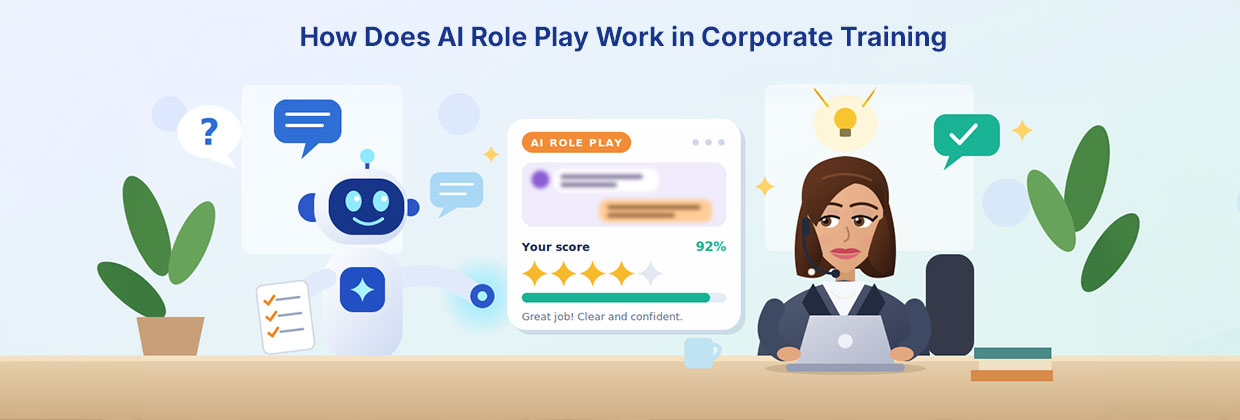
Read MoreAnyone can look up how to calm an angry customer. Ask a chatbot, skim a checklist, and you’ll have a decent answer in seconds. But the first time a real customer raises their voice, that checklist has a way of vanishing from your head. That gap between knowing and doing is where a lot of
-

Skill Lake LMS Partners With Udemy Business to Elevate Learning Experiences
Read MoreLearning is evolving, and so are learner expectations. Today’s workforce is moving beyond rigid, traditional training models to adopt more flexible, accessible, and personalized learning experiences. To meet this shift, Skill Lake LMS has partnered with Udemy Business to create a more unified and impactful learning journey. For modern businesses, this collaboration promises more efficiency

Anoop Kumar MS
Anoop Kumar MS, Product Manager of Fingent Global Solutions Pvt. Ltd., is an experienced product specialist with expertise in identifying customer needs and delivering innovative, data-driven solutions. Skilled in wireframing, UX, requirements analysis, risk assessment, team management, and root cause analysis, he excels in managing product lifecycles and fostering seamless collaboration to address real-world challenges.