How Does AI Role Play Work in Corporate Training?
Anyone can look up how to calm an angry customer. Ask a chatbot, skim a checklist, and you’ll have a decent answer in seconds. But the first time a real customer raises their voice, that checklist has a way of vanishing from your head.
That gap between knowing and doing is where a lot of workplace training quietly falls short. It is also where AI Role Play is starting to make a real difference. So how does AI role play work in corporate training, and why are L&D teams paying attention? This post walks through how it works, where it fits, and what it looks like for an L&D manager.
Why good practice is so hard to give people
Useful practice needs three things: a safe place to get it wrong, someone who pushes back realistically, and honest feedback afterwards. Coaches and experienced colleagues can offer all three, but their time is limited. Live role play with peers can feel awkward. Scripted e-learning simulations take a long time to build, and once you’ve seen the branches, you can simply click your way through them.
So most people end up practicing on the job, in front of real customers, real teammates and real deadlines. That is where mistakes cost the most.
How does AI Role Play work in corporate training?
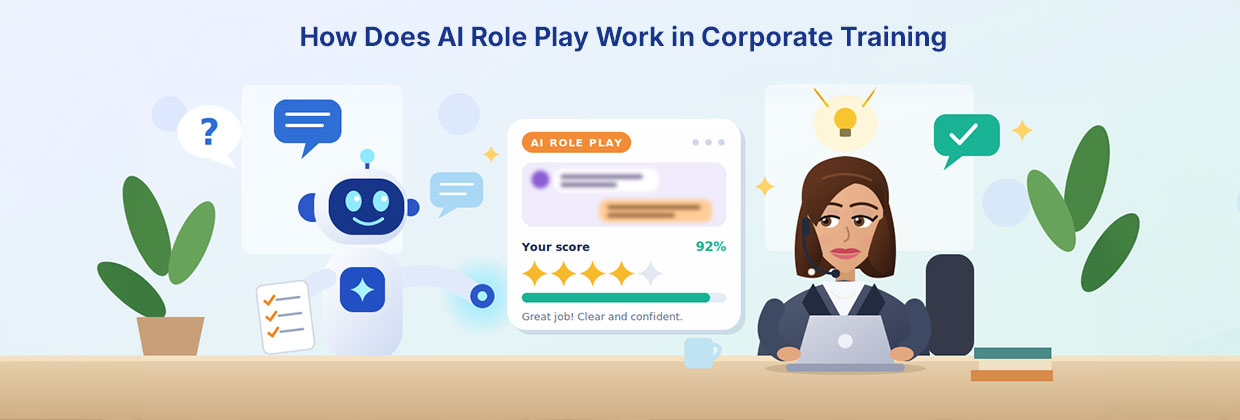
In an AI role play, the person on the other side of the conversation is an AI character that reacts to what you actually say. Be vague, and it asks for detail. Get defensive, and it gets defensive right back. Because nobody is watching, you can try the same conversation again, differently, as many times as you like. And the feedback arrives straight after, while the details are still fresh.
Here is the flow, step by step:
- The scenario is set. The L&D team defines a realistic situation, the role the AI character plays, and what good looks like, such as calming an upset customer.
- The learner has the conversation. They respond to the AI character as they would to a real person.
- The AI responds dynamically to what the learner says, allowing each attempt to take a different direction.
- Feedback comes straight away. The learner sees what worked and what to try differently while the conversation is still fresh.
- They try again. Repeating the scenario, with a different approach, is where the skill starts to stick.
- The results join the bigger picture. Practice sits alongside quizzes and skill-gap reports, so L&D can see where people still need support.
It doesn’t replace coaches and managers. It takes care of the repetition, so their time can go to the nuanced situations that no rubric can settle.
AI role play vs live role play
Both have a place. The difference is mostly about availability and repetition.
The strongest programmes use AI role play for the repeated practice and keep people for the conversations that need judgment.
Picture a customer support executive in her second month. She knows the refund policy and has passed the quiz. Then a customer calls, annoyed: he’s been charged twice and has already been transferred three times.
With AI role play simulation, she can have that exact call before she ever picks up a live line. The AI customer interrupts, sighs and asks for a manager. On the first attempt she jumps straight into the policy. On the second, she acknowledges the frustration first. By the third, she has noticed something no policy document could have taught her: the moment she apologizes sincerely and offers a clear next step, the customer’s tone changes.
The same idea works for handling objections in sales, giving feedback as a new manager, or handling a tough guest or patient conversation. Wherever the real skill is in the conversation itself, practice beats reading about it.
A day in the life of an L&D manager
Meet Anita, an L&D manager at a growing services company. Leadership has announced a new customer escalation process, and 150 people across three locations need to be ready in six weeks. She has one trainer, a 40-page policy document and a calendar that is already full.
Here is how it could go with Skill Lake.
- Turn the document into learning. Anita uploads the policy and uses AI course creation to get a structured first draft. She edits it so it sounds like her company, not a template.
- Add practice, not just reading. She sets up AI Role Play scenarios around situations her teams really face, such as an upset customer or a request that falls outside the policy, and assigns them after the course.
- Check the basics. AI-generated quiz questions confirm that people understood the process before they practice it.
- Look for patterns. After a couple of weeks, assessment results and skill-gap reports show that most people handle the opening of a conversation well but struggle when a customer asks for an exception.
- Spend human time where it matters. Instead of rerunning the whole training, Anita runs one 45-minute session on handling exceptions with team leads, then sends a short practice scenario to everyone afterwards.
What changes for Anita is the question she can answer. She isn’t only reporting who finished the course. She can say where people are still unsure, and what she is doing about it.
What makes role play worth doing
Not every role play is equally useful. A few things make the difference:
- Make it feel like your workplace. People take practice seriously when it uses their products, their customers and their language.
- Practice one thing at a time. A scenario with a clear goal, such as staying calm and offering a next step, gives better feedback than a vague “handle the call well”.
- Allow repeats. The second and third attempts are where the learning happens.
- Connect it to what comes next. Practice works best when it sits inside a bigger learning path, with quizzes, coaching and skill tracking around it.
What to look at after the role play
Practice is only useful if it leads somewhere. Once people have practiced, look at:
- Whether people complete scenarios and try again. Repeat attempts are a good sign that learners find it worth their time.
- Patterns in the feedback. If many learners miss the same step, that is a gap in the training, not only in the people.
- Quiz and assessment scores. These show whether the knowledge behind the conversation has landed.
- Skill-gap reports. They help you see which teams or competencies need more support.
- What managers notice on the job. Real conversations are the final test.
How Skill Lake helps
- Skill Lake brings these pieces together in one learning platform:
- AI Role Play for practicing real workplace conversations with immediate feedback
- AI course creation and document-to-course to turn policies and manuals into structured courses faster
- AI quiz generation to check understanding straight from your course material
- Competency mapping and skill-gap reports to see where teams need more support
- Mobile access so practice fits into the working day
Help Your Team Practise with Confidence
Let employees practise real workplace conversations with
Skill Lake AI Role Play.
Frequently asked questions
Q: How does AI role play work in corporate training?
A: An AI character plays a customer, colleague or employee in a realistic scenario. The learner responds, the AI reacts to what they say, and feedback follows so they can try again.
Q: Does AI role play replace human coaches?
A: No. It handles repeated practice, so coaches and managers can focus on complex situations and on the judgment that a scenario can’t capture.
Q: Which teams can use it?
A: Any team where the work happens in conversations: customer support, sales, new managers, HR, and frontline staff.
Q: Do employees need technical skills?
A: No. They simply have the conversation and read the feedback.
Q: How is it different from e-learning videos and quizzes?
A: Videos and quizzes check what someone knows. AI Role play lets them practice what they would actually say and do.
Ready when it counts
Confidence doesn’t come from reading the right answer. It comes from having said it out loud, getting it wrong, and trying again before it really matters. AI role play gives every employee that chance, not just the few who happen to have a coach nearby.
Build a culture of continuous learning with Skill Lake’s state-of-the-art people development platform. Give your employees professional training to help them excel in their job roles and propel your business to greater efficiency and success.
Start Today

Other Reads from Skill Lake
-

Skill Lake LMS Partners With Udemy Business to Elevate Learning Experiences
Read MoreLearning is evolving, and so are learner expectations. Today’s workforce is moving beyond rigid, traditional training models to adopt more flexible, accessible, and personalized learning experiences. To meet this shift, Skill Lake LMS has partnered with Udemy Business to create a more unified and impactful learning journey. For modern businesses, this collaboration promises more efficiency
-

Learning and Development Management Software: Key Features to Look for in 2026
Read MoreToday’s businesses need a capable L&D platform that acts beyond delivering courses or tracking completions. Choosing a modern learning and development software allows organizations to speed up content creation, simplify training management, facilitate skill development, and measure the true impact of training. If you are evaluating new L&D management software this year, here are the


Ashmitha Chatterjee
Ashmitha is a learning and development enthusiast who shares her insights on e-learning. She loves to create engaging and informative content and is dedicated to helping people learn and grow through her deep expertise in the field.