Top LMS Training Platforms for 2026: 10 Best Solutions for Corporate Learning

Legacy corporate training frameworks are failing to solve contemporary skill gaps. To build an agile, future-ready workforce, organizations need a modern corporate training LMS that drives active capability mastery. This post evaluates the top LMS training platforms for 2026 currently delivering measurable operational ROI.
Top 10 LMS Training Platforms for 2026
Note: Pricing and features based on data as of June 2026.
1. Skill Lake
Skill Lake is an AI-powered LMS designed to transform corporate talent development through advanced upskilling. It enables organizations to systematically address skill gaps by shifting the focus from passive training to verified, active role mastery.
Key Features:
- AI course generator, AI copilot, AI question/ quiz builder, document to course AI
- Interactive AI role play simulations and learning gamification
- LMS integrations with business critical platforms and tools
- Native mobile learning apps (iOS and Android) with offline access
- AR/VR immersive training to validate high-risk operational procedures
- Competency mapping to align training with corporate KPIs and employee skills
- Dual Learning: Blends synchronous, asynchronous, and micro-learning streams
Best Use Case: Excellent for SMBs, startups, and large-scale global organizations that aim to future-proof workforce development through immersive, experiential learning.
Why It Stands Out: Skill Lake eliminates legacy learning friction through AI-guided interactive role-play practice and provides instant performance feedback by assessing behavioral shifts.
Pricing: Flexible, scalable pay-per-user team plans alongside fully customized, white-labeled enterprise packages, hosted on your preferred cloud servers.
2. Docebo
Docebo is an AI-first, enterprise LMS platform engineered to automate and scale global workforce development. It seamlessly delivers personalized training paths, compliance mapping, and social learning pipelines across multi-audience corporate networks.
Key Features:
- AI-powered learning personalization and microlearning modules
- Extended enterprise capabilities for training multiple audiences
- Social and peer learning, engaging gamification, and rewards
- Fully customizable, branded mobile apps for learners
- Drag-and-drop reporting dashboards to understand training impact
- Seamless integrations with leading workplace communication tools
Best Use Case: Ideal for mid-market and large enterprises needing to train employees, customers, and global partners from a single, centralized platform.
Why It Stands Out: Docebo blends robust automation with customizable multi-tenant portals, turning complex enterprise compliance and onboarding into high-engagement, measurable business growth.
Pricing: Offers quote-based custom pricing across two primary tiers—Elevate (for standard needs) and Enterprise (for complex environments)—tailored to your active user volume.
3. TalentLMS
TalentLMS is a lean, cloud-based learning management system built for fast-growing mid-market companies and agile teams. It prioritizes quick deployment, allowing administrators to convert existing training materials into interactive modules faster.
Key Features:
- AI-powered content creation and intuitive course builder
- Multi-tenancy (branching) training portals for distinct audiences
- Intelligent skills management and time-saving automations
- Real-time, customizable dashboards and scheduled reporting
- Game mechanics to boost learner engagement and completion rates
- Native iOS and Android mobile LMS apps with offline access
Best Use Case: Ideal for fast-scaling businesses that require an intuitive LMS platform to rapidly onboard remote workers and maintain regulatory compliance.
Why It Stands Out: TalentLMS minimizes deployment complexity, offering a highly refined, self-serve interface that yields immediate workforce training productivity.
Pricing: Offers a range of transparent pricing plans based on active users. The plans are named Core, Grow, Pro, and Enterprise. Contact sales for a custom quote.
4. Absorb LMS
Absorb is an AI-driven employee training software that drives workforce performance through personalized upskilling. It specializes in multi-audience training and managing internal employees, global distributors, and customer training networks from one engine.
Key Features:
- AI-powered course creation and tailored learning recommendations
- Smart administration enabled by complex workflow automation
- Custom branding and UI, integrated e-Commerce module
- Robust analytics with standard and custom reporting features
- Deep enterprise integrations with critical business systems
- Social and gamified learning, native mobile learning apps
Best Use Case: Perfect for mid-to-large corporations requiring highly branded, distinct portals to manage internal talent development and external business channels.
Why It Stands Out: Absorb’s simple and intuitive user design minimizes learning friction, driving higher user engagement metrics across distributed corporate teams.
Pricing: Operates on an annual subscription model with custom quotes determined by your active learner volume and selected add-on modules.
5. CYPHER Learning
CYPHER Learning is an innovative LMS for employee training that uses AI to promote skills-centric course creation and career progression. The platform guides employees through dynamically adapted, automated competency development tracks.
Key Features:
- AI course creator to build new courses and refine existing content
- AI assistant providing personalized, on-demand support to users
- Adaptive learning paths to personalize learning journeys
- Gamification, deep automation engine, and built-in ecommerce
- Tracking and mapping learning to specific competencies or job roles
- Multilingual training support for highly diverse or global teams
Best Use Case: Ideal for mid-sized to large enterprises, franchises, and organizations that need AI-powered course creation, robust skills mapping, and e-commerce capabilities.
Why It Stands Out: CYPHER Learning embeds generative AI directly into the platform core, reducing course creation time and enabling personalized skill development.
Pricing: Provides customized, scalable annual subscription contracts divided into Enhanced and Enterprise feature packages based on active users.
6. 360Learning
360Learning functions as a collaborative workforce training software that transforms internal subject matter experts into active course creators. It replaces top-down training administration with social and collaborative learning, empowering frontline teams.
Key Features:
- Intuitive SME tools for collaborative authoring and course building
- AI-powered content generation and customized learning paths
- Instructors can track relevancy scores and share real-time feedback
- One-on-one actionable video coaching and pitch assessments
- Automation of end-to-end compliance training workflow
- Integrations with HCM, HRIS, and other critical business systems
Best Use Case: Ideal for dynamic organizations prioritizing bottom-up knowledge sharing, continuous product updates, and cross-departmental peer-to-peer training.
Why It Stands Out: 360Learning treats learning as a social habit, converting passive corporate content consumption into active, peer-driven business collaboration.
Pricing: Offers a Team plan for SMBs, and custom Business and Enterprise plans for large, growing organizations. Contact sales to get your quote.
7. Cornerstone OnDemand
Cornerstone OnDemand is an enterprise-tier LMS training platform that aligns talent development directly with workforce mobility. It enables organizations to upskill employees, manage compliance, and optimize recruitment and performance tracking.
Key Features:
- AI-powered content recommendations, self-directed learning
- Auto-curated career pathways based on individual skills and goals
- Automated compliance training and certification management
- User-friendly portals and marketplaces for extended enterprise training
- VR/AR for hands-on, simulated practice and real-time skill verification
- Performance review management and succession planning tools
Best Use Case: Built specifically for multi-national corporations requiring a highly compliant, scalable infrastructure that unifies global human capital development.
Why It Stands Out: The platform offers industry-specific solutions to bridge the gap between mandatory compliance and internal executive succession planning.
Pricing: Contact the team to procure custom enterprise quotes structured around aggregate employee headcounts and deployed functional modules.
8. iSpring LMS
iSpring is a streamlined corporate online training platform focused on rapid employee onboarding, compliance deployment, and skills assessment. Its industry-standard authoring tools allow companies to launch detailed training tracks quickly.
Key Features:
- AI-enhanced course authoring and smart assessment engine
- Immersive role play simulations and branching scenarios
- Gamification, 360-degree feedback, detailed reporting and analytics
- Native mobile learning app with offline access and support
- Compatibility with major e-learning standards like SCORM and xAPI
- Built-in asset library to build realistic e-learning environments
Best Use Case: Ideal for small, mid-sized, and enterprise organizations with non-technical training teams and industries with heavy compliance needs.
Why It Stands Out: Its built-in content authoring capabilities and deep integration with PowerPoint allow L&D teams to quickly publish highly interactive course materials.
Pricing: Uses a transparent user-volume model, priced under Business and Enterprise packages, that scale based on total active learner counts.
9. Moodle Workplace
Moodle Workplace is one of the best LMS software offering end-to-end solutions for workplace learning. Its intuitive interface and innovative tools help organizations engage diverse teams of learners, maximizing employee training outcomes.
Key Features:
- Separate, branded LMS environments for multiple business divisions
- Automated organizational structure mapping and management
- Dynamic audience rules to automate repetitive admin tasks
- Advanced, real-time report builder with scheduled stakeholder deliveries
- Structured learning paths and automated programs and certifications
- Unified, searchable learning catalog and structured learning pathways
Best Use Case: Ideal for highly technical enterprises, government offices, or defense sectors demanding total data ownership and custom code flexibility.
Why It Stands Out: Moodle’s enterprise-grade multi-tenancy and open-source adaptability allow companies to build a completely unique and affordable training ecosystem.
Pricing: The base platform code remains open-source, while enterprise hosting, implementation, and maintenance are quoted through certified Moodle Premium Partners.
10. Litmos
Litmos is a scalable, enterprise learning management system that combines a rapid internal content deployment framework with a vast, pre-built library of professional training courses, providing companies with a turn-key corporate learning ecosystem.
Key Features:
- AI Assistant for instant, comprehensive course search and discovery
- AI/ML video assessments to objectively grade learner video assignments
- Built-in authoring tools to create dynamic, mobile-responsive SCORM courses
- Extended enterprise training catalogs for vendors, clients, and partners
- Universal localization: Workforce training delivery in regional languages
- Ecosystem connectors to integrate with third-party software platforms
Best Use Case: Ideal for heavily regulated, large-scale enterprises that need to automate global compliance mandates and deliver quick on-demand sales or product onboarding.
Why It Stands Out: By blending AI-fueled automation with an instant-access content catalog, Litmos tries to eliminate long development cycles, ensuring immediate organizational training ROI.
Pricing: Offers flexible, quote-based enterprise tiers based on active user volume: Foundation (basic plan) and Platinum AI (for advanced corporate deployments).
Related Reading: Top 10 LMS Platforms for Employee Training in 2026
What is an LMS Training Platform?
A corporate LMS training platform allows organizations to assign, deliver, track, and measure employee training and performance. The best learning management systems replace fragmented training methods by automating compliance, streamlining onboarding, and providing deep analytics into workforce capabilities from a single dashboard.
Why Corporate Training Needs Modern LMS Platforms in 2026
Traditional training is unprepared to navigate today’s hybrid workplace ecosystems, frontline demands, and rapid skills decay. This makes the top LMS training platforms for 2026 an operational necessity for enterprise growth. A modern corporate training LMS offers critical capabilities, including:
- Unifying Hybrid Workforces: Distributed and remote teams receive consistent onboarding and training, regardless of location.
- Empowering Frontline Workers: Mobile-first platforms deliver micro-learning and multilingual modules directly to remote, distributed, field teams.
- AI-Driven Upskilling: Uses AI to automatically identify skill gaps and deploy personalized learning paths that accelerate workforce readiness.
- Automating Compliance Tracking: Automated certification loops and assessment tracking eliminate admin overheads and operational risks.
- Scalable Capability Building: L&D teams can seamlessly manage continuous upskilling across thousands of global learners simultaneously.
Key Features of the Best LMS Training Platforms
The best corporate training platform on the market today drives workforce capability through these non-negotiable features:
| 10 Must-Have LMS Features Every Business Needs in 2026 | |
|---|---|
| 1. AI for Course Creation & Personalization | 6. Gamification and Rewards |
| 2. Automated Compliance Management | 7. Content Interoperability |
| 3. Integration with Essential Software | 8. Microlearning Feeds |
| 4. Mobile Learning Access | 9. Social & Collaborative Learning |
| 5. Real-Time Analytics & Reporting | 10. Custom Branding & White-Labeling |
AI-Powered Personalization & Content Creation
Auto-generates custom courses, targets individual skill gaps with tailored recommendations, and utilizes AI role-play simulations for realistic, interactive training.
Automated Compliance Tracking
Minimizes administrative overhead by auto-enrolling staff, issuing and renewing certifications, and maintaining accurate, audit-ready data trails.
Seamless Business Integrations
Plugs directly into your existing enterprise ecosystem via APIs to natively sync with critical HRIS software, CRMs, and daily collaboration tools.
Mobile & Offline Learning
Maximizes workforce accessibility by offering dedicated mobile applications with offline synchronization, allowing frontline and field employees to learn anytime, anywhere.
In-depth Analytics & Reporting
Delivers real-time data and customizable dashboards to monitor knowledge retention, track overall engagement, and clearly prove the training’s bottom-line ROI.
Gamification Features
Boosts user engagement and course completion rates by introducing competitive leaderboards, milestone points, and achievement badges.
Content Interoperability
Supports universal eLearning standards like SCORM and xAPI, making it effortless to instantly import pre-built, third-party content catalogs.
Microlearning & Byte-Sized Delivery
Maximizes knowledge retention and fits training into hectic schedules by serving hyper-focused lessons (short-sized learning bytes) directly within the employee’s daily workflow.
Social & Collaborative Learning
Builds an organic, peer-to-peer knowledge culture through collaborative discussion forums, virtual classrooms, and shared internal learning channels.
Multi-Tenancy & Customization
Empowers large enterprises to spin up distinct, white-labeled learning portals for specific departments, branches, or external vendors while maintaining one secure database.
Major AI Trends Shaping LMS Training Platforms in 2026
Artificial Intelligence is actively rewriting the playbook for corporate L&D. The growth, enterprise adoption, and overall evolution of online training platforms are being driven by leading AI trends such as:
- Immersive AI Role-Play Training: Simulated AI role play sessions with instant performance feedback allow employees to practice and master complex, workplace interactions/ scenarios without real-world risks.
- AI-Powered Course Generation and Smart Assessments: AI-automated content tools allow L&D leaders to instantly build targeted courses, transform legacy documents into structured modules, and generate intelligent assessment quizzes.
- Real-Time Guidance via AI Copilots: A context-aware AI copilot directly embedded in a learner’s LMS interface acts as an on-demand virtual tutor. It guides the learner through complex topics, answering workflow questions in real time.
- Personalized Learning Paths: AI automatically maps individual competency gaps, tracks real-time performance data, and pushes dynamic course recommendations tailored to each learner’s unique professional needs.
Benefits of Using an LMS Training Platform
An enterprise-grade LMS turns corporate training from a cost center to a core driver of business growth and operational efficiency.
- Slashed Training Costs and Admin Time: Replaces tedious classroom lectures, typically lowering the costs and efforts associated with travel, venue, printing and manual scheduling.
- Accelerated Time-to-Productivity: Gets new hires up to speed rapidly through structured and self-paced onboarding paths, tailored to their specific roles.
- Continuous, Targeted Upskilling: An AI-powered LMS can instantly detect skill gaps and automatically push targeted learning content, maintaining a highly competitive workforce.
- Enhanced Compliance and Risk Reduction: Auto-enrolls staff, sends renewal reminders, and logs accurate, audit-ready data trails to protect your enterprise from regulatory fines.
- Measurable ROI and Executive Visibility: Generates sophisticated, real-time insights that allow decision-makers to directly correlate training completion with actual workforce performance gains.
Challenges in Corporate Training (and How an LMS Solves Them)
Legacy training frameworks struggle to keep pace with evolving operational demands, but a modern employee development software completely shifts the paradigm. It addresses:
- Skill Decay: Rapid changes render skills obsolete. An AI-driven LMS automatically detects gaps and deploys dynamic learning paths.
- Fragmented Teams: Dispersed workforces face uneven instruction. Centralized platforms deliver uniform onboarding and compliance globally.
- Unproven ROI: L&D leaders cannot justify budgets. Advanced analytics connect learning milestones directly to business KPIs.
- Admin Burnout: Manual tracking drains resources. Automated systems handle enrollments and certification tracking flawlessly.
- Low Engagement: Employees view passive training as a chore. Modern LMS software embeds gamification and interactive role-plays into daily workflows.
Related Reading: How AI Role Play in LMS Boosts Training Success and ROI
How to Choose the Best LMS Training Platform
While choosing an LMS training platform, organizations must look beyond basic features to evaluate long-term strategic fit, system flexibility, and technical alignment.
Alignment with Strategic Business Objectives
- Does the LMS help link training activities directly to organizational KPIs?
- Does it shift L&D from a cost center to a business growth engine?
Intelligent Automation and AI Capability
- Does it minimize administrative workloads through automated enrollments, certification and compliance management?
- Does it offer conversational AI role-play training for monitored, interactive assessment of behavioral skills?
Deep Tech Stack Interoperability
- Does the LMS offer pre-built integrations and APIs to connect natively with critical enterprise applications?
- Does it allow importing compliant content packages from third-party systems?
Frictionless Learner and Admin Experience
- Does it offer a user-friendly, mobile-first interface with zero learning curve?
- Does it guarantee high adoption rates for frontline workers, while reducing backend complexity for admins?
Security and Data Compliance
- Does the LMS provide a robust cloud infrastructure backed by enterprise governance standards?
- Does it offer verified data encryption, role-based access controls, and detailed, audit-ready tracking logs?
| The Ultimate LMS Training Platform Buyer’s Checklist | |
|---|---|
| Evaluation Category | Verification Items |
| User Experience | Intuitive UX, native mobile apps, offline access, and full localization. |
| Core Features | SCORM/xAPI support, automated paths, gamification, and compliance tracking. |
| AI Capabilities | AI course/quiz generation, interactive AI role-play, and learner copilots. |
| Content Creation & Management | Built-in authoring tools, instant version updating, and multi-format content support (video, PDF). |
| Competency & Role Mapping | Dynamic skills taxonomy libraries, proficiency tracking, and automated job-readiness gap analysis. |
| Integrations | Native HRIS/CRM sync, SSO, open APIs, and MS Teams/Zoom connectivity. |
| Analytics & ROI | Real-time executive dashboards, custom reporting, and clear TCO pricing. |
| Scalability & Performance | Verified 99.9% uptime SLA, high concurrent user handling, and regional data residency. |
| Data Security & Privacy | SOC 2 Type II / ISO 27001 certified, role-based access control, and GDPR compliance. |
| Implementation & Support | Dedicated deployment migration support, 24/7 technical help desk, and sandbox pilot testing. |
Beyond 2026: The Future of LMS Training Platforms
The future growth, innovation, and long-term strategy of enterprise LMS platforms will be defined by some major upcoming shifts, such as:
Autonomous AI agents that act as active project collaborators and real-time conversation partners for advanced training.
Spatial computing will enable future platforms to stream interactive 3D assets, allowing frontline and medical workers to master complex procedures.
Fluid “skill graphs” generated by intelligent LMS platforms will dynamically track daily work outputs rather than simple course completion metrics.
Context-aware, “invisible” workflow learning enabled by next-gen LMS platforms that embed the LMS interface directly into daily software like CRMs, ERPs, etc.
The Next Step for Leaders: Upgrade from Training to Workforce Readiness
Smart L&D leaders are stepping away from traditional event-based tracking to embrace automated capability orchestrations. Relying on outdated training pipelines stalls your enterprise’s true capacity for growth. The top LMS training platforms for 2026 exist to solve real-world talent gaps at scale. Review our guide and select the best LMS software that can turn your employee potential into predictable corporate performance.
Take the Next Step Toward Workforce Readiness
Let’s discuss your unique Learning & Development requirements and discover how AI-powered learning can help your workforce grow faster.
Frequently Asked Questions
Q: What features should organizations look for in an LMS training platform?
A: Look for an advanced LMS platform prioritizing:
- AI-powered course creation and quiz generation
- Gamification for boosting learner engagement
- Personalized learning paths and course recommendations
- Automated compliance and certification management
- Mobile learning accessibility and multi-lingual support
- AI role-play for interactive learning experiences
- Document-to-course conversion for rapid content creation
Q: How does an LMS platform help improve employee training outcomes?
A: By replacing passive content with interactive role-plays and micro-learning, modern employee training software significantly boosts engagement, accelerates time-to-productivity, and transforms routine onboarding into certified role mastery.
Q: Why are AI-powered LMS platforms becoming the preferred choice for enterprises?
A: AI in LMS helps enterprises automate the taxing content creation process and deploy personalized learning paths. AI’s predictive capability and smart automation of repetitive admin tasks drive continuous workforce capability.
Q: How can businesses choose the best LMS training platform for their needs?
A: Evaluate long-term strategic alignment, data security standards, and tech-stack interoperability. Choose a scalable workforce training software that directly links ongoing learning milestones to tangible business KPIs and ROI.
Build a culture of continuous learning with Skill Lake’s state-of-the-art people development platform. Give your employees professional training to help them excel in their job roles and propel your business to greater efficiency and success.
Start Today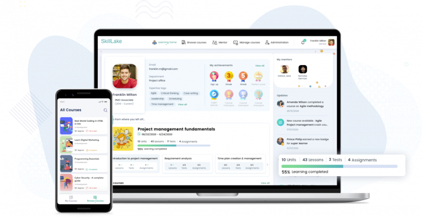

Other Reads from Skill Lake
-

Top 10 Best LMS for Restaurant Training in 2026
Read MoreRestaurant training is a daily challenge, especially with high staff turnover and evolving safety standards. Traditional methods rarely keep up with today’s fast-paced teams and rising industry demands. Having an enterprise-grade AI learning platform makes it easier to train everyone in your organization, from employees and franchise owners to customer-facing teams – all in one
-
Top 10 Best LMS for Insurance Industry in 2026
Read MoreTraditional insurance training methods can no longer keep up with complex policies and strict state regulations. Relying on static training manuals leaves agents unequipped for real-world client interactions, leading to compliance bottlenecks. Modern insurance learning management systems solve these challenges through automated certification tracking and scenario-based practice. This guide explores the 10 best LMS for


Anoop Kumar MS
Anoop Kumar MS, Product Manager of Fingent Global Solutions Pvt. Ltd., is an experienced product specialist with expertise in identifying customer needs and delivering innovative, data-driven solutions. Skilled in wireframing, UX, requirements analysis, risk assessment, team management, and root cause analysis, he excels in managing product lifecycles and fostering seamless collaboration to address real-world challenges.