Top LMS Trends 2026: The Future of AI-Driven Employee Learning

Employee training has gone way beyond the training rooms. Organizations are now demanding learning experiences that are role-relevant, performance responsive, and deliver quantifiable business value. And that is what is shaping the LMS trends of 2026.
Modern LMSs are increasingly transforming to deliver automation, intelligence, and personalization in training. The year 2026 is expected to witness significant transitions in workforce training with Artificial Intelligence at the forefront. Studies even predict that soon, over 60% of enterprises will be dependent on AI-driven learning systems for employee training.
This blog will help you discover the ‘Top LMS Trends 2026’ —how AI and other new-age technologies are transforming employee training.
The Rise of AI in Employee Training
Employee training plays a crucial role in business success. At a time when businesses are expected to adapt to the rapidly changing markets and customer behavior, ensuring effective employee training is imperative. However, continuous employee training is often hampered by delays in course generation. Learners also face cumbersome learning methods that slow down knowledge gain and retention rates.
AI offers speed and efficiency. In learning management, AI is proving to be a saviour for both learners and mentors. With AI, trainers can instantly generate courses targeted to a specific learning need. Assessments and content delivery are eased. For learners, AI is personalizing the way they consume content, elevating experience and skills.
What are the top LMS trends in 2026?
In 2026 LMS platforms focus on personalization, recommendation, and engagement. Also, modern systems use automation to improve training efficiency and learner outcomes. With an LMS system, organizations expect faster content creation and skill-focused learning experiences.
The modern trends shaping LMS platforms include AI course generation, AI quiz & question generation, AI role-play, AI Copilot, microlearning, and gamification. These innovations help companies deliver adaptive learning and improve participation. They also build workforce readiness by aligning training with business goals and employee performance.
Trend 1: AI Course Generation — Transforming How Training Is Built
Why AI Course Generation Leads 2026
Manual course creation consumes time and delays course delivery. AI course generation solves this challenge by instantly converting existing business knowledge into structured learning programs.
Key Benefits for Leaders
AI-driven course generation delivers speed, consistency, and reduced manual workload. Learning teams launch programs faster, update content easily, and maintain compliance across departments.
Real World Workforce Use Cases
Organizations use this capability to streamline compliance training, product education, and role-based skill programs. But, its value goes far beyond because it allows learning teams to build training that adapts to workforce needs.
For example, AI can automatically update compliance courses when regulations change, which helps teams reduce manual development effort. It keeps employees updated with real-world challenges. Also, AI supports personalized learning paths by analyzing employee performance and skill gaps.
These outcomes reflect why AI course generation remains central to top LMS trends 2026.
Trend 2: AI Quiz & Question Generation — Faster, Smarter Assessments
Simplifying Skill Evaluation
Evaluating skills remains a challenge for many organizations. Generating apt questionnaires or tests requires expertise. AI removes this bottleneck by instantly generating assessments aligned to learning objectives and course difficulty. It also supports varied question formats and helps organizations maintain updated evaluations without manual effort.
Key Benefits for Leaders
AI quiz and questionnaire generation saves time and ensures consistent evaluation across teams. Deloitte study shows that organizations using adaptive assessments improve learning effectiveness by over 30%. It also helps leaders gain better visibility into skill gaps and training outcomes, supporting smarter workforce development decisions.
Real World Workforce Use Cases
AI quiz and question generation helps organizations maintain consistent skill evaluation across multiple training programs. It supports compliance training by quickly updating assessments when regulations change. During onboarding, it helps measure understanding and readiness of new hires.
Sales teams use AI-generated quizzes to validate product knowledge and customer handling skills. Also, technical teams use it for assessing operational proficiency and system knowledge. This automation reduces manual effort while ensuring employees meet role-specific performance standards.
Trend 3: AI Role Play — The Future of Personalized Learning
The Need for Experiential Learning
Employees learn best by doing. Scenario-based learning helps to make the difference between theory and real life situations in the workplace. Traditional training methods usually fail to prepare employees in advanced interactions and decision making challenges.
But, AI roleplay in learning presents interactive simulations that can enable the employees to train in real-life scenarios in a secure setting. This approach creates confidence and makes employees better equipped to face up challenges that come in the workplace.
Key Benefits for Leaders
AI roleplay assists employees in developing competencies with confidence through real-life practice. It provides instant feedback on tone, clarity and effectiveness of communication. The learners get performance feedback, which allows them to decide and prepare better to work.
For leaders, AI roleplay simulation provides quality training across all teams. It also helps in analysing behavioral skills development, making it easy to monitor the effects of learning and improvement in employee performance.
Real-World Workforce Use Cases
The AI roleplay can be used in various workforce training programs in the organization. The sales teams can train on customer conversations, objection handling and negotiation skills. The customer service teams can be trained on how to resolve complaints and service recovery situations. Also, through leadership programs, it is possible to simulate challenges of decision making and team management.
AI Roleplay can be used by compliance trainers in preparing employees to act in ethical and regulatory situations. It also helps new employees to practice real job interactions before they start interacting with customers or any stakeholder.
Trend 4: AI Copilot — Supporting Modern Learning
Powering AI with Copilots
AI Copilots enhance modern LMS by assisting in content creation. They help mentors in generating relevant and high-quality courses quickly and simplify complex topics. By breaking concepts into clear and easy formats, they ensure learning aligns with business goals and improves employee comprehension.
Benefits for Leaders
AI Copilots allow leaders to create and refine content efficiently. Copilots ensure clarity, accuracy, and reduce the need for manual review. This helps employees grasp concepts faster and develop skills effectively. AI Copilots help leaders in gaining consistent content quality across teams. It further saves their time and resources in the process.
Real-World Workforce Use Cases
Organizations use AI Copilots to refine content for multiple learning programs. For example, in onboarding, mentors adapt AI-generated courses to help new hires learn faster and gain role readiness quickly. Similarly, compliance training benefits from instant updates that keep courses accurate and up to date.
Sales and customer service teams practice real scenarios with tailored content, improving readiness. Also, technical teams use AI-enhanced modules to improve workflows efficiently, allowing them to perform confidently on the job.
Other Important Learning Trends Shaping 2026 (Beyond AI)
Microlearning and Continuous Reinforcement
Bite-sized learning modules help employees grab information faster. Continuous reinforcement improves retention and application in daily work.
Gamification for Higher Engagement
Badges, points, and leaderboards increase motivation and participation. Also, effective gamification in LMS increases motivation and participation by making learning engaging and goal-driven. Leaderboards and rewards push employees to complete training courses and return for more.
Mobile-First Learning Experiences
A geographically dispersed workforce makes consistent learning difficult. Different locations and time zones limit employee access to traditional training sessions. This gap creates uneven learning experiences and slows skill development across teams.
An LMS mobile app allows employees to learn anytime and anywhere. This access matters more for frontline and distributed workforces who rely on mobile devices. Moreover, mobile learning keeps employee learning consistent, accessible, and connected to daily tasks across roles and locations.
Seamless Integrations and Open API
Modern platforms integrate smoothly with HR, CRM, and performance systems. This flexibility supports enterprise scale deployment of learning management systems trends.
All these trends help organizations reduce manual workload, launch programs faster, scale learning across locations, and deliver stronger skill outcomes.
What These Trends Mean for Learning & Talent Leaders
The top LMS trends 2026 are shaping corporate learning into impactful experiences. It’s motivating leaders to drive smarter training programs that deliver measurable results rather than just course completion status.
But these trends also demand that leaders reconsider the conventional LMS selection rules. Rather than choosing platforms solely based on content hosting capabilities, organizations will need to compare solutions based on AI adaptability, personalization capabilities, depth of analytics and flexibility to integrate solutions.
Regarding the decision-making side, learning leaders should focus on the platforms that help to sustain the skill development and provide insights into the workforce in real time. The implementation must be made in phases, with the initial high-impact areas of training like compliance, onboarding, and leadership development. Organizations can make LMS adoption a long-term talent development strategy by linking technology investment with business performance objectives.
To make the right LMS investment, organizations must stay informed about the platforms shaping employee training in 2026. Understanding how different systems support automation, analytics, scalability, and skill development helps learning leaders choose solutions that deliver real business impact.
Explore our guide on the 10 Best Learning Management Systems (LMS) for 2026 to discover the top platforms, features, and tools driving modern workplace learning.
Why must leaders embrace the top LMS trends?
Leaders can use these trends to make employee development a strategic move and build an agile, skilled workforce. They can help learners grasp skills faster and promote accountability. By embracing these top LMS trends, organizations can effectively tackle some of the main challenges in learning management like,
- Reduced manual workload
- Faster content rollout
- Scalable learning across teams
- Better learner experience and skills
Why Skill Lake Is Built for LMS Trends of 2026
Skill Lake is a unified platform meant to train employees in modern times. It facilitates effective learning with course delivery, management of training, and various modes of learning. Being an advanced Learning management system software, Skill Lake will facilitate blended, self-paced, and experiential learning aligned with business goals.
Skill Lake features include:
- AI Course Generation
- AI Course Recommendation
- AI Quiz and Question Creation
- AI Role Play
- AI Copilot
Skill Lake also promotes individualized learning journeys that are role and skills-adaptable, providing true AI-powered learning at scale. These capabilities position Skill Lake at the center of the top LMS in 2026, as it allows organizations to be smarter trainers and perform better.
Conclusion
In 2026, the workforce learning in your organization should be smart, dynamic, and performance-oriented. AI strengthens the most critical elements of learning, from content creation to real-world skill practice. An organization that is aligned with Top LMS trends 2026 will create agile and future-ready workforces. Skill Lake enables businesses to be able to achieve this change at scale, efficiently, and with measurable impact.
FAQ
Q: What defines a future ready LMS in 2026?
A: A future ready LMS uses AI to personalize learning and track growth. It supports microlearning and mobile access for flexible training. An LMS also provides analytics dashboards so leaders track outcomes and improve workforce development strategies.
Q: How does AI role play improve employee performance?
A: AI role play creates realistic workplace scenarios and helps improve decision-making. It provides instant feedback and highlights skill gaps during simulations. Employees learn through practice and assessments, which strengthens their confidence. Also, scenarios based performance keeps training relevant for continuous skill improvement.
Q: Can AI generated courses replace instructional designers?
A: AI generated courses speed up content creation and support data-driven personalization. But, instructional designers shape learning strategy and maintain content relevancy. Instructional designers create learning frameworks and maintain engagement while AI supports automation and content scaling.
Q: Is AI powered LMS suitable for compliance training?
A: Indeed, AI powered LMS supports compliance training through automated content updates and role-based learning. An AI powered LMS tracks regulatory changes and aligns courses with new policies. It helps organizations maintain compliance accuracy and reduce manual work because AI offers consistent and targeted training delivery.
Q: How to choose an LMS for enterprise scale in 2026?
A: Organizations should choose an LMS that supports advanced learning features and offers multiple benefits. They must compare analytics strength and scalability because large teams require unified learning systems. Businesses also choose platforms that support continuous learning and align training with performance outcomes.
Build a culture of continuous learning with Skill Lake’s state-of-the-art people development platform. Give your employees professional training to help them excel in their job roles and propel your business to greater efficiency and success.
Start Today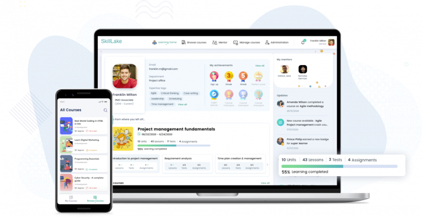

Other Reads from Skill Lake
-

When to Replace an Employee Learning Management System: 10 Signs to Look For
Read MoreIs your employee learning management system helping you build real skills, or is it just frustrating your team? Outdated software wastes your budget and turns training into a tedious chore. If your current LMS platform feels hard to use, lacks modern features, or takes too much manual work to run, it’s time for a change.
-
Top 10 Best LMS for Restaurant Training in 2026
Read MoreRestaurant training is a daily challenge, especially with high staff turnover and evolving safety standards. Traditional methods rarely keep up with today’s fast-paced teams and rising industry demands. Having an enterprise-grade AI learning platform makes it easier to train everyone in your organization, from employees and franchise owners to customer-facing teams – all in one


Anoop Kumar MS
Anoop Kumar MS, Product Manager of Fingent Global Solutions Pvt. Ltd., is an experienced product specialist with expertise in identifying customer needs and delivering innovative, data-driven solutions. Skilled in wireframing, UX, requirements analysis, risk assessment, team management, and root cause analysis, he excels in managing product lifecycles and fostering seamless collaboration to address real-world challenges.